
Yoga
Contents
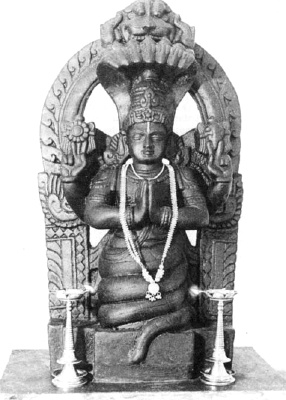
Vedic term literally means uniting or unity. It's about the uniting of one's consciousness. It is filognostically the discipline of spirituality leading to stability in wisdom (gnosis), bliss and consciousness.
One discerns many forms of yoga, but one mostly speaks of a threefold (trikânda) consisting of:
Hatha yoga, is what popularly is meant with the term yoga, it is the uniting of the forces of the body by means of postures. In that context one also speaks of the eightfold ashtânga yoga consisting of the eight limbs discussed underneath. Raja yoga, a specific school therewith, is a part of that again. Aadhar yoga , the yoga of Anand Aadhar, literally the foundation of happiness, is the integral approach of yoga in the sixfold notion of filognosy.
Yoga is the nuclear discipline of Hinduism, referred to in all holy vedic scriptures (s'ruti and smriti), and is formally an integral part of the six philosophies of India, the darshanas. See further uniting.
The basic values of yoga in which one achieves control by fortitude and detachment (abhyâsa and vairagya), are known as the legs of the bull of dharma or the vidhi: they are satya (truth), dayâ (compassion), s'auca (cleanliness) and tapas (penance). These values are implemented in filognosy as the foundation for its moral reality, principles and virtues.
The vow of yoga
The basic confession of penance in yoga is called yama it says in Sanskrit: ahimsa satyâsteya brahmâcarya âparigraha yama; it means nonviolent, truthfull, without stealing and celibate, not striving for possessions.
Angas, as levels of transcendence
The eight levels of transcendence one speaks of in filognosy are derived from the eight angas or limbs of yoga:
Like in yoga first respecting the don'ts of the vow to follow these principles (yama) and following the do's of regulating the activities as discussed (niyama), after which you sit in postures (âsana) to regulate your breath (prânâyâma), turn inward (pratyâhâra) and concentrate with a mantra (dhâranâ) to meditate (dhyâna) and find absorption (samâdhi) and stability in the self, is also your whole life in filognosy a process similar to such an individual exercise. One should not think all too linear about the following enumeration.
One may go from low to high, from the ethereal to the material, with these levels or areas of interest of the eight-fold yoga in your life climbing to heaven, but equally you may descend to be of concrete actions and presence this way. This ability to go up as well as going down is the (âroha/avaroha) quality of having matured in filognosy, of having that love for the knowledge that you and the rest of this world need to survive, be motivated and rejoice.
Sâdhana, the discipline of yoga
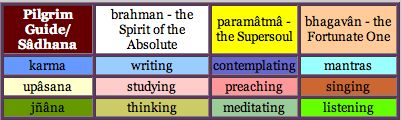
The discipline of yoga follows the directives contained in the yama and niyama angas or limbs of the yoga system. What one actually does in yoga can be recognized as relating to the two dimensions of the three types of yoga on the one hand and the three disciplines of realization on the other hand. These disciplines concern the specific actions to find integration in respect of the facts, the principles and the person. For each department of sâdhana discipline there are typical activities that can be divided over the three types of yoga. Thus there is for the discipline of brahman realization, the realization of the spirit of the absolute, the action of writing to overcome one's karma, the action of studying to be of devotion and conscious consideration or deliberate thinking as the action in service of the jñâna department of yoga. Even so is there contemplation as karma yoga, preaching as bhakti-yoga and meditation as jñâna-yoga for the discipline of realizing the Paramâtmâ, the Supersoul. With the Bhâgavan discipline there are the typical actions of practicing mantras, of singing and of listening that are specific for respectively the karma, the upâsana (bhakti) and the jñâna aspects of yoga. Each of these different aspects of sâdhana can be found and practiced for each separate discipline. The table to the right only suggests the actions that are typical for each type of discipline, they do not exclusively belong to them. Sâdhana, the yogic discipline thus constitutes a path, a pilgrimage so to say, of step by step, action by action, going inward to reach His abode and personal integrity, to find His sat, cit and ananda, or stability of consciousness in the happiness of God. (see also under emancipation for the process of elevation). Below follows a list of tips and tricks of importance to a successful yoga practice.
Practical tips and tricks for the beginning yogi
- 1) Be a vegetarian. It is important to be nonviolent with all living beings. The joy of life is otherwise not found in your meditations. Enlightenment will not be found with eating meat. Eating meat belongs to the mode of passion. Passion is the root cause of lust and anger. It is a form of attachment. One can only progress in yoga with letting go of attachments. Greater care is then needed though to have a wholesome diet: see to it that sufficient proteins (beans and cereal), fatty acids (omega-fats found in cheese and nuts), vitamins (especially B12 found in milk and D from real butter preferrably, A in carrots) and minerals (iron from figs and broccoli e.g.) are consumed. Care for real food, that is, health food. To eat natural food stuff thus. Use no sugar and little salt. Sweeten with Stevia, a natural sweetener. Do not forget to eat fruits, nuts and fresh vegetables. Vitamin C deficiency will give depressions.
- 2) Never follow standard time as the basic reference for your schedule of meditation and devotional service, always offer your meditations to the natural order of the sun and the moon. Cultural time is a different consciousness, or sense of regularity, motivated by money and disrespect for the non-profit meditator and volunteer. Clock and calendar are best settled with the natural order (see also tempometer and FCO). Standard time is dominated by a motive of ulterior pragmatical considerations incommensurable with the motive of freeing oneself from one's karma. With standard time one not only cherishes one's karma, one even builds more karma with it.
- 3) To the rule of celibacy it is important to remember that some kind of emotional wellbeing must be heartened. Therefore expressions of emotions should be practiced. This is best done with singing. This can be congregational singing, but also individual practice of mantras is effective. Both is best. At least three times a day practice the AUM mantra saying it ten times, just to keep in touch with your healthy ability to express yourself verbally and emotionally. Also other more filognostic prayers can be used. This gives a better control and a greater satisfaction.
- 4) Nocturnal emissions (accompanied by sexual dreams) may break one's continence and confidence in the process of overcoming the lusty motive. It is important to empty one's bladder regularly during the night and sleep in an atmosphere of naturalness free from cultural stress. Empty your postbox before you go asleep. Be done. Answer your email in time. Do not watch pornographic movies. Do not worry about the need to discharge upon stimulation, nor about sexual potency [see also entry 10*]. Do not use pills for this. Trust the body its natural regulation of fluids. Thus there is less emotional stress in general and especially less pressure on the prostrate and thus a better chance of continence of the seed and emotional stability. Also unplug all electric equipment at night (like the phone and other communications equipment). Do not be open to cultural intrusion at night. To sleep in a cold room is better than in a heated one. Always care for proper ventilation.
- 5) Keep your home tidy as also your clothes. Wear every day clean underwear. Do the dishes after each meal. Clean your teeth three times a day and shower regularly (depending the need). Cleanliness is next to godliness.
- 6) Do not sleep or eat too much, nor too little. Watch your weight and hold on to a BMI of 22 (see the filognostic slim plan). Six hours of sleep for an adult is enough, provided one meditates three times a day for at least ten minutes. Do your âsanas, your yoga postures then. Many diseases are the result of eating more than is needed.
- 7) Regularly go out and celebrate life. Have a once a (cakra-)week snack evening, and a little extra once a day. Do not torture yourself with a discipline too austere and dry. Have a break, take a day off. Be liberal with your fellow man. Don't make an ego of your yogic self. Spread your holidays. Keep in touch with the community and with your vitality. It is not about keeping strict to the discipline, it is more about knowing what your freedom is relative to the respected discipline. Like with setting the time to the sun and moon: let the system be the one compulsory, don't be such a square yourself. (see also fields)
- 8) Celibate as you are, stay affectionate with people, hug them. Love must always be where it is a right thing to be of love. Express your appreciation and don't critize devotees or other schools and religions, however nurdish they might be. All that one in devotion, in love of God, does is one's grace. It cannot be demanded and must be welcomed with enthusiasm whenever possible.
- 9) Do not try to accumulate property for the sake of collecting as a hobby or looks. Get what you need and what you think is proper to your meditation. Do not care too much about money. Running after money is for misers, not for yogis. The profit motive defines the karma. Voluntarism is dharma.
- 10) Whenever sex happens, don't fight it, but meditate on it. It is not about doing or not doing it, it is about being in control of oneself. And don't get attached to it either chosing in favor of it. The years you spent buiding sexual habits you may count for the amount of time needed to have them fade away. That is natural. You're not fully renounced in a day. It is a process. You can pick up karma just as well associating with karmis. You can take the burden of others. That is not bad, Jesus did so, but try to go for the better company of spiritually like-minded people. Be a good karma yogi, do not stay a karmi doing yoga.
- 11) Be careful with ambitions and desires. The passion for material things and the anger upon frustration can ruin your spiritual life. Yoga is not about accomplishing anything in the material world, it is more about leaning to meditate with whatever you do, with a positive result or not. The constancy of the happy and understanding self is the purpose. Seek that enlightenment with a proper attitude of voluntary service. Stay friends with people and don't try to make them pupils or play the guru. To be equal is the purpose, not to elevate oneself over the other. Don't play the farao-game building social pyramids with the greatest 'profit' at the top. Social pyramid games are cheating.
- 12) Concerning politics and voting and such, always go for the integrity of the civil virtues. The one above the parties is what one should be directed at. Yoga is ruled by soul and not by ego. Beware of the constant effect of politicizing everything into power games of public opinion. Never allow any political motive to set up one civil virtue against the other. You have to combine these virtues within your person. Do not become a divided self opposing an individual interest with a social one or concrete business interests against the necessity of the more abstract cherishing of ideals. The best guarantee of political integrity is to cover the external fields in a balanced manner with natural timing (that is in not being attached to the days of linear weeks or to fixes of standard timing).
- 14) Concerning the use of television and computer, remember they are just media like books and CD's. You can meditate on them provided you mind not to get caught in the clutches of standard time conditioning. Know the society you are dealing with. Have your answers up to date and be prepared to deal with the actuality. Life and culture are dynamic processes. Speak the language of the actual culture. Set rules for attending to the public media like: never during the day. Be in the world and not of the world. Beware of soaps (a standard time catch). Digital tv programming and HDD recorders allow you to manage your own timing and still check and keep in touch with what you want. Do not collect video's.
- 15) Don't be ashamed of living on social security. The yogi gets rid of karma, frees himself of the load of profit minded work, that is the nature of the game. So don't be disappointed not finding a job or not having success with offering your service. Yoga is selfrealization and thus appreciate the freedom the Lord of Yoga gives you to find and evolve your own nature of service. The salaried people are the greatest profiteers, never mind them trying to accuse you of their own weaknesses. If tired of being a salaried person, start being a parttime salaried person and be thus in a better way of service to others or to the benefit of the greater society. The volunteers do the actual work for the cause. Unemployment as such does not exist for a yogi. Be thus worth the money or whatever the support the society offers in respect of the human rights. Your adaptation is appreciated and rewarded. Still be consequent in your wish to be of service according your own nature. Persevere in this and be insistent when approached for service. You go sick by denying your own nature. Serve the cause of uniting the consciousness always, whatever the societal field of action you're in (job, private, downtown, or club).
- 16) No unsollicited preaching. Be clear about your conviction when asked, do not expect others to follow you or even be interested. Do not impose nor accept others imposing themselves upon you. But always try to respect the laws of the country. Moral maturity is a purpose. Share what you have without expecting anything in return. In case of difficult feelings because of things that went wrong with others (offenses), do the Gâyatrî mantra or its filognostic equivalent. Forgive yourself and others and forget.
- 17) Beware of illusions. Check your own actions for misconceptions and mistakes as well what others do. The world is full of illusion and makebelief, still you have to keep confidence. Mistrust is a bad lead. To stay alert is wise though. Better fight against illusions with people than against people with illusions.
- 18) Be of regular sacrifice. Like a tree offering fruit and being appreciated and maintained for it, put your energy regularly in some type of work for the cause and offer that without expecting anything in return. That is the secret of a sane society as well as personal sanity. Gratefulness rules a happy society, not greed. Do not become a bomb keeping everything for yourself and then explode because you have to be somehow present with an answer to what society offers you. This sacrificing also implies to fast every fortnight with drinking milk and juice only. Your health requires it to turn that fatty reserve switch so now and then (plan this with the cakra-order.
- 19) Be reciprocal with people. Don't run after people not interested in you, but do visit people who visit you. Try to engage them in natural regularity (see cakra-order). Don't expect the world to worship you because you are a such a holy yogi, it will not happen (unless the Lord deems you worthy the burden of representing Him, which is rarely the case thus with Him very well able to manage His own business). Accept it though if some person has a special respect for you as a yogi. Help people to become good yogis free from charge or inequality. Build association if you can, but accept it also to be alone for a long time. A good yogi is never alone, he is all one, united in the spirit with all that lives.
- 20) Read regularly in the scriptures or listen to lectures or readings. You don't get attached to the knowledge and culture of detachment. It needs to be confirmed every day to keep in touch with the science of yoga. If welcome lecture yourself to help others on a basis of friendship in this and always refer to the classical vedic order.
- 21) Last but not least: meditate regularly. There are different ways for a yogi to meditate. Most common is saying the mantra AUM ten times, slowly breathing, three times a day combined with sitting postures. More advanced in the eightfold system of yoga one turns the attention inward with the help of controlling one's breath. The purpose is to have a continuous and regular inward and outward flow in using a mantra to appease the mind. Vaishnava's use the Mahâmantra in repeating the three words Hare, Krishna, and Râma. This can be done silently or aloud alone or together, that is why this mantra is called the big one (maha). One can become sleepy of meditating. It is important to get enough sleep first, for meditation brings you to the threshold of sleep. Proper meditation though prevents you from sleeping too much. The more you meditate, the less you have to sleep. Normal is six hours of sleep and spread over the day meditations adding up to two hours eventually. Best time to meditate is early in the morning, later you will first sleep a little meditating before you really clear up by meditation. With proper meditation one attains another state of consciousness [called turiya] different from waking, dreaming and dreamless sleep.
(see further Aadhar Yoga)
See also
External Links
- A Song of Fortune - A Classical Gîtâ.
- A Song of Fortune - A modern Gîtâ
- The yoga-sûtras of Patañjali read; the basic understanding of yoga the way we in the West learned it from India.
- Wikipedia definition of yoga
- The sixfold philosophy of India (Wikipedia)
- Description of yoga in all its aspects in a narrative form: the Bhâgavata Purâna; the Story of the Fortunate One.
Category: English | Definitions
Page views for this page since Dec. 14 2007: