
Nonviolence
(redirected from Main.Nonviolence)
| Nonviolence and Vegetarian Sharing: |
| The Filognostic Diet. |
Food preferred by the ones in goodness increases the duration of life, purifies ones being,
gives strength, health, happiness and satisfaction and is juicy, rich, wholesome and a pleasure to the heart.
Krishna - (B.G. 17:8)

Contents
Part 1
- Introduction
- Different types of vegetarians
- Deeper meaning
- Arguments to become a vegetarian
- Health and Food
- Biochemistry of the filognostic diet
- Economy
- Ethics
Part 2
Part 3
- Karma
- Beyond being a vegetarian
- Government Parliament Party for Animals
- Department of Environmental Affairs starts initiative for ending bio-industry
Part 4
Introduction

-Nonviolence- This sculpture was a present <br> of the Government of Luxembourg <br> to the United Nations in 1988.
Nonviolence or compassion: The principal rejection of all unnecessary violence with whatever goal one may have in mind. In Sanskrit it is called ahimsâ, which stands for nonviolence, not to injure, to be harmless, to be safe and secure. If you do something that is positive for you, everyone else and for the world, then you are a person of nonviolence. Nonviolence means also to learn the "law of love". Nonviolence is further:
With a nonviolent lifestyle is one also not of unnecessary violence against nature in general and against animals in particular, and is one thus a vegetarian, a human being who doesn't eat meat. The word 'vegetarian' is derived from the Latin word vegetus, which means "intact, undamaged", "healthy", "fresh" or "full of life", as for example in homo vegetus (a mentally and physically powerful person). The original meaning of the word suggests a philosophically and morally well balanced lifestyle.
Don't fight against others with illusions, but against illusions with others.<br> Aadhar
Different types of Vegetarians
- Lacto-vegetarianism: the most common form; diet with dairy products but no meat, fish and eggs. In the production process of eggs many male chicks are killed in a shredder. It is important to keep one's protein intake in check as found in grains, beans, nuts and cheese. Most of the vegetarians in India and the Mediterranean Sea area.
- Vedic-vegetarianism: no meat, fish, eggs, onion, garlic, coffee and black tea and chocolate (vedic: anything concerning the spiritual knowledge of the Vedas and literature thereafter i.e. Upanishads, Purânas, Itihasas).
- Ovo-vegetarianism: diet with eggs but no meat, fish and dairy-products.
- Lacto-ovo-vegetarianism: diet with eggs and dairy-products but no meat and fish.
- Fish-vegetarianism: diet as a lacto-vegetarian, but with fish; in fact this is not a real vegetarian diet because here cold blooded animals are killed for food.
- Veganism: a kind of vegetarianism where nothing of an animal is consumed and on top no leather products are used. These people may not neglect their vitamine B12 and must wear plastic or linen shoes. They have to consume linseed oil for their essential fatty acids.
- Flexitarian or parttime vegetarian: a vegetarian also eating meat. Prepares a vegetarian meal four times a week, not because of the principle, but because its healthy. The dutch reason to leave meat out of the meal has less to do with health and more with environment and the wellbeing of animals. When eating out they choose to have a dish with meat (more easy). It can be stated that cooks in restaurants still do not really know (or are not really aware of) how to prepare a vegetarian meal containing all the necessary items for a satisfyable veggie meal. 'With the quantity of water to produce a steak one person can take 1300 showers. When a person skips meat once a week, two animals do not have to be slaughtered in a year. Japanese scientists have found that to produce one kilo of beef the energy to drive a car for three hours is needed, while at the same time all the lights at home are switched on.' Vegetarians weigh less in general, their cholesterol drops considerable, diabetes patients can do with less medicine and vegetarians live three and a half years longer than nonvegetarians. 'Many people find it to difficult to become a vegetarian out of principal. But to be a flexitarian is a good alternative.' (source: Newspaper Volkskrant 21-10-2007).
- Only fruit: the most extreme kind of vegetarianism. Humans who only consume fruit, respect the life of animals, trees and plants. That's why they only eat fruit and nuts (in extreme cases), because the tree and plant thus stay alive while fruits and nuts are meant as food. Fruit vegetarians need to add food supplements to their diet in order not to develop any shortage, because taking only fruit means imbalance. In nature chimpansees for example who only eat fruit and leaves become agressive after a couple of days and then kill another monkey to have their protein and vitamins. People have almost the same digestive system as monkeys. Gorillas who are complete vegetarians have to eat all day long and have to lick stones etc. for their essential minerals and other food supplements.
Deeper Meaning
Most vegetarians are people who understood that, in order to contribute to a more peaceful society, they first have to solve the problem of inner violence. It is therefore not that surprising that thousands of people of different styles and ways of living, in search of the truth, have become vegetarians. To be a vegetarian is an essential step towards the ideal of a better society, and people taking the trouble to think about the advantages of vegetarianism, find themselves in the company of great and famous personalities like Pythagoras, Socrates, Plato, Clemens of Alexandria, Buddha, Leonardo da Vinci, King Âs'oka (273 BC-232 BC), Jesus Christ, Mohammed, Sri Caitanya Mahaprabhu, Montaigne, John Milton, Thomas Moore, Isaac Newton, Voltaire, Benjamin Franklin, Jean Jacques Rousseau, Henry David Thoreau, Leo Tolstoy, George Bernard Shaw, Bhagavân S'ri Sathya Sai Baba, A.C. Bhaktivedanta Swami Prabhupâda, Bhagwan Shree Rajneesh, Albert Einstein, Rabindranath Tagore, Mahatma Gandhi, Henriette Roland Holst, Albert Schweitzer, Wouter J. Bos, Rudolf Steiner and many more.
Plants are the only living creatures able to produce their own food.
Arguments to become a Vegetarian
People have been eating animals since at least the Ice Age, when, so say some anthropologists, our early ancestors abandoned a plant-oriented diet in favor of one containing meat. The custom of meat-eating has continued to the present day, through necessity (as with the Eskimo), habit, or conditioning. Most of all, the practice has continued due to lack of awareness.
- World Food Problem: the food used to feed cattle (read: production of meat) can be exerted more efficiently to lessen hunger in the world. The quantity of food an animal needs to grow is much and much more than the quantity of meat one finally gets after killing the animal. So one can become a vegetarian out of solidarity with the starving fellow man.
- Concern for the environment/milieu (air, earth, water): for the production of vegetables much less agricultural land is needed than for meat production. The manure surplus (ammonia) and the used medicines lay a heavy burden on the environment/milieu.
- Compassion with animals: a motive sprouting from aversion to the bio-industry and/or the objection to killing animals.
- Religious or spiritual reasons: compassion with all living beings forms the basis for equality, peace and spiritual health. According the Golden Rule "Do unto others as you would others like to behave unto you". To recognize the interest of your fellow man as your own is the basis for solidarity, compassion and love for one's fellow-man in God. The before mentioned rule stems from the vedic culture where ahimsa stands for non-violence in the vow of renunciation (yama) in the philosophy of yoga. Later on this was adopted in the christian monastic rule of Benedict. Vegetarianism is an integral part of the uniting principles in the world's major religious traditions. Monks of all religions practice non-violence, that is to say, vegetarianism as the basic principle for selfrealization?. It is the most important principle for stability in spiritual association; only through nonviolence, not to hurt, to be harmless and to reject destructive and inequitable actions, can there be safety, security and prosperity for an individual and the society at large (see below the part on religions). These explanations lead to a vegetarian diet.
- Human health reasons: some research projects have claimed that vegetarians are healthier and live longer than meat consumers. Other studies refute this argument. But again there are also studies pointing out that the consumption of fish and poultry is healthier than that of game, beef and pork. Some studies prove that vegetarians have a smaller chance to get certain cancers (in some cases even 50% less risk) and heart disorders. A vegetarian diet reduces the risk of suffering gall stones, kidney stones and osteoporosis.
- The taste: some people can't stand the taste and have an aversion to meat.
Moreover, meat-eating today involves - for the animal - a long and cruel process of forced imprisonment, biological manipulation, transportation over long distances in crowded and unsanitary conditions, and finally, violent death in the slaughterhouse. After that, the poor animals' remains are eaten.
Health and Food
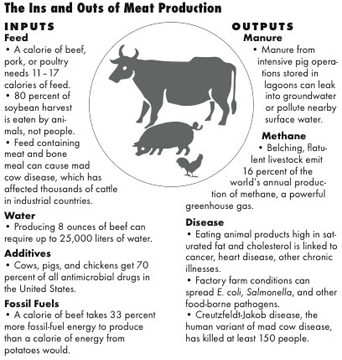
-The Ins and Outs of meat production-
The central question concerning vegetarian diets used to be whether it would be healthy to eliminate meat and other animal foods. Now, however, the main question has become whether it is healthier to be a vegetarian than to be a meat eater. The answer to both questions, based on currently available evidence, seems to be yes. Today, with increasing evidence of a diet's critical effect on good health and longevity, more and more people are investigating this question. Is the human body better suited to a vegetarian diet or to one that includes meat? It has been proven by medical research that there is a connection between consuming meat and deadly diseases like heartconditions and cancer. Ever since has being a vegetarian been observed with more interest (1).
Grasses are the greatest single source of wealth on earth
'All flesh is grass' - even coal and petroleum are plant life of the past.
Biochemistry of the filognostic diet
The reason that we feel hungry with a vegetarian diet and even may experience emotional instability is caused by a wrong composition of nutrients. Compared to a meal with meat, one has to, if one is a filognostic person, i.e. loves knowledge, think of a sufficient variation and quantity in one's vegetarian diet in order not to suffer a shortage or a surplus. I.e.
- Think of the complementation of proteins, so that, during a period of twenty-four hours (not per se in every meal), always a combination of grains and beans is consumed, so that the body can take care of the synthesis of high-quality proteins and produce enough building material, out of the on themselves incomplete proteins.
- Further, think of the essential (the necessary, not made by the body) fatty acids, omega three and six (vitamine F), i.e. necessary for building up cartiledge and a healthy nervous system. Fish oil is not suitable for the vegetarian not eating fish. That vegetarian should take flax seed oil (see also 'what is flax seed oil' one or two tablespoons in the dessert for example) and or a good sandwich (two slices pref. wholewheat bread) with (vegetarian) cheese per day.
- Another point is ion, present in chicory, figs, spinache and broccoli. Without sufficient ion one becomes anaemic.
- The element Selenium against symptoms of old age and as an anti-oxidant: eat at least four slices of (wholewheat) bread per day and now and then some brazil nuts. Nuts decrease cholesterol, take care of a good digestion because of dietary fibres and alleviate one's hunger; nuts also contain protein, the reason why they're a wonderful supplement for vegetarians; nuts contain diverse anti-oxidants, vitamines and minerals, like vitamine B1-B6-E, folic acid, magnesium and selenium, nuts are stuffed with them. Think also of carotine present in carrots, good for our eyes.
- Vitamine D, present by sunlight, in real butter and margarine. Getting older (50+), having a dark skin or spending less than 15 minutes outside a day, necessitates the intake of extra vitamine D (vitamine D3). Beware of added sugars (like dextrose) in vitamine pills.
- Half a plate of vegetables and three pieces of fruit a day, everyone knows it, but is easily forgotten. It is true. Vitamine C and other elements keep body and spirit together and healthy. Depressions and ilnesses can be the result of shortage here. In the past sailors got scurvy lacking vitamine C.
- Use less or no refined sugar. Sugar is not good for our teeth and the whole organism and leads to overweight (obesity), heart diseases, diseases of the vascular system and diabetes. Fasting on a regular basis, drinking only juice, water and milk, one whole day every fourteen days, is beneficial for your health and lengthens the life span. A natural order to sun and moon garantees to break with conditioned bad habits. It is good for our body to get a holiday now and then so that the body can start on fat reserves; it prevents obesity so that overweight can be avoided. This is pre-programmed in our genes and only to be switched on. It is quite normal (in our evolution) to eat less or nothing for a day. This done on a regular basis the biochemistry of the body adjusts to it and even can be experienced as a release.
- Eat natural, organic food as much as possible, nature is the best pharmacy. Bad eating habits cause a great deal of diseases. Chemical additives, artificial food and toxins burden our health via our food and may finally damage and cause cancer.
- Elderly people do not move so much anymore and produce less gluco-samine, a substance necessary to build up cartilage. This is the reason that they can get problems with their joints like arthrosis. Gluco-samine is an aminosugar, also active in suppressing feelings of hunger. Although the substance is obtained from crustaceans, it is advised also for vegetarians when not moving so much and old age, not to gain too much weight and thus not to get arthrosis, to use gluco-samine as a food supplement. To get rid of overweight and emotional instability is (as discussed before) linseed oil helpful. (see further filognostic method of slimming down with the Vitaminstable above it and Yoga).
See further also Filognosy and Vegetarian Sharing: What's a good vegetarian diet?
"Vegetarian food leaves a deep impression on our nature. If the whole world adopts vegetarianism, it can change the destiny of humankind." - Albert Einstein.

Economy
Meat feeds few at the expense of many. For the sake of producing meat, grain that could feed people feeds livestock instead. According to information compiled by the United States Department of Agriculture, over ninety percent of all the grain produced in America goes to feed livestock - cows, pigs, sheep, and chickens - that wind up on dinner tables (15). In Great Britain eighty-five it is percent. Yet the process of using grain to produce meat is incredibly wasteful. Figures from the U.S. Department of Agriculture show that for every sixteen pounds of grain fed to cattle, we get back only one pound of meat. (16).
In Diet for a Small Planet, Frances Moore Lappé asks us to imagine ourselves sitting down to an eight-ounce steak. "Then imagine the room filled with 45 to 50 people with empty bowls in front of them. For the 'feed cost' of your steak, each of their bowls could be filled with a full cup of cooked cereal grains." (17)
Affluent nations do not only waste their own grains to feed livestock. They also use protein-rich plant foods from poor nations. Dr. Georg Borgstrom, an authority on the geography of food, estimates that one-third of Africa's peanut crop (and peanuts give the same amount of protein as meat) ends up in the stomachs of cattle and poultry in Western Europe (18).
In underdeveloped countries, a person consumes an average of four hundred pounds of grain a year, most of it by eating it directly. In contrast, the average European or American goes through two thousand pounds a year, by first feeding almost ninety percent of it to animals for meat. The average European or American meat-eater, uses five times the food resources of the average Colombian, Indian, or Nigerian (19).
Facts such as these have led food experts to point out that the world hunger problem is artificial. Even now, we are already producing more than enough food for everyone on the planet - but we are allocating it wastefully. An Harvard nutritionist estimates that bringing down meat production by only ten percent would release enough grain feed sixty million people. (20).
Another price we pay for meat-eating is degradation of the environment. The heavoly contaminated runoff and sewage from slaughterhouses and feedlots are major sources of pollution of rivers and streams. It is fast becoming apparent that the fresh water resources of this planet are not only becoming contaminated but also depleted, and the meat industry is particularly wasteful. The production of livestock creates ten times more pollution than residential areas, and three times more than industry (21).
In their book Population, Resources and Environment (22) Paul and Anne Ehrlich show that to grow one pound of wheat requires only sixty pounds of water, whereas production of one pound of meat requires anywhere from 2.500 to 6.000 pounds of water.
But now let's turn from the world geopolitical situation, and get right down to our own pocketbooks. A spot check (2006) of supermarkets showed that sirloin steak cost around four dollars a pound, while ingredients for a delicious, substantial vegetarian meal average less than two dollars a pound. An eight-ounce container of cottage cheese costing sixty cents provides sixty percent of the minimum daily requirement of protein.
One pound of tofu costs 0,85 eurocent. Tofu is an excellent source for high quality protein and also some B-vitamins. Tofu and tahoe are two different names for the same product: an alternative for meat, made of soybeans. Tofu is the chinese name and tahoe the indonesian name for this product. Diets rich with animal proteins cause more loss of calcium via urine. A replacement of animal protein by soy-protein (in combination with grains) can help prevent this loss in human bones. If you would become a vegetarian it would save you many dollars (euros) a year; and that means tenthousands of dollars/euros during your whole life. Savings (see also money) of consumers would increase to millions of dollars/euros a year all over the world. If we would take this in account and look at this all together then one has difficulty to understand how one can allow oneself not to be a vegetarian!
Ethics
People consider the ethical reasons the most important of all for becoming vegetarian. The beginning of ethical vegetarianism is the knowledge that other creatures have feelings, and that their feelings are similar to ours. This knowledge encourages one to extend personal awareness to encompass the suffering of others. In an essay titled The Ethics of Vegetarianism, from the journal of the North American Vegetarian Society, the conception of humane animal slaughter is refuted:
"Many people nowadays have been lulled into a sense of complacency by the thought that animals are now slaughtered 'humanely', thus presumably removing any possible humanitarian objection to the eating of meat. Unfortunately, nothing could be further from the actual facts of life... and death. The entire life of a captive 'food animal' is an unnatural one of artificial breeding, vicious castration and/or hormone stimulation, feeding of an abnormal diet for fattening purposes, and eventually long rides in intense discomfort to the ultimate end. All 'superfluous body parts' like tails, canine teeth, beak tops are cut off or burned off. No mercy is shown while 'treating' the animal. The holding pens, the electric prods and tail twisting, the abject terror and fright, all these are still very much a part of the most 'modern' animal raising, shipping, and slaughtering. In bio industry animals change into 'units of meat production'. What counts is efficiency and profit. To accept all this and only oppose the callous brutality of the last few seconds of the animals' life, is to distort the word 'humane'."
The truth of animal slaughter is not at all pleasant - commercial slaughterhouses are like visions of hell. Screaming animals are stunned by hammer blows, electric shock, or concussion guns. They are hoisted into the air by their feet and moved through the factories of death on mechanized conveyor systems. Still alive, their throats are sliced and their flesh is cut off while they bleed to death. Why isn't the mutilation and slaughter of farm animals governed by the same stipulations intended for the welfare of pets and even the laboratory rat? Many people would no doubt take up vegetarianism if they visited a slaughterhouse, of if they themselves had to kill the animals they ate. Such visits should be compulsory for all meat eaters.
In ancient times already there were humans who did not close their eyes for the distress and misery of animal slaughter practices. Pythagoras, famous for his contributions to geometry and mathematics, said: "Oh, my fellow men, do not defile your bodies with sinful foods. We have corn, we have apples bending down the branches with their weight, and grapes swelling on the vines. There are sweet-flavored herbs, and vegetables which can be cooked and softened over the fire, nor are you denied milk or thyme-scented honey. The earth affords a lavish supply of riches of innocent foods, and offers you banquets that involve no bloodshed or slaughter; only beasts satisfy their hunger with flesh, and not even all of those, because horses, cattle, and sheep live on grass."
In an essay titled On Eating Flesh, the Roman author Plutarch wrote: "Can you really ask what reason Pythagoras had for abstinence from flesh? For my part I rather wonder both by what accident and in what state of mind the first man touched his mouth to gore and brought his lips to the flesh of a dead creature, set forth tables of dead, stale bodies, and ventured to call food and nourishment the parts that had a little before bellowed and cried, moved and lived ... It is certainly not lions or wolves that we eat out of self-defence; on the contrary, we ignore these and slaughter harmless, tame creatures without stings or teeth to harm us. For the sake of a little flesh we deprive them of sun, of light, of the duration of life they are entitled to by birth and being." Plutarch then delivered this challenge to flesh-eaters: "If you declare that you are naturally designed for such a diet, then first kill for yourself what you want to eat. Do it, however, only through your own resources, unaided by cleaver or cudgel or any kind of ax."
The poet Shelly was a commited vegetarian. In his essay A Vindication of National Diet, he wrote, "Let the advocate of animal food force himself to a decisive experiment on its fitness, and as Plutarch recommends, tear a living lamb with his teeth and, plunging his head into its vitals, slake his thirst with the steaming blood ... then, and then only, would he be consistent." Leo Tolstoy wrote that by killing animals for food, "Man suppresses in himself, unnecessarily, the highest spiritual capacity - that of sympathy and pity towards living creatures like himself - and by violating his own feelings becomes cruel." He also warned, "While our bodies are the living graves of murdered animals, how can we expect any ideal conditions on earth?"
When we lose respect for animal life, we lose respect for human life as well. Twenty-six hundred years ago, Pythagoras said, "Those that kill animals to eat their flesh tend to massacre their own." We're fearful of enemy guns, bombs, and missiles, but can we close our eyes to the pain and fear we ourselves bring about by slaughtering, for human consumption, over 1.6 billion domestic mammals and 22.5 billion poultry a year. (24).
The number of fish killed each year is in the trillions. And what to speak of the tens of millions of animals killed each year in the ''torture-camps" of medical research laboratories, or slaughtered for their fur, hide, or skin, or hunted for "sport". Can we deny that tis brutality makes us more brutal too?
Leonardo da Vinci wrote, "Truly man is the king of beasts, for his brutality exceeds theirs. We live by the death of others. We are burial places! He added. The time will come when men will look upon the murder of animals as they now look upon the murder of men."
Mahatma Gandhi felt that ethical principles are a stronger support for lifelong commitment to a vegetarian diet than reasons of health. I do feel, he stated, that spiritual progress does demand at some stage that we should cease to kill our fellow creatures for the satisfaction of our bodily wants. He also said, The greatness of a nation and its moral progress can be judged by the way its animals are treated.
Category: English | Articles | Author: Marja Langkamp
Page views for this page since August 8, 2009: