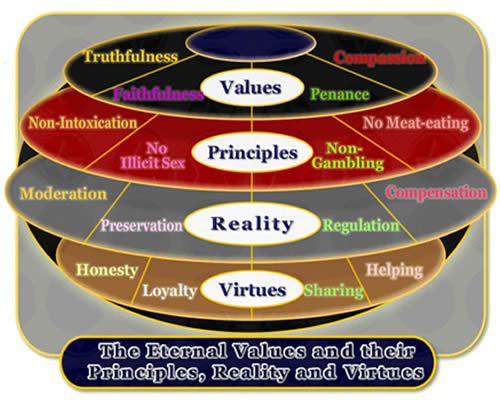
Of
course any historian and subculture can dispute
this sketch of our moral evolution, the writer
is open for further discussion and arguing. But
anyhow here is a beginning of understanding of
what we have been building up concerning the
right to speak. The moral authority telling
politicians how to counter the ignorance of the
masses has developed through the ages these
themes of heartening the interest of
non-illusion, love, reward and social quality
with a different effect. To begin with: from the
evolutionary point of view it is important to
have this time-line (however debatable). From
the development in the past one can predict the
future and thus arrive at a descriptive lead
(although subject to a paradigm of cultural
management always), that could answer our first
question. This descriptive lead has been
projected at the virtues of The Order of Time,
the internet participation platform that
proposes a paradigm of alternative
time-managment as a complement to the existing
management of standard-time. Their
set
of values
describes the above history in short as a coming
down to earth of divine values (the vedic) via
disciplinary principles (the turmoil of
history), compromising with the social reality
(the democratic set of values), ultimately
offering the practical outcome of human virtues
(filognosy or love for knowledge) for which it
all was conceived.
Without
extensive arguing about the here and there
forced division in four categories of systems
that would at least claim ten of them (like the
christian ten commandments) important insights
can be derived from this scheme.
1.1.1
From this
time-line concerning the world-cultures
one can perceive a gradual process of arriving
at a worldorder: first it is restricted to
India, then spreading to China, coming to the
Middle East and Greece, arriving at larger
Europe, then the western Hemisphere as a whole
and finally it covers the whole world in an
economically just, democratically freed and
interfaith tolerant culture of loving the
knowledge (information-culture). This latter
concept of filognosy is in the process of
becoming in the heart of the information-culture
with the so called digital revolution of the new
medium of Internet, because of which this
description is tentative and self affirming. But
it answers to the demand of prediction and
description formulated.
1.1.2
The theme of
non-illusion common to all value-systems
as the first purpose seems to have a fuzzy
history: at any epoch truth is the common value
in fighting the disasters of delusion and
bewilderment that would punish mankind for its
culture of illusion, lies and hypocrisy with war
and pestilence. To ward of this danger illusion
must be countered with truth: but how to define
and guarantee it? It would be done with at first
rituals (to take away the delusions of power).
This can be observed from the earliest cultures
until today but was after Asia cultivated it
never the complete conviction. More than mere
ritual was needed to arrive at the truth of
peace. The greek philosophers preached the sober
sense of reality that later culminated in the
sciences of the western hemisphere proving their
truth by the practice of instrumental
implementation, thus becoming dominant (not in
the least by war-technologies). Cartesian
philosophy called for the principle of doubt in
service of the truth and soul that is now
practiced in the new physics in respect of The
General Theory of Relativity. This would
ultimately secure the democratic sobering
moderation in respect of each his interest by
economically realistic cuts and even debts of
the state itself in spending for the sake of
righteous and sensible divisions. The modern
concept of honesty which can be observed in the
almost unlimited freedom of the media
(especially television) as a non repressive
approach to the human weakness was after the
christian love for the truth and the mohammedan
pressure for confession the essence of realizing
a new sense of truth of being reborn in service
of a worldorder. Illusion is gradually overcome
by means of a collective confession in the
culture of the media who took it over from the
confinement of religion. Honesty would be the
natural virtue resulting from this growth of the
respect for the sober truth whether it is wanted
or not.
1.1.3
The second theme of
liberation is that of love. Only love
would keep the devil of destruction away, but
how should that be understood, preached and
practiced? From the earliest times love has been
given other names. In the Veda this love would
be loyalty and purity of body and spirit to be
attained by religious practice. Forgetting the
purity the time line betrays the gradual
descending down to earth of love. Maybe not so
pure loyalty to the (asian) concept of state,
the marriage and family is today still the
dominant theme of love. With the greek it was
called courage (fortitude in Rome), the courage
to take a stand for the truth, be consequent in
its practice and thus attain to the Goddess her
grace or love.. Christianity also stressing
loyalty had to face the mohammedan who made love
also a system of donating gifts for the sake of
God. Although later on after the middle ages it
was understood as a function of proper division
(cartesian/scientific) and democratic
preservation of the for economic justice
necessary moderations, love ultimately turned
hard-core out to be nothing more and less than a
system of taxes that would formalize the love of
the state for the individual (person,
foundation, culture, enterprise) in need.
Impoverished countries would have more problems
to defend societal and personal love missing the
economic value of it. Later on in the second
half of the twentiest century this love was
recognized as maybe too materialistic and
subdued to the revolutions of politics (the
cultural revolution), science (kuhnian
paradigmatic revolution) and natural living (the
sexual/psychedelic revolution). Love since then
was called by its name and only needed loyalty
(interfaith) to ones own true nature
(filognosy...'ones own interactive website') to
be real. Nowadays the liberating of love can be
found in the capacity, opportunity, and will to
sacrifice ones individual material interest at
the apollonian altar, the computer, for the sake
of the interactive world-order (the Internet):
each may have his own love & revolution,
sexual or not, willfully supported by the
individual state, religion or subculture or
not.
1.1.4
The
third purpose found with the cultures of
liberation lies in the attaining to a system or
conception that would be rewarding enough
to have a feasible idea of practice or society.
There is a wide range of practiced values in the
diverse systems, and it is without further
systematization impossible to find your way out
of this cultural confusion about what the proper
reinforcement of a world culture would be. From
the behavioral sciences we may state that there
is the positive and negative sanction not to be
confused with punishment and reward. Both reward
and punishment are positive sanctions and all
cultural discourse about it flourishes on the
first distinction of sanctioning: should we
ignore 'the ignorant' or not, to begin with.
Ignoring would imply that the culture runs the
risk of being ignorant itself: ignorance is a
lack of control and cannot be the objective of
the culture. Thus there is always proselytizing
religiously, warfare politically and discord or
paradigmatic struggle scientifically. Let us now
consider the history of this preaching warfare
and knowledgeable fugue (in the dictionary
described as a disturbed mental state). At first
it seems that sobriety is the purpose of the
practices of love for the sake of non-illusion.
To be sober once was a reward: one attains to
the serious and solemn state of mind, finds
control in it and enjoys the happiness of the
righteous. This is the original point of vedic
departure. According to that culture we did
nothing but lose it ever since. To the buddhist
of Asia and assorted philosophies, the reward is
found in the insight: the contemplation or even
better the enlightened ability to contemplate is
the purpose of the ritual loyalty of the
meditator. It didn't have to be anything serious
anymore, a laughing Buddha is also okay. Next to
that fun of contemplation as a reward did the
greek philosopher realize that temperance was
the ultimate practice of reward. A lack of
control would always end up in punishment, thus
reward is identified with temperance. Later on
with the arabic approach one found this even in
fasting: one can only enjoy food - the ultimate
reward- if one breaks fast with it. And right
they are, modern medicine even says one lives
longer that way. Christianity though before that
settled the purpose of loving non-illusory as
fairness in reason and maybe also in legislation
to give each his charitable share of the common
wealth. Later on science realized from the
cartesian point of view that to settle for some
decent order would be the inevitable consequence
of having proper divisions to the problem of
truth. Thus from christian fairness we arrived
at the paradigm of state known as the righteous
regulation of wages step by step settled by
democracy, economic theory and multicultural
human righteousness. The question is whether we
really have attained to sharing with these
practices. Each paradigm would formulate a
system of reward and ignore, repress, (socially)
starve and humiliate anyone unemployed by the
system (originally christian-wise burnt at the
stake for heresy and witchcraft). Therefore is
the mission of filognosy found in the
realization that to be honest and loyal to each
member of society and thus to the society as a
whole means that one shares, not only the duty
of sacrifice and the legal rights, but also in
mutual cultural and economic respect. Why would
any unemployed voluntary worker for his own
culture in his private enterprising
non-commercial sacrifices deserve less respect
than each employed obliged worker in his
dependent commercial competition and carreer
ambitions? Who are we to judge about each his
own commitments to society and say that this
action deserves all reward and respect and that
action none whatsoever. It is exactly this
opposition of the monetary employment-reward
philosophy of power and control that meets its
own ignorance at the battlefields of senseless
wars. If the UCK/Kosovo rule could have
effectively applied for Serbian state support
and gotten it, the necessity of terrorist action
and the resulting war would never have been.
With the money wasted in this war after one
month all of Kosovo would have had perfect
economic support for at least ten years. Thus
seen the philosophy of reward is central to the
maintenance of peace and welfare. If the
practice of sharing in mutual (economic
/cultural) respect would have been, the war
could not exist. The fundamental error of
thought and philosophy is found in this
reward-philosophy: as soon as peace does not
realize that it is founded on the simple reward
for adaptation in righteousness ('from the
offering at the feet of the Godhead') the system
falls down from its delusions of power and
control unacceptable to the other culture. One
should so to say be legally obliged to give a
medal or something for not being a criminal or
not claiming to be sick otherwise.
1.1.5
The small history
of the values of liberation finds its completion
in the struggle for social quality. What
exactly are the values that give us the society
we can be proud of instead of having to be
ashamed of warfare in failing systems of
rewarding the love for non-illusion. This social
quality is the absolutely necessary outcome
needed. The outcome originally would be
compassion. This was so already in the vedic
culture with its command of dana, charity and
ahimsa, nonviolence. It meant and still means
respect for all living beings: it would give the
(asian) harmony and (platonian) justice of an
(christian) empathic fellow man. This was so
conceived in the old days and is still valid
today. Only this result of living up to the
rules would be worth the sacrifices. In the
Middle East one realized that this could only be
achieved by means of pilgrimage: the conscious
practical journey towards ones original purity
and innocence. The grace of God had to be sought
actively, without it sin wouldn't be dominated
enough to become of second interest. This theme
is these days found in the spiritual seeker
traveling, zapping and surfing the world probing
the cultures for alternatives of
selfrealization. Scientifically it was realized
from the cartesian method that the ultimate
practice of 'grace' would be to incorporate as
many elements possible within the order of one's
truth. Such a holism was not a simple religious
catholic (kath-holos, concerning the whole)
invention but also an action in the profane
domain with all its hidden divinity and 'order
of God'. Democracy realized that all had to be
compensated for the repressions of the system
that went against them: we are morally obliged
to help minorities, protect trees, refugees,
drop-outs, stranded whales, guru's and sick
seals. Ultimately the economic social genius
realized this as a social security-check or
basic income security and adaptation award for
helping all the pitiable creatures in need of
christian compassion. As a child of the sixties
the maturity of the nineties realizes the hidden
theme of these proselytizing victims: do me no
harm, do good. Be non-violent, protect the
animals, become a vegetarian, protect the seas,
forests and american Indians and fight pollution
(whatever kind), nuclear waste and everything
bad for the with life teeming environment.
Non-violence is the mission of the interfaith
tolerance and action. The basic idea in this is
in the end: are we willing to give each and
everyone the help wanted? Because of our
paradigmatic, humanly egoistic and animal
weaknesses and limitations it is difficult to
help but a few according to our philosophies of
reward. The challenge is to arrive at an order
and filognosy that would settle for a complete
worldorder in respect of the needs of every
living being. And what paradigm would that be?
Assuredly from this latter value of social
quality must be concluded that it must be some
or another holistic option of culture in respect
of each and every ones freedom of choice further
to be explored hereafter.
1.1.6
After realizing the social
qualities attained with our cultures of
liberation the question is: 'what was their
effect?'. Attaining to a certain quality
can even have an opposite effect. German fascism
fighting for 'aryan' civilization attained to
total selfdestruction not realizing the simple
rule not to do to others what one doesn't want
to be done to oneself. Thus this is the proof of
the pudding: did our theory, our culture of
values really work? Did the vedic realize
world-dominance as it seems to have tried for
thousands of years? The answer is no. They
accomplished selfdiscipline to such a degree
that nowadays in India it seems to be more
important to leave one other alone (worshiping
the Godhead) than to help. Although a mess and
starving at times at least the priority of peace
is preserved. Mother India with its vedic
philosophy is the original spiritual teacher
(remember that even the Bible mentions in
Genesis the arrival of "the sons of God" from
over the mountains), but the practice of a
worldorder must come from the diverse national
duties. If the disciple doesn't serve the
teacher the teaching has failed. So what did we
achieve thus far in respect of the ultimate
discipline? In short: asian harmony built an
uncorruptable sense of community mainly
politically explicit maintained by China
although at the cost of the freedom of opinion.
And this was so already before Christians
preached their greek philosophical political
ideas of proper sacrifice in accord with the
reformed roman emperor, the Pope. This good of
societal will culminated in the worldwide
culture of peace known as Islam, that could miss
the proper concept of Jihad so now and then but
still maintained the intelligence of the
christian lamb of sacrifice (as long as the
Christians support it). That this peace wouldn't
be enough on itself as a result was already
acknowledged in the 17th century where (also
vedic) reform lead to the enlightenment of the
western mind with all its scientific and
artistic fruits of penance and commitment. The
Pope feared the worst with it, fought it,
reforming himself, violently and turned out to
be justly worried facing the reality of
revolutions that created great havoc in the
world: we lost control and found ourselves in
selfdestruction with the after all not so
enlightening achievement of modern science. Holy
miracles of science like gunpowder, clocks and
more evolved appliances were not easy to control
by people who didn't really realize what kind of
discipline would be needed for the maintenance
and attainment of civilization with it. It had
something to do with the vedic aryan and
swastika, but some racial ego wasn't overcome
with it. First some colonial karma of false
dominance had to turn against ourselves. Somehow
the world survived this bitter beginning of
enlightenment and self-realization that later on
would become sweet according to a verse in the
Bhagavad Gita (18:37). Liberation should sooner
or later be found in a common order, nowadays
known as the international agreement of justice,
human rights and economic intelligence probing
for a proper worldorder (with its sanctioning
and state-wise 'mental health care'). This
(interfaith) 'unity' would not create opposition
between East and West; communal and capital
interest and complements of wisdom alike. Still
the complaint is of decline: more crime, more
drugs, more political discord or whatever the
news likes to present us for further
consideration. The effect missing yet is the
restoration of social control, the concept most
polluted by all immature cultural attempts for
individual dominance. Still social control,
maintained by the asian option in fact within
families, (Islam) state-monopolies and (also
christian) religious orders is the cohesion we
are living upon. Whatever the order the world
may come to, social control in respect with the
other effects of the previous cultures, must be
its ultimate effect, as without a social
definition no paradigm of (world-) culture can
exist.
1.2)
Conclusion.
As
for the right to speak this paragraph may have
proven that all cultures have their own
contribution and according right of speaking on
behalf of an emerging world-order. This latter
matter is something one must believe in to
perceive it. (like with the gaia-brain of
mankind: internet). Overlooking this small
history of the values of liberation, that is not
value-fee but fed by an ideal of practical
order, one might easily declare the religious
God and culture dead and our becoming
meaningless destined toward a chaos of natural
(information-)entropy. The rest of this article
will be dedicated to seeking the answers to the
elementary questions left over from this
'self'-constructed logical conviction of values
in evolution as stated above in 1.1.
 CHAPTER
2
CHAPTER
2
2
What literature should be read?
At the
introduction we saw that when the goal is peace,
the intellectual is recognized as the
practician, while the talking politicians
apparently did not theorize sufficiently to
arrive at the proper relative of complementing
in peace in case of a war. From that argument we
arrived at the realization that to talk might be
less important than to listen and that to read
might be more important that to write. Writing
this piece e.g. is less important than the books
that were and are read meanwhile. The books are
the treaties of peace from which we derive the
authority to speak and settle the law. If we
lose the peace we have to go back to the
readingroom and write another conclusion after
further study. Thus what books should be
respected in the first place? Apparently the
book of law we work with ultimately is more a
consequence of study than the root of study.
To the root of
study we saw in our historical sketch that we
have vedic culture as the epistemological basis
of modern culture. In that culture we should
find the wisest; wisdom pertains to the greatest
experience with the different practices of truth
(the vision of reality): It defines the concept
of knowledge as the understanding gained by
experience. True knowledge the philosopher
maintains is the knowledge surviving the test of
time. If the form changes and the knowledge
stays the same, then the wise conclude that it
must be true knowledge. So from which book are
we quoting this? Vedically this question is
nonsensical as the original Veda (Sanskrit for
true knowledge) is no book at all but the
knowledge handed down in disciplic succession by
means of the oral tradition (sruti & smrti).
Therefore the question 'who is your spiritual
teacher' would be more relevant. But times have
changed and teachers and schools quarrel and
disagree to such an extend that no sensible
person these days would dare to proclaim one
before the other. Indeed teachers are there and
are of importance, but they may not speak
anymore without reference to basic literature.
In this article the Bhagavad Gita has been
quoted. Does that make this book the fundamental
reference when it comes to vedic scripture? The
answer is no. Vedic culture can in fact not be
pinned down to this or that book since it relies
still on this catch 22 system of disciplic
succession: escape referring to a book is
refuting the teacher and escape referring to the
teacher refutes the book. Each teacher preaches
in fact his own concoction of the different
vedic sources and the pupil is kindly requested
to arrive at his own conclusion (vedanta)
adapted to his own nature, time and
circumstances. The factual lie is to go against
that. One should speak from selfrealization and
maturity, not from being a parrot of learning or
an hypocrisy of favorable reference.
Being a
selfrealizer referring to ones own experience,
there are still a few problems in need of
further attention:
1) it is the
problem
of
reference:
from what do we derive our certainty and
freedom?
2) it is the
problem of the
form of God:
is He to be considered personal or impersonal?
3) it is
the
problem of
authority
to the mature person, how can selfrealization go
hand in hand with the acceptance of the
necessary outside authority?
2.1
The
problem of reference.Since the loss of
the single authority of teachers, books and the
fellow men (parents, colleagues, friends etc.)
on them selves we have to deal with all of them
as a trias-politica source of reference. This is
the modern situation: fixes of tradition,
christian or vedic or islamic were denounced and
overthrown by the 'enlightenment' of modernity:
the argument of individuation gained ground
before that of the community with its false
authority. In fact it became a political
opposition in the management of the planet since
repression of the individual against the
collective and its reverse wouldn't be possible
in reality. To have worldpeace and order, a
worldcoin of economy and an international book
of law, we have to consider this problem of
fixation in political trias politica-like
opposites so nicely dealt with in the
psychoanalytic studies. Individuation as a fix
on the person, either on oneself or on a
'leader' is called of as egoism and immaturity
and denounced since the sixties of this century.
Communal dominance is considered a threat of
freedom and destructive to progress in general.
Predominance of the intellect with all its
literary fixes was put aside as false dry
speculative book knowledge estranged from the
real of life. Then from what would we derive our
certainty? We have, fearing false authority,
split up the society, denounced all reasonable
reference and are suspect to be a neurotic and
schizoid collective of madmen in danger of
losing control any moment as a victim of war and
destruction.
Philosophically
we derive our certainty from true knowledge:
that of which we are absolutely certain about as
being true. It is the first thing in the
cartesian method of science; what is the problem
to begin with? Should we doubt all claims of the
truth as possible hysteria and false complaining
in favor of a beforehand conceived conclusion?
Isn't any fix of the problem the problem itself?
Can any certainty be found in the material
world? Isn't all metaphysics a lie when it comes
to realize what the nature of the problem is we
should work at? If we withdraw from the material
world because it is misery, can we find anything
but the preaching of death when there is not
allowed to be a world, heaven or planet after
this one with angels, gods and wisdom that is in
some kind of form subject to change too? Some
vedic literature states that in the higher
planets the same problem is found as in the
lower ones: never the ambition dies to outdo the
other one, never one will be free of jealousy
and other weaknesses. The higher one rises, the
deeper one falls. So what is the conclusion to
all this escapism of theory? Sure is that we are
seeking for certainty. Sure is that any fix will
be subject to change however holy or high in
heaven. Also the Lord has to come down to earth
in another form to make sense of goodness. Since
even the holiest of forms is subject to change,
there is nothing left but the holiness and
absolute of change itself. As long as everything
changes we can rest assured and be certain that
we are still alive. This makes the material
world even more real than the more stable
eternal world of the true self. The latter
wouldn't change that much and would therefore be
more of death than the real world of matter
alive. Whatever the quality of life thus, high
and stable or low and conflictuous,
change
is the essence of
life. That
is the first conclusion we have to accept
probing for the proper reference of
certainty.
2.2
The form of
God. There is general agreement about the
fact that the concept of God only makes sense
when it is realized as some manifestation of the
nature of goodness. It can be a goodness of
heart, mind, body, nature or culture. Whatever
the form, the goodness is the quality of God.
This should be the form that is no form and
should not really change. But this thesis cannot
be maintained. Goodness must be as good as to
fight the devil for us. Good is only good if it
does evil to evil. At least some theory of good
and bad is required to tell us who will be
rewarded and who should be punished for being of
the devil. As we saw in the previous section we
have a history of evolving values of
liberation.. There is no real fix in history of
what goodness would defend: its quality we
experience in its being alive. As long as
goodness has the goodness to adapt to our
changing beliefs we are willing to put it to the
test of war to find out at who's side God really
is. It is a bit of a primitive strategy to test
goodness for its quality of dominance over the
bad. God should also not be put to a test. So we
are not really finished with the problem of form
stating that (attachment to) goodness is the
ultimate form. It might be the wanted experience
and likely outcome, but the way and christian
cross towards it might not feel that good at
all. Not only beauty has to suffer to
attain.
The next
candidate of transcendental forms is the
practice of detachment. Detachment is free from
material passion and anger and thus the form of
God we should practice and worship. The Pope
should rise to the throne and all should worship
him for his indifference and detachment about
it. Finally the roman empire has his emperor of
God Good and Virtue: the Pope. Now the problem
is solved and the form of God, our Holy Father
in Rome will do the rest. But what happens?
Should we all be celibate? Should all married
people be banned from the government as
attachment to wife and kids, or the incapacity
to get them as with some famous dictators,
cannot rule the world.? Can we have leadership
of detachment when that does not make a proper
example of living and can be considered the way
psychoanalysis considered it (as regressive)?
Isn't spiritual progress without material
progress equal to the sect committing suicide?
Of course the answer to this problem is to say
that the Pope is not our leader of state, but
just the leader of our state of mind (to be
called spirit thereafter). Church separated from
the state, soul separated from ego would settle
order by division as we saw before. It can give
a nice political dialectic of worldcultures. And
with that we still did not solve the problem of
the form of God. Should it be the Lord? The
answer is yes, but what would be his name? What
would be his form? At least He should be alive.
Or not? The Romans and Jews are not so sure
about it. He better be indestructible. But what
should be his form then? Let us say that we are
capable of destroying the whole planet. Thus the
Lord cannot be on the planet. Somehow He should
be in the sky, still visible, but untouchable by
us madmen and testers of God. Should He be the
sun or the moon? We have the roman
gregorian/julian calender set to the sun. That
we have. But is the calendar the form of God or
is the sun the form of God? Most likely neither
of both as we already saw that change is the
first conclusion. Should we change the calender
every year or so? Have a contest about it? Or
put the political manipulation of standardtime
in the New Bible as the holiness of God? It's in
the book of law all right, but that we
systematically doubt in political debate. That
is not the root reference.
The problem of
the personal God against the impersonal is
solved recognizing the Lord in the impersonal
(as far as He would admit to it Himself, which
is vedically not the problem). Change we
recognize as a product of the reality of time.
The problem of reference to time is thus in fact
the result of this philosophical exercise. Thus
far we have a nice conclusion: anyone respecting
a clock or calendar is not just an obedient
citizen but a full scale devotee of God, whether
he believes in the concept itself or not. As
long as the philosophers and politicians know
it, they can rest assured that the goodness of
God is saved, and lead in trust and faith. Time
conquers all, rules all and pacifies all. God
took the form of time, He is visible, cannot be
touched and is even omnipresent. What more do we
want to make a beginning with
worldorder?
2.3
The
problem of authority.
Now that we
know what the form of God should be, that is the
form of Time (with an uppercase T), there is one
problem left: that of representation. So what is
the original nature of time and how should that
dynamic of life be represented? If we cannot
answer this question, we cannot have a
worldorder. No representation, no authority.
Politicians
know very well that who determines the time has
the power. At least this is what they think. On
closer study, first must be said that
religiously we are not allowed to manipulate the
concept of time (God). Logically it is easy to
understand that whatever scale of the clock and
calender of year you take, it is always relative
of importance. It compares to walking on two
legs: each fix of time (a leg) would only stand
firm and make life (walking) relative to another
equally valid clock and calendar. Politically
one might say: 'we have to make a choice, either
one system or the other'. From this point of
view there would always be repression,loss of
consciousness, ignorance and suffering with the
fix of time because of not 'walking' on the
duality of the for the maintenance of peace
necessary consciousness. Thus seen standardtime
as we have in the twentiest century is a
necessary evil stealing our freedom of choice.
But that is just politics. The delusion of
seeing this as a problem is in the duality of
the formal state against the reality of the free
individual. A formalized respect of time may be
working like a one-sided paradigm with all its
complications, but no one can formally forbid
the free individual to settle in his own free
time his own calendar and clock. Formalized
society cannot tell you which days to watch
television, when to go to the cinema, read a
book or meet your fellow men in a pub. Nor can
any other system ever command how one should
celebrate the joy of being liberated from that
very system after the job has been done. Formal
society is after all just an agreement of what
would be employment, miserable maybe, but not
more than that. The fact that normally one uses
the same state-wise formalized order of time to
settle ones private life may not obscure the
fact that that must not necessarily be so. This
turns the problem of peace ultimately to the
behavioral side of psychology. For the problem
of peace, freedom and the maintenance of
consciousness, there
is no political
solution:
the more the politicians decide for others, the
more they are of the devil religiously or
degraded, philosophically. Once the individual
has mastered the psychology of time-management
he is liberated to his own authentic practical
and real nature of respect and service to the
God that can be seen as the manifest of Time
(His will).
Thus the
problems of authority end:
there
is no political
solution,
nor is there any calendar or clock that would be
better than the other one. Only that concept
that would respect the 'walking of life', the
duality of the consciousness of time, would do.
The rest may be a matter of paradigmatic
preference, whether one would live to a
time-duality of logic versus nature, politics
versus religion, or locality against a mondial
concept. Why would swiss world-time be better
than Greenwich worldtime? or Standardtime be
better than true (sundial-) time? In fact one
needs a computer to offer service to all these
options of personal freedom and cultural
selfrealization. The challenge is to manufacture
a tempometer reflecting this dualistic
time-option that would be valid throughout the
whole world (see
the design
of The Order of Time).
CHAPTER
3
What
action is the action of peace?
Thus far the
consideration of work and unemployment has been
about action in the sense of speaking and
dealing with the literature for and about it, to
which was concluded that the right to speak came
from the authority of a set of values -
describing the effect of cultures of love in
favor of non-illusion to have social quality
with a system of reward - that were best
understood in a historical time-line of
evolution. The literature was best respected in
consideration of proper reference, form and
authority concluding to change, time and
selfrealization in stead of fixations, lordships
and politics. At the introduction was stated
that the issue of action was easily understood
by realizing that people engaging in warfare do
not really act in peace while people not acting
for the illusory victory of destruction are the
ones who really act on behalf of peace. Further
it was clear that somehow the war still has to
be fought with the weapons of knowledge: peace
would be the product of filognosy (loving the
knowledge properly). Thus fighting in a war is
ok, as long as one uses the proper weapons. The
question next is that of action in peace. Once
we attain to peace, what to do? There is no war,
there is no enemy, and what is there to do for
all the soldiers, officials and politicians
fighting the crimes against the system? At least
you need criminals to exercise the law or
something... Religions, sciences and subcultures
tend to create their own problems in making
difficulties that maybe no one understands
(since they do not really exist as e.g.
unemployment). These group-ego's next declare
that the ignorant person who has no clue of the
program of the party is the problem. If you
don't read the holy books, the handbooks or the
not so simple instructions for use, you are the
problem. Thus the (social) system creates its
own enemies: those who 'pretend' not to need
those difficulties. It is like schools that seem
to have to cultivate ignorance in order to be
able to preach against it: must you first beat
up your children witless and than teach them how
to understand that? This cannot be the
reality.
For the
reality of peace the idea of progress is
essential. One should progress, whatever that
would be to a system that is planning its
curriculum. Progress, all agree about, is the
practice of peace. If you block growth,
progress, evolution, you are applying for a
disease, revolution, war or other frightening
forms of regression. If this simple truth is the
reality, then why do we lose control all the
time finding us in armed conflicts in the wrong
mode of selfconfrontation? Apparently we have
some serious misconceptions about evolution and
progress in general. And this must be a
fundamental misconception deep ingrained into
the very fabric of our knowledgesystems. As we
just summarized the solution has to be sought in
the selfrealization about time and change not to
fall into the ditch of fixations, personal
imposition (however holy), and political
(international) discord. Again we must revert to
a consideration of history relating to the
evolution of individuals and states. In this
consideration we have to ponder over several
options:
3.1)
The
consideration of the root-culture: the vedic
philosophy.
3.2)
The
consideration of our political
dialectics: the philosophical root
found in Greek wisdom.
3.3)
Thirdly
there is the concept of religion, liberation
and
enlightenment
that needs further scrutiny to find out where
the misconceptions about progress are hiding
that lead us astray all the time.
3.1
The
consideration of the root-culture: the vedic
philosophy.
The philosophy
of the Veda is highly integer. It teaches
selfrealization as the basis of all peace.
Provided one knows how to sacrifice to the
divinity, there can be no failure. All concepts
neatly defined, great, progress is perfectly
safeguarded. No problem thus far. But what
happens next? One makes a time-line of history
that, along with the descending Godhead makes a
nightmare of losing control. First there was the
era of Sathya Yuga where all values were
perfectly and naturally respected without any
false distinctions of class. This was the ideal.
But then the confusion sets in: next we have
Dvapara Yuga, or no Treta Yuga, sorry, a
mistake, where the decline sets in. First the
purity is lost, next the capacity to share and
last but not least the compassionate good of
will falls down in Kali-yuga (this age) and
everything apparently was destined to go to
hell. Whatever the Godhead was descending for
from heaven, He certainly would not succeed in
reversing the process of the downfall. According
to this concept of decay, with the regular
descendence of the Lord, He is more understood
as a vacuumcleaner sucking all the divinity out
of the world, just leaving all miserable
shrunken souls in hell behind, than as the
graceful one that would lead us back to the
glory of His eternal values and omniscient
control over all beings. How must we understand
this maya (delusion) of the culture fighting
maya? Is this the teaching of the school that
preaches ignorance in order to fight it? Is this
the corruption of keeping peace leading to more
war? Is this what the Lord Himself said, or is
this an invention of the religion that tried to
prosper on His glory by corrupting the truth? In
fact the vedic culture found its own reform in
the 16th century debunking the false authority
of the priestly upperclass and its caste-system
of false ego. Only the true love for the Lord
was declared valid independent of ones caste
(varna) or ashram (civil -spiritual- status of
being student married, withdrawn or hopefully
old, detached and wise enough to teach). This
lordship (Lord
K.C. and His 'sunshine band' - that is
Vaishnavism)
of reform in fact had to sacrifice his own
sanity to forgive his followers the delusions of
the perverted vedic philosophy. He could not
deny them their love for his person nor could he
declare mechanizing Kali-yuga holy although
apparently all the monsters and rakshasa's
(demoniac characters) of the old days were gone.
So this Lordship did not sacrifice His body, but
His sanity to forgive us our foolishness and
scientific experimentation of philosophy. He was
known to disappear inglorious as a madman out of
emotional control in the exemplary love for the
authentic Personality of Godhead (that He was
Himself of course). This drama of the vedic
crucifixion of modern sanity is not commonly
understood as the true nature of christian
reformation, but is still essential for
unveiling the predicament we as confused
revolutionary modern New Age people are in when
it comes to the concept of progress. Thus far it
can be said that Kali-yuga is not as bad as it
seems to be and that the old days might not be
as glorious as we would like in respect for our
ancestors. Sure is that we lost a lot of demons
and monsters and that the problem of evil should
be solved within ourselves rather than by
political or otherwise planned impositions from
he outside.
3.2
The
consideration of our political
dialectics: the philosophical root
found in Greek wisdom.
First of all
dialectics are hailed as the philosophical
panacea for all the troubles of ignorance. This
would be the perfect model for respecting true
knowledge. It is the religion of science to be
practiced in parliament and at the universities.
The discussion, discourse and paradigmatic
confrontation of the talking-cure of mankind is
mandatory. Without talks we are immediately lost
in hopeless wars that never end until we pick up
this psychoanaylic talking cure of rediscovering
the true identity of the father of knowledge
(whomever that might be). Still the monks in the
monastery maintain their poverty and silence
praying to God that one day we might understand
what the meaning of silence would be. To them it
is simple: we flee from selfconfrontation (the
'last judgment' that never ends) in attempts to
brainwash one other into the doubtful paradigms
of enjoyment and control that we suppose in
consonance with our social ego's to be perfect.
To them it is very natural that we fail: of
course we cannot brainwash one other to
subscribe to the theories that we can hardly
practice ourselves. How we dare to proclaim our
peculiar lifestyles as being holy is the real
mystery to them. So the talking cure should take
place in silence, it should be 'cogito ergo
sum'; from our thinking we realize who, what and
that we are. The dialectics should be
internalized as a talk with God or if that
doesn't work as a talk in favor of God (whom
ever that might be, again). That would be the
real philosopher: the devotee of God that knows
to listen and do his prayer. But who rules the
business, who steals the show? However much we
pray and think, we cannot escape from organizing
a state and planning for the future in paradigms
of control and progress. Despite of the
dialectic exercises the true nature of progress
is an open question. The fact that politically
we constantly end up in a nightmare of armed
conflict is indicative of a deficient philosophy
of progress. Somewhere at a basic level it must
also have went wrong with the divinity of
philosophy. Like with a fractal the disturbance
at the vedic level must also be there at the
level of politics and philosophy.
Greek
philosophy is a vast and interesting terrain.
There are so many greek philosophers that it is
difficult to make up at all what that philosophy
would be. Best one takes a look at the kernel of
its belief: they have individual opinions riping
into convictions that make a dialectic
understanding fit for scientific exploration and
confirmation. They could predict the
predominance of chemicals in medicine long
before there was any reasonable degree of
scientific knowledge about it. They did more
predictions. Best thing they did was to talk it
over amongst themselves and write it down.
Platonian philosophy came up with such a
conversation about the state called
'The
Republic'
where the different philosophers were portrayed
as a class of guardians that would save the
state from ignorance and downfall. They would
protect the young from abuse by the old,
educate, defend the individual sciences of
mathematics, geometry and astronomy and settle
for the proper age for marriage and the
specifics of education in gymnastics, music and
warfare. All very fine again as with vedic
philosophy. They even made a nice parallel with
the vedic eternal values which would be
fundamental to our modern political discourse.
As depicted in the small history of the values
of liberation in the previous section they
contributed to the liberation of modern man
proposing for a proper political and dialectical
practice to maintain the state. In fact they are
the godfathers of modern politics in stating
that wisdom, courage, temperance and justice are
the basic values dealing with the love of the
common man, fighting their illusions settling
for proper reward in a society of quality. This
discourse of "the Republic" inspired many of the
modern leaders and intellectuals to settle for
the proper state. All fine thus far. But
somewhere something went wrong. Just as seen
with the vedic philosophy they pictured a
process of steady decline when it came to the
succession of the forms of state. The perfect
state would be an aristocracy (reign of the
best) then others would evolve naturally like a
somewhat lesser society called Spartan described
as timocracy (the reign of the honorable). Step
by step decline would progress towards lesser
forms of state, knowing oligarchy (the rule of
the few) and democracy (the rule of the common
working people). Last but not least according to
this historical prospect we could expect the
ultimate glory of the tyranny (rule of the
tyrant, the dictator). All of our evolution
would sink into the deep sea of absolute terror
and hell. Again. All of wisdom, gained
experience, all of books and all the tears of
mankind would ultimately end up in the tyranny
of a single corrupt individual making hell of
each his existence. Now it must be said that
this we learned to know: we had a couple of nice
dictators in modern history, but the reality
teaches us to acknowledge that democracy is more
a result of that experience than the cause of
it. Apparently this blunder of philosophy is in
the corruption of the concept of causality: is
it the philosopher that is angry, cannot seize
the power and curses the community that does not
follow the glorious teaching. Is it the school
again preaching the ignorance it wants to
fight.? Again? History tells us that the man
behind the scenes of greek philosophy, the true
brain behind this fallacious causality was
poisoned condemned by the community to drink a
cup of hemlock. He would be the cause of
corrupting the innocence of the youth.
Nevertheless in 'The Republic' it is held that
ultimately the apollonian sacrifice should be:
"but to Apollo, the God of Delphi, there
remains the ordering of the greatest and noblest
and chiefest things of all. ". So whatever
their error was in philosophy it was their
dependence on the Godhead that failed to protect
them against a prosecution for their weaknesses.
Either Apollo could not manage to order, or they
could not manage to discover His divine
ordering. Not judging further it is sure that
the failure of their causality can be found in
their (social?) dialectics. They are not so
superior after all. Apparently some apollonian
ordering of - as stated - the concept of time to
deal with the changes of selfrealization, was
necessary.
3.3
The
concept of religion, liberation and
enlightenment.
First of all,
what exactly is religion? Literally religion
means to be realigned, re-ligare, reconnected
according to a concept of self described as
true, the soul. To the vedic point of view, the
atma is the sole reality and all else is in fact
a temporary play of forms to be considered
illusory and distracting. It is all about
overcoming the instabilities of psychology, the
human weaknesses or what the christian calls
sin. The stable self-aware is what the soul is
all about. From the section above one could say
that the decline projected could be the weakness
of the culture: how can one speak of an
effective approach if the world is more and more
in decay with it. It doesn't seem to be a
concept of worldorder and thus not really of
interest to the order of the society of united
nations we live in. Still it is not wholly
untrue: there is decline and decay. If the Greek
are right in saying that democracy is just the
forerunner of dictature and that the dictature
is the final result, just like the delusional
liberties of vedic Kali-yuga, we have to answer
out of respect for these spiritual and
philosophic authorities what this dictature then
would be. Their concept of decline might not be
as bad as pictured by the interest of their own
improvement, but at the other hand fully denying
it stating that these authorities are maya and
fallacious themselves either does justice to the
truth. The solution of the golden middle is to
say that it does not decline toward a collective
dictature. Philosophically seen might people and
their associations fall down to a dictature. It
is not uncommon to divorce when the marriage has
ended up in a dictature. This is the reality of
everyday life. The greek foresaw the decline of
Rome that fell down because of its roman
dictatorial material exploit of the conquered
territories. And indeed that dictature of
material interest was the end of that culture:
we were liberated from the complete culture and
could start all over with aristocracy,
timocracy, oligarchy, democracy and dictature.
As such the decline is a recurring process of an
individual culture or marriage with the world
that has to take rebirth to begin a new life. We
can only understand the greek philosopher and
his concept of decline if we accept this concept
of rebirth: otherwise there would be no hope for
us simply going to hell with all human effort.
The same way vedic culture and its concept of
decline also must be understood from the point
of view of liberation and rebirth. One can be
reborn to a new world governed by the spiritual
standard as opposed to the hell of material
dominance. The reality of history proves that
all individual cultures do fall down according
to the vedic description and greek succession of
forms of state, but what also can be seen is
that there is continuity: the present day rule
is still from Rome like in the old days; the
calender is still the same as in the days of
roman materialist dominance. To replace an
unholy emperor with a holy Pope can also be
regarded as a continuation of the old rule (read
calendar-division) with another policy (read
gregorian correction to the seasons). Just to
correct a calender and have a celibate emperor
wouldn't really be called a new but only renamed
or redefined civilization. It is the psychology
of guilt that gives the illusion of historical
discontinuity and rebirth. The roman empire
never fell down, nor did vedic culture; it just
grew wiser and became an institute of penance
and remorse. And that is how power works. That
is the reality. Politically we did not end up in
dictature. The reality is that aristocracy
learned to be religious and democratic: that is
the endresult of our social evolution. The rest
could not really maintain and fell down in war
and selfdestruction. Holy aristocracy called
clergy is still a palace and a ruler however
small the palace and the material effect. Vedic
decline of values did not result in a worse
society. As said the bad demons and monsters of
the old days do not exist anymore. These days we
know that good and bad is in each of us, no
demons, no monsters. The decline shows its true
face in religious and legislative tolerance
controlling the weaknesses by means of grace:
one may gamble in the casino according to the
rules set politically. One may have a red light
district as far as the local government permits.
One may drink alcohol although a license to sell
it is required. One may slaughter animals and
eat them although there are laws protecting
animals against abuse. The complete of lust is
simply tolerated, as such there is decline, but
the control over it which is the grace of the
culture is the true intelligence. The
psychologist tells us that repression of the
weakness and becoming a split personality is
worse than learning to live with weaknesses by
means of social moral control and legislative
precepts.
Thus far
religion is understood as an institute of
liberation and enlightenment: it gives us the
grace and control over our weaknesses without
becoming the victim of repression. But where
then would lie the misconception about progress
with the religious systems? Why would religion
not be the final concept of worldorder that
would keep all warfare out of the world? First:
all religions maintain a concept of suffering
war and destruction: with the Christians it is
losing control in crucifixion: there goes
goodness to heaven. In Islam it is the Jihad
that wouldn't shun armed confrontation: there
goes the tolerance for the sinner, and according
to the Hindus the war against illusion and their
representatives never ends: one may die in honor
for a better birth on a better planet or in a
higher caste. With all three options we end up
in either another place called heaven, or in a
fundamentalist society void of religious
tolerance, or on another planet or in another
caste being reborn an honorable loser (not
liberated from the cycle of rebirth). None of
these concepts give us the picture of continuing
history as a positive form of progress in
worldorder. None of them believe that this world
can be and really has become a better place: it
must either be heaven, another planet (or better
life in a higher caste or sky) or another
culture. In Asia one maintains that there is no
solution to material suffering but total
dissolution in the happy void. Also from that
concept of worldorder nothing much can be
expected.
The concept of
liberation and enlightenment has been welcomed
by the scientific option: we would be out of
these religious forms of desperation: they would
be superstition and magic defying the true
complexity of the world. Religion would be all
regressive delusion in fact and science would
give us sober reality without illusions. That
would be the liberation and enlightenment. At
the same time it gave us paradigmatic conflict,
which is just another definition of warfare.
There is no real possibility for peace in the
world because never will all sciences agree and
live in peace themselves. Never there have been
so much battles of the ego and political
(destructive) oppositions as with the scientific
paradigms in struggle of progress, control and
definition of reality. For instance man as
evolved from the ape was set opposite to man
evolving from the exemplary lordship. But how
could the two positions ever exclude one other?
Science finally seemed to simply turn all
progress into a material concept, calling matter
the illusion-free reality and ending in the
opposite of the dictature of their own falldown:
the conditioned body is the dictator. There
would be no other purpose of service than
service to the body and its senses. All we need
is products for consumption and programs of
stimulation.
In fact,
filognostically, enlightenment and liberation
are relative concepts. Never one is completely
free (only empty space is) and in fact all duty
of maintenance can be recognized as a desire to
live and be attached. Hence absolute
enlightenment and liberation in service are
themselves the real illusion. Aren't we just
quarreling about who would be the boss defining
service and maintenance as liberation and
enlightenment? He who defines it is the most
liberated one and the most enlightened since all
others would have to be the servant of that. The
only escape from this realization is to say that
no personalistic concept or struggle for power
will bring real peace. One either becomes a
servant of some program of action and find
enlightenment in being a maintainer of the
system in stead of being an unenlightened
maintainer of its opposite, the physical selfish
body, or one becomes a lusty profiteer being
served by the system until excused of being
guilty by ones service and commitment which is
the final liberation.
The true
problem of enlightenment is in the latter
realization. It is not being the master of the
system that is the issue here, it is more the
question: 'can the Lord of the system be an
equal within the system without the ego of in
fact being Him Self Superior and of Necessary
Worship?'. Then the only right system is, in
accord with what we saw at the above
considerations of authority, indeed the one of
equality, freedom and brotherhood, not that of
Lordship, class and enmity. The Lord is only
right and at the goal of progress if He is The
Common Man of the system. Thus progress would
indeed be the decline of the divine miracle
towards the state of normality. The only problem
left considering a worldorder of progress then
is: what is the normality to progress
to?
CHAPTER
4
4
What
political complement should be the practice of
political management?
Having cleared
out the obstructions of progress found in the
vedic root, the political root of greek
philosophy and the religious and also scientific
concept of liberation and enlightenment, the
quest for the worldorder of peace can be
continued. The religion has to become a
scientific system that would give the Lord the
same place as His followers. Probing for the
action of peace defined as filognostic
(non-fallacious or realistic) progress ended
with the question what the norm or normality of
service and freedom would be that makes a
worldorder that would give us the right to speak
on behalf of a set of values in progress. Thus
discussing what the real nature of work and
unemployment would be for the future there is to
be considered the following:
4.1)what is
the
nature of the
holism
that would make a political complement of
any practical value?
4.2) What are
the consequences of such a concept
for
mental health
care
and
4.3) In what
sense can
there be any formal system of
liberation
that is nor politically impotent nor of
destructive opposition and false
authority?
Answering
these questions is necessary for without a
concept of holism one can never formulate the
complemental that is needed for a
non-destructive political debate. It takes all
to party, not just one party to take all by the
nose. This is in accord with the cartesian
method that has as its fourth and final
conclusion to include as many elements as
possible after having explored the problem,
divided the problem in subclasses and formulated
an order for a solution. Thereto is mental
health care the essence of a state-policy when
it has to deal with education and deviation. The
education would warrant the mental health and
adaption to the system and mental health care
would reflect the state-policy and norms of the
system. In the old USSR the dissident would
receive psychiatric treatment and the chinese
would prefer to reeducate the practical or
mental misfit. The west simply would train all
aggression against and dissence with the system
with drugs explaining that the misfit has or
worse just is a deficient biochemical system.
Thirdly the policy of the state must accept
formal identification: normally it is done in
political parties, one is a member or one is
not. One can also prefer a military, police or
spiritual uniform denying all differences of
vocation and civil status. This necessary
formality somehow is in need of liberation: how
do we derive service to our individual freedom
and identity from formality? At 2.1 we saw about
the problem of reference that freedom and
certainty should be sought in the concept of
change rather than in fixations. But how about
settling an order of state? Does freedom still
exist after settling for a formal concept of
state-order or worldorder at large?
4.1)What
is the nature of the holism that would make a
political complement of any practical
value?
Holism, the
very term is a contradictio in terminis. The
-ism implies that there is something that is not
whole, in this case. That something is the
ignorance, according to holism, of only seeing a
part in stead of the whole. The sum would be
greater than the parts separately, just as with
an organic body the sum of the organs makes a
reality that can hardly be seen from the single
part. It would be more honest to say that holism
is only whole if there is no holism anymore. As
long as there is a separate part out of the
holistic reality, the whole is not complete and
thus only a theory, a holism, an option, a
challenge for action. If holism incorporates
everything on this planet it is still holism,
since the cosmos is big enough to leave a
zillion worlds not incorporated in the
considerations and practice of the whole. Purely
linguistically this sets the term as a motive of
action, a definition of work. Unemployment as
such would be anything that does not link up to
the whole. Considering the purpose of peace and
worldorder, holism thus represents a
revolutionary reformulation of the concept of
labor. Labor is not longer some action by which
one sells ones freedom in exchange for
delivering a service. Nor is it taking
responsibility for an important part of society.
This can both be considered unemployment as only
service to the concept of holism, the actual
linking up of the responsibility and service do
count as employment. One is in service,
employed, by the whole, by the worldorder, by
the ultimate concept of peace and liberation, or
one is simply of a futile activity, unemployed,
egotistical and possibly dangerous as a
contra-productive disturbance of the worldorder.
But all of this is just linguistics.
Philosophically,
concerning the sophistication of our knowledge
it looks different. First there is the
consideration of the different stages of the
evolution of filognosy, love for knowledge, the
purpose of the sophistication of philosophy.
According to the platonian book " The Republic",
there would be an evolution of opinion
towards belief. From belief one would
derive the necessary understanding to
arrive at a properly instituted science,
a paradigm of management with its own internal
logic, justice and right of existence in the
sense of proof, confirmation and control. The
question to this evolution of knowledge is
whether the psychology is controlled with it.
One could say that philosophy in control of the
psychology makes the the true of filognosy we
are after. Psychology in the negative sense can
be understood as a form of internal conflict.
Projecting the conflict upon victims, enemies
and the poor or whatever minority belongs more
to the category of injustice and crime. The
proper state doesn't manage a double standard.
With it it will be falling into the oppositions
of a civil war of some kind (of which simple
crime is an example). If I take a loaf of bread
not paying for it, it is a crime as we cannot
have a double standard of some people who
wouldn't have to pay. If I want free bread, then
everybody may have that also, otherwise there is
unrighteousness and conflict. Therefore apart
from the problem of projecting the conflict, the
so called false or unrighteous solution of the
problem of psychology, we have as the first
mission to overcome the inner conflict. If
holism is the cure for the psychology, then the
different stages of knowledge development are no
real stages that replace one other, but separate
layers of consciousness that make up the
complete organism of mental physical and
societal health. Then, from this point of view,
would repression of the previous stages, denying
them their organic coherence with the other
parts, be the real psychological problem of
philosophy. Lets say that political parties
maintain opinions of how a state should work.
Debate is then the prayer of belief without
which there can be no peace: without the war of
the words, there can be no peace in material
management. The understanding following is the
policy of the government democratically chosen
from these debates of opinion. Anyone who does
not belief in the debate is excluded from the
understanding of the government. Also is
understood that international debate for the
understanding of a world-government is also
needed. Ultimately we want to arrive at a
science of social management that would do
justice to all worldcitizens. The problem in
this case is in the repression of the individual
philosophies of management: The single opinion
does not really need or want the debate in
parliament. Nor does the debate really need all
opinions to participate. It can just as well be
a conspiration of civil servants who only care
for a salary. Also the government is convinced
that it can work without the duality with the
parliament: only a strong leader is needed.
Ultimately the science of worldorder comes
around saying that whatever the government,
debate, or individual political opinion, the
science itself does not need nor depend on these
realities. The psychology in this context can be
recognized as that of the social ego. The ego or
material self of a science, government,
parliament or political party, tends to declare
itself godlike and omnipotent, not in need of a
soul of filognosy that would master this 'so
called psychology of repression' that always
leads to injustice, halt of progress by
corruption and abuse and ultimately total
destruction of the very ego of false authority
itself in armed oppositions and warfare. From
this example it is thus life-important to
overcome the egotistical repression of
philosophical psychology and arrive at a
holistic concept of filognosy. Thus the
practical value of the holism becomes apparent.
Missing it is simply costly and dangerous. The
science has to accept all kinds of
understanding. The understanding has to
acknowledge all kinds of beliefsystems. And all
belief has to accept & forgive the
individual aberrations of opinion. Not one stage
of knowledge development can stand firm without
the foundation of the other stages. It is a
complete building of holistic filognosy of which
not a single cornerstone of evolution can be
missed. The government thus cannot go without
the goodness and trust of understanding, a
concept of God for the need to belief and a
motive of action, and an individual opinion to
prove its own relativity to time and place.
Without these filognostic preconditions there
cannot be a wordgovernment ever. How can the
leadership of the world go without goodness
& trust, God & order, motives &
hope, and relativity & identity. This
concept of holism has a (scientific !) basis in
philosophy itself. From the cartesian method we
may remember that after 1) doubt for recognition
of the true of a problem, one 2) has to arrive
at proper categories and divisions from which 3)
an order can be derived that would figure as a
solution. The end stage of the method is then 4)
the holistic cartesian conclusion to incorporate
as many elements in this order as is possible.
Thus socratian questioning and doubt finds its
commitment to the apollonian holistic order of
filognosy it was originally dedicated
to.
4.2)
What are the consequences of such a concept
for mental health care?
Easily it is
forgotten that the government and the wanted
worldorder constitutes a concept of mental
health. One may safely say that such a concept
of order is as difficult to attain as the cure
for schizophrenia and psychosis. Isn't war just
a form of collective psychosis? Isn't the war of
the nineties against the Serbs founded on a
declaration of insanity? Isn't a civil war of
Serbs against ethnic Albanians a form of
state-schizophrenia (to be treated with an "Iron
Curtain" after total defeat)? Are the military,
mental health workers, psychologists and
psychiatrists? Are the politicians behavioral
scientists? Is the practice of defending human
weaknesses in psychotherapy by means of
psychologically trained therapists supported by
the Government or the international diplomacy?
Are there any psychologists defending the Serbs
if this war is a trial for answering the
question what proper fighting against
UCK-terrorism would be? Apparently the
prosecution of psychiatric intervention by the
NATO is not the problem of the government.
Apparently it is difficult for the government
internationally to keep in touch with the
economically uncertain and governmentally
neurotic and schizoid psychological client by
means of state-supported psychological help.
Apparently the politicians have no idea of how
to support a science which has no clear opinion
about good and evil, no clear respect for
beliefsystems and is in no agreement about what
and how to understand. Still psychology is a
social science with quantitative methods and
systematic controlled practices of treatment,
assessment and experiment. From the previous
section it may be concluded that psychology may
only expect to be part of the governmental
policies if it masters the philosophy to the the
degree of holistic filognosy, just as philosophy
can be respected by the government if it attains
to mastery of the psychology of its own
paradigmatic repressions. Maybe mental
healthcare is only right in the hands of the
scientific community as a whole to which the
civil population might democratically decide for
themselves which authority best to consult for
what purpose psychologically labeled or not.
Shouldn't mental health care from the beginning
be in the hands of education? Parents and
schoolteachers for kids and academics of all
specializations for the adults? But this is only
possible if science itself realizes its
brahminical (vedic) ground and unity. This might
only be possible if the complete of christianity
accepts and recognizes the reality of the
practical vedic reform of filognosy it has
experienced in the second half of the twentiest
century and in the nineties somewhat vaguely
known as New Age holism. Time will tell whether
this is really what has taken place this
century. Seen this way New Age (the New Time !)
is not an heretic form of nouveau riche egoism
and false enlightenment, but a serious
transformation of the whole of the western
christian, nay complete world culture. The
confusion about this definition of social
reality may be called post-modernism: the new
clothes of the emperor and dictator of bodily
egointerests or positively stated the recovery
of the theme of cultural enlightenment and
renaissance out of the turmoil of scientific
progress.
Soberly seen
mental disease, whether seen individual or
collective is a problem of social control.
Always it is the mission of the individual to
settle his inner world of imagination in
agreement with the outer world of society and
culture by means of social control. The (social)
reality-testing is the crux of the problem. Of
course psychiatry is right saying that there are
chemical imbalances in the 'disturbed' brain and
that they can be dealt with artificially
(temporarily). But from what are these problems
originating? Psychologically it is a problem of
programming behavior to the demand of a balanced
lifestyle (and resulting balanced chemical
state). To be balanced is the definition of
mental health. Fearing the confrontation with
the inner world people live unbalanced lives fed
by desire, greed, lust, envy, anger and other
weaknesses. Either one works too hard, sleeps
too much, eats too much (or too little), is too
selfcentered, too altruistic, too much of
television, too much of alcohol and cigarettes,
is too little of exercise or too fanatic in
morality. Always there is some part lost out of
sight and the result is a psychology of symptoms
that can be approached physically with medicine
(or military with arms). Still the only true
cure for an unbalanced life is to settle for a
proper time schedule that provides for all
aspects of life that need balancing. Order is
simply the perfect remedy and the name of God in
psychology. To be in order psychologically is
the same as being a good devotee of God (not
arguing about belief). The problem of a balanced
lifestyle is that of social control. To check
reality a state, family or a single has to face
the respective international commune, the
society and the public life to assure the
possible reality testing that makes up the
social control. The problem is in the necessity
of free association. It is a paradox: the
control is in the freedom while the freedom
escapes from control. One cannot say one should
be member of the European Union, that one should
invite or accept invitations of people for
dinner, or that one should be member of a
political party. It is not a matter of the
people one goes for, it is a matter of the
system one associates with. The alternative of
social control against the private interest
(however profitable to itself) cannot be of the
same interest, of the same system. If the
private interest of free individual sovereign
enterprising is from the same mind and system as
the system of social control then never can
there be found any enlightenment in it.
Ultimately one escapes from the one option to
the other. Therefore they cannot be of the same
kind. If one escapes from selfconfrontation in
socializing that social control will reflect the
dictature of the bodily desire one needed to
escape from. The social control will be an
extension of the same problem and be just as
miserable and unenlightened. If one escapes from
selfconfrontation fleeing from social control
then the dictature of the fearsome ego-interest
will result in an equally unenlightened
nightmare of forsaking the duties, losing the
mind and lacking selfesteem. The buddhist and
yogi may only meditate if the dharma is right,
if the duties are done. First clean the house,
and then meditate. Thus enlightenment will be
righteous and thus will the selfconfronted
spirit not be alienated and schizophrenic but
holy and unestanged. On the filognostic
precondition of a balanced holistic development
of knowledge, one free from repression,
projection and denial, such a mature independent
sovereign and sane worldcitizen, worldfamily and
worldstate is possible. Without it it is
doubtful if there will be any way out of the
recurring problem of warfare, unrighteousness,
false authority and loneliness. Mental
healthcare seen from this perspective of
progress thus wouldn't be really in the hands of
a psychotherapeutic elite, government or union
of states. It would be a worldorder of proper
alternation to which all deliver service, all
are employed, not to persons, but to a system
that assures the proper freedom in ones choice
of social control, reinforcing and guarding the
preconditions of filognosy (as a science of
goodness, understanding, belief and freedom of
opinion).
4.3)
In what sense can there be any formal system
of liberation that is nor politically impotent
nor of destructive opposition and false
authority?
From a
cartesian concept of holism and the necessity of
alternation and balancing for proper mental
health the question is about freedom
answering what the proper politics of complement
would be. Does freedom exist in an ordered
society, or are we trying to agree about an
illusion of freedom always being caught in the
shackles of of a system? Whatever the
non-political works of selfrealization, the
state is in need of a set of rules that delimit
the freedom of the members of the state. The
constitution of a state or union of states or of
a future worldorder is inevitably a fix of law.
Although the peace is derived from individual
selfrealization as we saw, the maintenance and
defense is from the state, the union or
worldorder in constitutional agreement. From our
small history of the values of liberation there
was the realization of our postmodern confusion
of values: there was sexual, paradigmatic,
political revolution, conflict and war in the
second half of the twentiest century. These wars
in Korea, Vietnam, The Gulf and in Yugoslavia
have something in common. They are conflicts
about the sovereign right of states to settle
their own order in defiance of dependencies of
an international nature. Just as with single
adults each is fighting for his independence
learning his own lesson from his own history.
Korea and Vietnam showed the opposition of the
cold war: capitalism against communism. The Gulf
and Yugoslavia show the opposition of religious
systems: Christians against Muslims or
Christians against Christians that are against
Muslims. The arguments in the latter two wars
are the same as in the fist two: the
fundamentalist Muslim tries to paint the
christian a capitalist swine while the Muslim is
accused of socialist repression of individual
freedoms and civil rights. Apparently modern
time (since '45) is a confusion about moral
directives. Common wisdom says that where two
are fighting two must be guilty. Also from the
psychological point of view must be said that
here we might see the reality of projection. In
the previous sections we dealt with the
individual responsibility for one self. When it
is about freedom, sovereign rights and moral
standards, we turn out to be blaming one other
of our own weaknesses. Modern time was all about
fighting for freedom individually, but how about
fighting for freedom statewise? What weakness
are we factually dealing with? From the second
worldwar we remember that there was a call for
strong leadership: fascism was a cramp of
leadership. In the war against the Serbs we see
the opposite: there is factually no real
leadership as simply the government has to deny
the lawlessness. There is a discrepancy between
the rational defense and the actual practice of
ethnic cleansing. The latter is done with all
kinds of illegal practices as wearing masks and
destroying identity papers to prepare for the
argument that these Muslim refugees are not
refugees but illegal immigrants. The fact is
that the state goes against its own laws
betraying its own people with propaganda, thus
betraying in fact an absence of leadership. The
fearsome state official, the president, has to
obey the dictature of emotional resentment and
irrational conduct. This kind of illicit free
enterprising could not be countered: it was born
from within the system of state-management that
missed the necessary holism to cope with the
complementary nature of the two main cultures of
Islam and Christianity. The next question is
thus in what sense can we attribute qualities to
these two main cultures that can work as a
political complement in stead of ending up in an
uncontrollable opposition of misunderstanding
the common holistic ground?
War shows the
nature of the conflict: uniforms go against
uniforms and from that may be concluded that any
war is a failure of peaceful formalized order.
We still are waiting for an international order
of formal identification that makes an order
thus holistic that it no longer fights itself in
the uniform. Wearing different uniforms is not
the solution for the problem of being uniform of
an opinion or belief of order. The war also
shows that there is a need for difference,
identity and in fact liberation from the
uniform. The uniform on itself constitutes no
liberation in that it does not serve a personal
identity, but is a symptom of lacking it. This
quest for an identity is recognized as a
psychological problem of ignorance: we do not
know how to have an identity and not fall into
false authority and international armed conflict
with it. Of course the solution for these
conflicts of opinion about sovereign rights can
be found within the beliefsystems that should
give the proper political understanding of a
(social)science of peace (see 4.1). Islam has
the strong practice of respecting time: their
religion implies that five times a day one has
to bow to Mekka. This is a clearcut order of
time. Christianity is in opposition with this
religious practice of time. Christianity makes a
pragmatical use of time manipulating the clock
for the ease of international communication and
transport, while the Bible itself talking about
the nature of the Beast (nr 4 in Daniel's dream)
states (Daniel 7:25) " He will speak against the
Most High and oppress his saints and try to
change the set times and the laws. The saints
will be handed over to him for a time, times and
half a time".
One may
also doubt if the Islam is really free from this
error of moral conduct as not each mosk may have
the same time-schedule of prayer neatly set to
the order of Allah or God, that is real sun
time. And if as well as Islam as Christianity
are worshiping the Beast of time-manipulation
this way, then who is surprised finding these
systems in armed conflict to learn about the
hell of their own disobedience? From a
scientific point of view this 'disobedient
service to the beast' might be difficult to
classify: one could say that it is not
democratic, never did the people of Amsterdam
ask fascist leadership to impose American
zonetime the wrong way. Never did the people of
Europe ask the politicians of the Union to set
summertime to the English option. Politically
the Beast is called demagogy: we do in
leadership as we like as long as we can make the
people believe in it. This could be the
dictature the platonian "The Republic" was
talking about: democracy would be perverted and
go to hell with the dictature of apparently
standardtime and its subduing of the Jews and
holy man of modernity. Mean time was brought by
the French Revolution (the revolutionaries
couldn't it figure out for themselves, they
projected it in an ambition for power over
Europe). The first worldwar created the seeming
necessity of not having a free selfrealized
tropical schedule but an demagogical state
imposed concept of summertime to save energy
collectively as a measure of crisis (only
America allows nowadays each state the freedom
to have it or not as e.g. in Arizona and
Indiana). And the greatest horror of the Beast
came with the imposition of zonetime over Europe
by the fascist rule (and this zonetime is still
the only thing respected from that falsehood).
So far the Beast of false authority in politics.
In the other sciences it can also be seen as
reprehensive and Beast-like: purely
philosophically it is not wise not to see the
reality of time-changes as it naturally and
culturally is and reduce the concept
electromagnetically ('against' Newton) to the
mere validity of the unit of measurement. There
is philosophically no reason to believe or
argument to defend that the paradigm of
electromagnetic time would be any better than
the newtonian timerespect for the heavenly
bodies. Thus we arrive at psychiatry that could
say that to make a worldconcept of your own with
an incomprehensible idiosyncratic technical
jargon that as good as no one understands equals
the incomprehensible paralogics of a madman not
capable of transferring any knowledge. The
physicist would say that to the definition of a
year, a day or even a minute or second there are
as many options as there are stars in the sky
and that maybe pragmatically standardtime is
handy for sitting in a train or using the
telephone, but that to say that it would be more
intelligent, they will certainly dare to doubt.
Scientifically the defense of standardtime and
the Beast can be found in the behavioral and
social sciences that simply have the mission to
respect man and its culture of time-manipulation
as he is without further moral judgment and
directives. In fact they are the reverends of
the scientific belief that standardtime with its
pragmatical-economic paradigm could make a
peaceful world. They defend the reality of the
state teaching people in therapies that it is a
matter of selfrealization. What is your
individual answer to the dictates of the state?
Not to change the world, but to answer, to
respond to the challenge of state-authority and
have your own system against the system is the
true complexity and order of life. Psychology
goes in many paradigms to prove that that is the
way to deal with the Beast: it loses its power
in the individual freedom of the selfrealized
ego. Egoism is the answer to the devil. Fight
the Beast with its own weapons. That is how you
win the war. Just remember the assertion rule
that you may not harm the interests of others
with your selfrealization, that is in fact the
only morality preached. Thus in sum we might
religiously need some penance concerning
timemanagement, politically we could need some
passivity not to make a greater chaos of
demagogy and its contarevolution and
scientifically we can best conclude that to give
each the right to settle his own paradigmatic
time of preference does best do justice to the
human reality. Filognostically this holism of
worldorder would have to look like an as good as
religious motivation for a time of God,
political passivity (not to confuse with
indolent unresponsive disservice to the
democratic -time & order-will of the people)
not imposing anything further and scientifically
have for all a timepiece that, just like a
computer, reflects the individual preference
under the complementing guidance of an
operating-system of time respecting the natural
tempo of spin of everything in the sky that is
of relevance to the experience of natural time
(shown is an astrarium or tempometer, see
designs
of The Order of Time). This way a world peace is
feasible in respect of individual freedom and
identity and necessary cultural complementing
and implementation. Thus mankind can make a
start with considering wearing another uniform
than the military and police-uniform - that
defies and battles against the 'evil' of
individual identity and ego in vocation and
civil status - and thus arrive at a formal
system of identification, liberation, work and
employment; a compromise between the total chaos
of individual freedom (each is free to
participate and contribute) and the necessity of
an ordered and sanctioned state, union or
worldorder (no one is free to go against the
constitution thereof).