N.B:
this article contains hyperlinks that are
outdated
TIMES
OF OUR LIVES
: second
part / first
part
BY: Professor
M. C. K.
Department of
Sociology & Anthropology
Trinity
University
715 Stadium
Drive
San Antonio,
Texas 78212
E-mail
ABSTRACT:
A sociological
exploration on the subject of Time with the
thesis that most of the times of our lives have
a cyclical quality. This article takes the
reader just about everywhere, from circadian
rhythms to the implications of historical
ignorance.
taken from
"A
Sociological Tour Through
Cyberspace".,
(for the text
with pictures and full names go to the
source)
.
OUTLINE
First
Part:
WHAT
TIME IS IT?
: RESOURCES FOR HOROLOGISTS
THE
NATURAL RHYTHMS OF LIFE
#THE
NATURAL RHYTHMS
#THE
DAY-NIGHT CYCLE
#THE
LUNAR CYCLE
#THE
SEASONAL CYCLE
#THE
MACRO RHYTHMS OF NATURE
#PREDICTING
SOLAR ECLIPSES
#DON'T
FORGET
SOCIAL
RHYTHMS ACROSS CULTURES AND
TIME
#THE
CULTURAL RHYTHMS OF LIFE
#DIMENSIONS
OF CULTURAL TIMES
#MONOCHRONIC
VS. POLYCHRONIC TIM
#CYCLICAL,
LINEAR, AND UNORDERED
#ORIENTATIONS
TOWARD PAST, PRESENT AND
FUTURE
#SACRED
AND PROFANE TIMES
#THE
PACE OF CULTURAL LIFE
#TIME
AND CULTURAL EVOLUTION
#PREINDUSTRIAL
TIMES
#CULTURAL
CONSEQUENCES OF RAPID SOCIAL
CHANGE
#CROSS-CULTURAL
CASE HISTORIES
#ZODIAC
TIMES OF CHINA AND
JAPAN
PERSONAL
TIMES
#
LIFE-CYCLE
TIMES
#
GENERATIONAL
TIMES
#
BOOMERS-LINKS
#
GENERATION
X-LINKS
TEMPORAL
FACETS OF SOCIAL INEQUALITY
#THE
TEMPORAL WORLDS OF SOCIAL CLASSES
#TIMES
OF THE UPPER CLASS
#GENDER
TIMES
#THE
DOUBLE STANDARD OF AGING
#RACIAL
TIMES
SECOND
PART
SOCIAL
RHYTHMS, CYCLES, and CLOCKS
#STANDARD
TIMES
#THE
DAILY CYCLE
#NIGHT
TIME
#DAYLIGHT
SAVINGS TIME
#THE
SEVEN-DAY WEEK
#THE
MONTHS
#ANNUAL
SOCIAL CYCLES
#INSTITUTIONAL
RHYTHMS
#RHYTHMS
OF THE "CONJUNCTURE"
#HOW
SOCIAL TIME IMPINGES ON THE
INDIVIDUAL
#SPECIAL
CLOCKS--GAUGING THE SOCIAL
ORDER
#CALENDARS
#NEW
YEARS
#SPECIAL
DAYS
TEMPORALITIES
OF SOCIAL INSTITUTIONS
#FAMILY
TIMES
#THE
LIFE-CYCLE OF FAMILY
RELATIONSHIPS
#SPOUSAL
TIMES
#PARENT-CHILD
TIMES
#SCHOOL
TIMES
#THE
LENGTH OF THE SCHOOL YEAR ND THE SHIFTING
TIMES OF THE SCHOOLDAY
#THE
LESSON OF SPEED
#THE
SACRED TIMES OF RELIGION
#TIMES
SACRED AND PROFANE
#WORK
TIMES
#LEISURE
TIME
#CONSUMPTION
TIMES
#POLITICAL
TIMES
#CYCLES
OF LIBERALISM AND CONSERVATISM
#DAYLIGHT-SAVINGS
TIME
#TEMPORAL
PERSPECTIVES OF THE SCIENCE
DEALINGS
WITH THE PAST AND FUTURE
#COLLECTIVE
REMEMBERING AND FORGETTING
#USE
OF HISTORY TO LEGITIMATE SELF
#USE
OF HISTORY TO LEGITIMATE
REGIME
#USE
OF HISTORY BY CITIES &
COMMUNITIES
#RECREATIONS
OF THE PAST
#NOSTALGIA
#FUTUROLOGY
#UTOPIAN
(AND DYSUTOPIAN) ENVISIONMENTS
TIME
TO GET A LITTLE CRAZY
SOCIAL
RHYTHMS, CYCLES, and CLOCKS
Although
the concept of a group often brings to mind
spatial connotations, such as the different
neighborhoods of a city or the "turfs" of street
gangs, groups
can also be understood as temporal
systems.
Members of work groups, for instance, cross the
temporal boundary between family and work when
they "punch in" at the company time clock. They
are reminded of the pressures of group existence
through such exhortations as "don't waste time"
and "time is money." Mothers attempting to get
all family members to the dinner table for a
shared meal are attempting to reaffirm family
solidarity through establishing the centrality
of family time
boundaries.
It is the group that creates "time to get
serious," "born-again experiences," the
pressures of deadlines, and the daily, weekly,
monthly, and seasonal flows of
activities.
As E. D. observed in The Elementary Forms of the
Religious Life, it "is the rhythm of social life
which is at the basis of the category of
time."
P. S.
(Sociocultural Causality, Space, Time, 1943)
noted how
human life is an persistent competition for
time by
various social activities and their often
conflicting motives and objectives. With R. M.,
he illustrated the significance of associating a
group activity or event with a temporal setting,
thereby reaffirming the centrality of the group
to the individuals who observe its temporal
demands as well as coordinating activities that
promote group solidarity and/or productivity.
"They arise from the round of group life, are
largely determined by the routine of religious
activity and the occupational order of the day,
are essentially a product of social interaction"
("Social
Time: A
Methodological and Functional Analysis," The
American Journal of Sociology,
1937:621).
And
what
conceptual scheme is to be used for analyzing
these temporal patternings of social
life?
Consider the following elements that Robert
Lauer (Temporal Man) and others have focused
on:
*
temporal
patterning,
whose elements include periodicity, tempo,
timing, duration, and sequence. For instance,
consider the extent to which group times specify
daily, weekly, monthly, and annual cycles of
activities.
*
temporal
orientation:
the group's rank-ordering of the primacy of the
past, present, and future;
*
and
temporal
perspective:
the positive or negative value placed on the
past, present, or future by the
group.
STANDARD
TIMES
It's hard to
believe that only about a century ago most towns
in this country had their own time. The hands of
the clock in the town square would be
synchronized with cosmos, "high noon" being
established when the sun being at its highest
point for the day. But owing to technological
innovations (particularly the railroads, whose
schedules of arrival and departure times
required greater temporal uniformity) and
enhanced interdependencies between social
members, "standard time" emerged.
This
replacement of local time- reckoning with
supralocal standards of time marked a
fundamental change in our relationship to time:
human activity was to be increasingly oriented
to social as opposed to natural times.
THE
DAILY CYCLE
The day
that starts bad, ends bad.
--Old Mexican
saying
Even though
human activities have become increasingly
divorced from the natural rhythm of day and
night, society still often specifies that
certain things should be done during certain
times of the day. Consider, for instance, our
temporal socializations during the school day.
Students are taught that certain subject matters
are to be studied during specific times of the
day. "Johnny, put away those crayons! Art time
is over and math time has begun." Querie: Are
there certain times of the day when we are best
able to do math, social studies, music or art?
Consider looking at the mean grades given to
students who take the same course with the same
instructor but at different times of the
day.
Individuals
vary considerably in terms of their preferred
times of the day. During the Fall and Spring
terms of the 1986-87 academic year, Trinity
University undergraduates (n=166) were asked:
"In general, do you consider yourself to be a
`morning person' (11% so identified themselves),
an `afternoon person' (17%), an `evening person'
(41%) or a `night owl' (41%).
Majors
in the arts, humanities and social sciences were
significantly more likely to be "night people"
than those majoring in business, economics, and
the natural sciences.
For your
"Trivial Pursuit" files: Why is midday called
"noon"? Fasting Christians were permitted
centuries ago a snack at the ninth hour after
sunrise, a time called "Nones," usually occurred
around 3 p.m. But the most devout got hungry and
had an early snack. In the 12th century, such
fudging stabilized at midday and became
"noon."
NIGHT
TIME
In "Night as
Frontier" (American Sociological
Review,43,1979:3-22), M. M. developed the
parallels between the colonization of space and
the colonialization
of time,
night-time that is. "Many of the factors that
stimulated expansion
into the dark
are the same as those that led to expansion
across the land. ...Demand push operates when
over-population and crowding begin to impel
people toward new areas. That push is
complemented by supply pull, the lure of the
untapped resources in areas beyond established
areas."
DAYLIGHT
SAVINGS TIME
Do you know
why it's hotter in the summer than in the
winter? Because in the summer we have an extra
hour of daylight, which we take away in the
winter.
--Anonymous
Debates over
daylight savings time continue around the world.
Widespread opposition in Mexico, for instance,
postponed its nation-wide implementation until
1996. Many viewed such
alteration
of their time as a exercise of centralized
power.
When Colorado first experimented with Daylight
Savings Time newspapers were filled with
hostile
letters to the
editor.
One person complained that the government had no
business fiddling with
"God's
time" and
hinted that the principle of separation of
church and state had been violated. Another
griped how the extra hour of sunlight was
burning up her yard (Chance, Paul. 1988. "Got a
Minute?" Psychology Today
Nov.:59-60).
Blame our
"Spring forward, Fall back" ritual on the Brits.
Although B. F. toyed with the idea in a 1784
essay, credit is generally given to W. W., a
British builder and astronomer, who campaigned
in 1907. W. suggested that the clock be moved
ahead by 80 minutes in four 20-minute increments
during the spring and summer months. The
benefits, he reasoned, would be extra time for
recreation, less crime, and higher energy
savings as people would use less fuel for
lighting. But it took world war to finally put
the time change into practice, and even then it
didn't stick. Congress adopted year-round
daylight-saving time for a two-year trial period
that began Jan. 6, 1974. But it only lasted one
season, once again a victim of public
complaints. From 1975,the number of months
falling to daylight-saving time was reduced
until 1987, when Congress passed an amendment to
the Uniform Time Act that made daylight-saving
time run a full seven months.
THE
SEVEN-DAY WEEK
In his The
Seven Day Circle: The History and the Meaning of
the Week, E. Z. develops how the
history of the
week
is a story involving religion, holy numbers,
planets, and astrology--hence our shortened
labels for Saturn Day, Sun Day, and Moon Day
(see
also B. H.'s "Origins of the Seven Day
Week").
Some numbers are considered desirable, lucky, or
holy in many nations. The number seven is one of
these. This is one reason why there are seven
days in the week (in fact, in many languages the
word for week is synonymous with the word for
seven).
Much of our
lives is centered and structured around a weekly
pattern. Indeed, as P. S. observed,
the
week is "one of the most important points in our
`orientation' in time and social
reality."
As children, we learn the meaning of the weekend
before we learn the meaning of a month. There
are clear phenomenological differences between
Friday time and Monday time; we are not
biologically hardwired nor naturally triggered
to feel knotted stomachs on Sunday evenings.
When Trinity University students were asked what
their favorite day of the week was, 25% said
Thursdays, 37% said Fridays and 22% Saturdays.
Is it not the
case that each day of the week has evolved to
have its own "flavor"? (see Global
Psychics page
on superstitions associated with each week day)
I've often thought about how early Boomers may
have been socialized toward such weekday
distinctions. Consider, for instance, the
lessons of one of their most popular
after-school television programs, "The Mickey
Mouse Club." Do you remember how the days
went?
* On Mondays,
Fun with Music Day, the sequence opens with
Mickey playing an upright piano. Realizing he
has an audience, he leaps up and addresses an
unseen group of children:
Mickey: Hi,
Mouseketeers!
Children: Hi,
Mickey!
Mickey: Big
doings this week - adventure, fun, music,
cartoons, news - Everybody ready?
Children:
Ready!
Mickey: Then
on with the show!
* For Guest
Star Day on Tuesday, Mickey appeared once again
playing the piano. This time, it's a grand, and
he's nattily attired in a tuxedo.
Mickey: Hi,
Mouseketeers!
Children: Hi,
Mickey!
Mickey: Got
guests comin' and everything. Everybody neat and
pretty?
Children: Neat
and pretty!
Mickey: Then,
take it away!
* Wednesday
finds Mickey dressed as the Sorcerer's
Apprentice from Fantasia, riding onto the stage
on a rambunctious flying carpet. It's
interesting to note in the dialogue that follows
that Mickey refers to the day as being Stunt
Day, although it was actually Anything Can
Happen Day.
Mickey: Whoa,
boy! Whoa, steady! Hi, Mouseketeers!
Children: Hi,
Mickey!
Mickey:
Wednesday is Stunt Day, Mouseketeers, so hang
on, anything goes! Ya ready?
Children:
Ready!
Mickey: Then
let the show begin!
* For
Thursday, Circus Day, Mickey is dressed in a
band costume and plays the slide trombone. This
is the shortest of the introduction
scenes.
Mickey: Hi,
Mouseketeers!
Children: Hi,
Mickey!
Mickey: Well,
today is, ah, oh, ah...
Children:
Circus Day!
Mickey: Right!
Okay, Mouseketeers, all together
now...
Children: On
with the show!
* The final
opening sequence is for Talent Round-up Day on
Friday. Mickey appears dressed as a cowboy,
twirling a lariat as he speaks to the
audience.
Mickey:
Yee-ee, Yee-ee! Hi, podners!
Mickey: This
here's our roundup day, so you all pretty nigh
ready?
Mickey: Sure
enough!
Mickey: Let's
get on with it!
Among the
weekly rhythms (and
myths
of daily
differences)
we find:
*
rich
international folklore concerning each day's
traits, such
as how individuals'
temperaments are shaped by the day on which they
are born
or how Fridays, because it was the day of
Christ's crucifixion, are associated with
misfortune;
*
a
distinctive week cycle of births, whether
vaginal or
cesarean,
with Monday peaks and weekend troughs;
* weekly
cycles of lethal
heart attacks, with Mondays being the deadliest
day,
according to a 1980 study reported by University
of Manitoba researchers. In their long-term
follow-up study of nearly 4,000 men, they found
that 38 had died of sudden heart attacks on
Mondays while only 15 died on Fridays. Further,
for men with no history of heart disease, Monday
was particularly dangerous. While there were an
average of 8.2 heart attack deaths for Tuesdays
through Sundays, Mondays were three times as
lethal.
* weekly
cycles of violent crime;
* in France,
automotive lemons are referred to as "Monday
cars;"
Certainly one
driving force behind these weekly cycles is the
rhythm of working (or "week") days and days of
the weekend. Speaking of
manmade
times that
have come to accrue a sense of "naturalness" and
to compartmentalize a very clear set of
"appropriate" social activities, the weekend is
one of the most obvious.
Yet this
special time for familial, religious, leisure,
and consumptive activities is a
historically-recent
creation.
According to W. R. in Waiting for the Weekend,
the Oxford English Dictionary finds the earliest
recorded use of the word in an 1879 English
magazine. Battles over the precise meaning of
this time continue. Through the eighteenth
century when the workweek concluded on Saturday
evenings, not only was Sunday the only weekly
"day off" but was to be a day of moral restraint
(no merriment please) and religious ritual. This
was the legacy of the Reformation and
Puritanism; Sunday was the weekly holy day, a
time designed to displace Catholicism's numerous
saints' and religious festival days. But then
there is the fact that
work time and play time was more blurred in the
past,
unlike their strict segregation nowadays. The
workplace featured a number of recreational
activities. R. notes how trade guilds often
organized their own outings and singing and
drinking clubs.
In 1926, H. F.
closed all of his factories on Saturdays--not to
increase time for moral reflection or personal
development but to increase consumption.
But
it was not until the Great Depression that the
two-day weekend became firmly fixed, and that
was to remedy the shortage of jobs.
THE
MONTHS
Another Month
Ends All Targets Met All Systems Working All
Customers Satisfied All Staff Eager and
Enthusiastic All Pigs Fed and Ready to Fly.
--Entry in Weekly Schedule of New Zealand
Symphony Orchestra
Like the days
of the week, each
month has a rich folklore tradition of
associated beliefs
shaping
the course of human activity. Take a look at the
Les tres
riches heures du Duc de B. at the Paris
Webmuseum.
Each month has its own portrait featuring the
activities of the peasants and aristocracy. Is
it not interesting how varied the monthly
activities are even for the peasants, especially
compared with nearly indistinguishable monthly
activities of the contemporary post-industrial
"peasants" working in fast food franchises and
malls?
For events
associated with each day of the month in
addition to material on Black, Women's, and
Lesbian and Gay History Months click
here.
As portions of
the day and week have taken on their own
separate meanings and activities, so too do we
see differing rhythms of the month (even though
they are generally less significant to our lives
than the seasons in which they are grouped).
There are, for example, times of the month to
pay bills or to summarize economic activities of
the previous four weeks.
ANNUAL
SOCIAL CYCLES
In examining
the
natural rhythms of
life,,
a number of seasonally-related phenomena were
observed, such as:
* Since the
turn of the century, wills are most frequently
made in the spring-in the months of April, May,
and June.
* When
examining college student reports of
relationships concluding with boyfriends and
girl friends, Z. R., C. T. H. and L. P. found
the large majority of breakups took place during
May/June, September, and December/January.
What annual
social rhythms can you think of that cannot be
accounted for by biometeorological
factors?
INSTITUTIONAL
RHYTHMS
Here we
consider such rhythms as the
liberal-conservative cycles studied by political
scientists, the boom-bust cycles detected by
economists, the rural-urban migration cycles
measured by demographers, and the cycles of
nostalgia and utopianism analyzed by
sociologists.
The
Longwave and Social Cycles Resource
Centre
Wm.
M.'s Time Page
US
Economy: Business Cycle
Indicators
The
Coming Collapse
Foundation
For The Study Of
Cycles
RHYTHMS
OF THE "CONJUNCTURE"
In
Civilization and Capitalism 15th-18th Century:
Vol. III The Perspective of the World, F. B.
develops the various endless periodic movements
shaping human life. The combination of these
movement forms what he calls the conjuncture,
affecting economics, politics, demographics,
crime, artistic movements, and popular culture.
Of these he writes:
These
conjunctures, just like the tide, carry on their
backs the shorter movements of more short-term
waves. Each can be studied during its upward
trend, peak and crisis, and downward trend, and
then how its phase synchronizes with the other
social movements. For instance, historians have
observed how economic declines can encourage
cultural explosions. In describing the
creative
surges spawned by the collapse of
cultures,
H. I. writes:
With a
weakening of protection of organized force,
scholars put forth greater efforts and in a
sense the flowering of the culture comes before
its collapse. Minerva's owl begins its flight in
the gathering dusk not only from classical
Greece but in turn from Alexandria, from Rome,
from Constantinople, from the publican cities of
Italy, from France, from Holland, and from
Germany (Innis, 1951:5).
In speaking of
the surge of creativity in war-ravaged Lebanon,
C.R., president of Lebanon's state-run
television system, reflected in 1982: "A
political shock is always pregnant with cultural
achievement. When simply walking down the street
becomes a matter of life and death, people start
to ask themselves very fundamental questions.
And what is culture if not expressions of man's
questioning himself about his ultimate
destiny"?
HOW
SOCIAL TIME IMPINGES ON THE
INDIVIDUAL
So how are
these various rhythms experienced by the
individual?
* they provide
a
sense of temporal
order,
giving people a framework for making social life
predictable. As Mark Twain put it: "Time is
nature's way of preventing everything from
happening all at once." The antithesis: the
feelings of suspension, of being somehow "lost"
during a vacation when without a schedule.
* contributing
to time's ability to shape a sense of social
order are the
temporal boundaries
marking the beginning and conclusion of a social
performance. Enter, for instance, the power of
temporal deadlines, which demand not only the
culmination of social projects but, like the
life reviews of those on their deathbeds or
students' crammings for final examinations, also
demand summative reflections as to the net
meaning of the entire social enterprise.
Individuals are classified in terms of how they
react to such timetables. Among the more notable
types are the procrastinators
.
*
time
is the container of not only our social actions
but our emotions as
well, evidenced in our temporal feeling rules.
The holiday season, for instance, can often
elicit depression among those who sense that
they are supposed to feel joyous and yet feel
they aren't.
* out of the
normal rhythms of various social activities
arise socially expected durations. When
durational expections are violated, individuals
experience a form
of
temporal
frustration
called impatience.
*
temporal
commitment
= social commitment. To what extent does the
time individuals spend in a particular role
shape their self-understanding of what they
think are their most important social
activities? "I'm spending ten hours a day doing
this-- it must be really important to me."
*
temporal
oppression.
The greater the social
control
the more likely the timing of one's activities
are programmed by society. In E. G.'s "total
institutions," such as prisons and nursing
homes, the timing even of such biological
processes as eating, sleeping, and defecating is
socially dictated.
*
temporal
conflicts.
Because of our numerous role obligations, many
of which make potentially limitless temporal
demands ("Acme Widgets expects you to give
110%), individuals often feel they are role
failures, feeling guilt and stress as a result.
The premier example is the working mother, who
is torn in two directions by the demands for
full-time commitment by both her children and
employer.
*
temporal scarcity.
One consequence of temporal conflicts is the
growing sense of time's finiteness. The lack of
time seems to rank among Americans' top
concerns, echoed in a 1989 Time magazine cover
story, "How America Has Run Out of Time,"
wherein cited were the results of a H. survey
showing the amount of leisure time enjoyed by
the average American having shrunk 37% since
1973 and how, over the same period, the average
workweek including commute time having increased
from under 41 to nearly 47 hours.
SPECIAL
CLOCKS--GAUGING THE SOCIAL ORDER
D. S.'s
Longitude (1995) is an engaging story how how
the Navigation Problem, that is knowing one's
longitude, was ultimately solved by thinking in
time. If one always knows what time it is at
some agreed-upon zero-meridian (Greenwich,
England, where else?) as well as one's own time
(by setting the local clock to noon when the sun
was directly overhead), then the following
calculation can be made: one hour of difference
in time equals 15 degrees of longitude
separation.
This idea of
knowing where we are by using time has evolved
considerably, from measuring where we personally
are in space to where we are both in our
personal and collective endeavors. There are,
for instance, the
micro-measures of scheduled
time: At
Oxford's slacks factory in Monticello, Ga., a
new system clocks every worker's pace to a
thousandth of a minute. The workers, mostly
women, are paid according to how their pace
compares with a factory standard for their job.
An operator who beats the standard by 10% gets a
10% bonus over her base rate. If she lags 10%
behind the standard, she has 10% knocked off her
wages.
Time is also
employed to gauge where our society is in
history. Think about the various clocks that we
have running:
* Since 1947
the Bulletin
of the Atomic
Scientists
has included a "doomsday
clock,"
ticking a countdown to nuclear oblivion. Between
1947 and 1994, the hands have been moved
thirteen times.
* The Census
Bureau has its population
clock.
What time is it? It's half past 267 million
Americans, thank you.
* The
Census
Bureau also brings you its Economic
Clock.
* The United
Nations Development Program maintains a
Poverty
Clock,
tallying the increase since January 17, 1996, in
the number of people who live on less than one
dollar a day around the world. Time as of
November 11, 1997:
* In New York:
"Our National Debt: ... Your Family Share ...
The
National Debt
Clock.
*
The
United Nations Development Program's Poverty
Clock
ticks off the number of people around the world
who are living on less than one dollar a day.
* Among the
digital timepieces of the Millennium
Institute
are those marking the number of species becoming
extinct each day and the number of years until
one-third will be lost.
*
Digital
Doomsday is a "digital
indicator
of the threat to cyber-rights everywhere.
*
The
Teen Pregnancy
Clock.
Every 26 seconds another American adolescent
becomes pregnant; every 56 seconds an adolescent
gives birth.
* In 1993
there appeared in Times Square an electronic
billboard that tallies the number of gun-related
homicides.
* In Los
Angeles: "Smoking Deaths This Year and
Counting"
*
World
POPClock
CALENDARS
I've been on a
calendar, but never on time. --Marilyn
Monroe
One basis of
social life is the predictability of others'
actions. One way that this is obtained is
through the social creation of regulated rhythms
and temporal boundaries for specific social
activities. From the perspective of individual
actors, these periods are understood (and
internalized) to be
"appropriate
times;"
culture and society specify not only how things
are to be done but when.
This is the
essence of what J. R. refers to in Time Wars as
"calendrical
power."
These specified times not only specify the
timings of various activities but also become
the bases of in-group solidarity and identity.
As E. Z. concluded in "Easter and Passover: On
Calendars and Group Identity" (American
Sociological Review 47 [April
1982]:288),
The calendar
helps to solidify in-group sentiments and thus
constitutes a powerful basis for
mechanical
solidarity within the
group. At
the same time, it also contributes to the
establishment of intergroup
boundaries
that distinguish, as well as separate, group
members from "outsiders."
Not
surprisingly, changes in group solidarities have
historically brought demands for calendrical
reform, as can be seen in the Calendar
Reform Homepage.
Calendar
Land
One
World Global Calendar
Calendar
Leap Day
Leap
Year/Leap Day @ February 29 LEAP
DAY -
LEAP YEAR 1996
Perpetual
Calendar
Ecclesiastical Calendar: Enter a Year...
Today
Date and Time
The
Chinese
calendar
dates back to what would have been March of 1953
B.C., when Mercury, Venus, Mars, Jupiter and
Saturn all rose with the crescent moon. It must
have been an impressive conjunction for they
chose it as their Year Zero. Those in the West
have no Year Zero: 1 B.C. is immediately follwed
by A.D.1.
NEW
YEARS
As is the case
for all social
endings,
the conclusion of a calendrical year brings
reflection, comparison, and anticipation.
Increasingly it seems there the "Best Ofs" and
"Worst Ofs." The year's end brings the National
League of Junior Cotillions list of the 10 best-
mannered people of the year. Newspaper articles
of late December and early January feature box
scores of crime rates, rainfall totals, and host
of economic measures. And there are "milestone"
summaries of who of note had died.
Chinese
New Year
SPECIAL
DAYS
Yahoo
- Society and
Culture:Holidays
Yahoo
- Society and
Culture:Holidays:Children'sDays
GROUNDHOG
DAY--PUNXSUTAWNEY,
PA--WEATHER
CAPITAL OF THE WORLD
!
April
Fools on the
Net
Return to
Times of Our Lives Index Page
TEMPORALITIES
OF SOCIAL INSTITUTIONS
Social
institutions are the broadest organizers of
individuals' beliefs, drives, and behaviors.
Evolving to address the separate needs of
society (e.g., the military institution out of
the need for defense; the family out of the
social needs for procreation, socialization, and
intimacy), social institutions are free-standing
social units with their own inner dynamics and
rhythms. Like separate musical scores, each has
its own melodies, harmonies, and rhythms. The
more powerful a given institution is in any
given society, the more likely its times
influence everyday life. Many researchers (see,
for instance, the Foundation
For the Study of
Cycles)
have detected cyclical patterns of historical
change in these chronosystems.
At the
personal level, these institutions come to
control the social rhythms of life in a process
called entrainment.
As described by J. McG. and J. K. in Time and
Human Interaction: Toward a Social Psychology of
Time (Guilford Press, 1986):
In biological
study, the term "entrainment" means, roughly,
that an
endogenous body rhythm has been "captured," and
modified in its periodicity and its phase, by an
external cycle with a rhythm near to the one the
body rhythm would have
had (in
its "natural" endogenous form) had it not been
thus captured and modified. ...[T]he
particular biological cycles most often used to
exemplify entrainment are
the
circadian rhythms that become entrained to the
day-night cycle of life on this
planet...It
is such temporal entrainment of social and
organizational behavior--as distinct from the
entrainment of physiological and psychological
processes--that is of
central concern within a social psychology of
time.(pp.
43,48)
FAMILY
TIMES
What is the
meaning of family time? Unlike the past, it
rarely is interwoven with work time as when
families would together farm or operate some
small family feed or grocery store. When we
nowadays think of family time it is more in the
realm of leisure time. And perhaps this
intersection
is what underlies many of the problems
now
besetting the institution.
The first
institutional time system, or "chronosystem,"
that we're conditioned by is the family. It is
here that we receive our first temporal
socializations, specifically, learning how
to
synchronize one's biological
processes
with social timetables of others (the feeding
schedule becomes the first social constraint).
Later the child learns how different activities
have their own temporal demands, and it is here
that we can see how
time is employed by institutions
to
demarcate their sphere of coordination and
control.
THE
LIFE-CYCLE OF FAMILY
RELATIONSHIPS
One strategy
of sociologists is to take a
life-cycle approach to family
systems,
following a couple from courtship and marriage
through the death of one spouse. This approach
sensitizes us to the various timetables of
family life and how
they have changed
historically:
* the
timetables of courtship. There are, for
instance, normative times for dating
relationships to become "serious" emotionally
and sexually. And do we not tend to smirk at
engagements of two weeks or ten years in length?
* the age
differences of spouses. One measure of gender
bargaining power in a relationship is the age
advantage of the male. Over the course of the
twentieth century, this advantage has declined
from 4 to 2 years, despite the second marriages
of males to their "trophy" wives.
* the
timetables of first marriage. In 1890 in the
United States, males first wed at an average age
of 26.1 years and females at 22.0. By 1959,
these ages had declined to 22.5 and 20.2,
respectively. In 1994, they had increased to
26.7 and 24.5.
* when the
first child arrives. In the recent past, society
frowned on those born outside of marriage and on
births occurring within nine months of "shotgun
weddings." Three highly publicized contemporary
fertility phenomena involve children having
children, the sizable percentage of women having
children outside of marriage (now the case in
three out of ten births, with the greatest rate
among women 20-24 years of age), and the midlife
births of career women sensing their "biological
clocks." The pregnancy rate for Americans 15 to
19 years old stands at 96 per 1,000, compared
with 14 per 1,000 in the Netherlands, 35 in
Sweden, 43 in France, 44 in Canada, and 45 in
England and Wales. According to a
National
Survey of Family
Growth,
of the nearly 16.5 million births to
ever-married women that occurred from 1983
through 1988, approximately 5.8 million, or 35
percent, were unintended. Of those, about 30
percent were unwanted, and the other 70 percent
were mistimed (wanted at a later time).
* when the
last child arrives. In 1960, the average age of
an American mother upon the birth of her last
child was 26.1 years. With fertility treatments,
women as old as 61 have given birth in the
1990s. Such timings determine such things as
when the "empty nest" period intersects the
mother's biography (also affecting this event is
the lengthening period of children remaining
with their parents: by the early 1990s, one out
of three single men between the ages of 25 and
34 was living with one or both parents).
* when one's
spouse dies. Whereas for most of American
history one spouse had died before the youngest
child left home, owing to life-expectancy
increases the average age at which a female is
widowed has increased from 53 years in 1890 to
over 66 years currently.
SPOUSAL
TIMES
A 1987 survey
(K., P. W., and S. L. N. 1987. "Time Together
Among Dual-Earner Couples." American
Sociological Review 52:391-400) of wives from
dual-earner couples say they and their husbands
spend:
* 44 minutes
daily watching television together
* 36 minutes
daily in homemaking and personal care
* 33 minutes
daily eating meals together
* 12 minutes
daily talking with each other
The same year
on ABC's "20/20" (Oct. 30, 1987) the observation
was made about how, without many role models
outside of their generation, contemporary
dual-career couples are receptive to the recipes
and advice of numerous experts. There are
self-help manuals, such as The Working
Relationships--a work book employing many
corporate planning techniques to running a
marriage, recommending such activities as
defining short-term and long-term goals in a
personal relationship, staging annual summits
that set aside 48 hours to concentrate on such
subjects as love, home, and creating a "priority
action plan." One problem, of course, is
applying hard, rational, bureaucratic management
principles to a relationship traditionally (at
least for the past two or three generations)
based on romantic and spontaneous ideas. But
lives
have become so busy, so hectic, that there is a
need for structure and organization in order to
even get by.
And then add on top of this what is perhaps the
most unpredictable, most spontaneous, most
time-demanding, and least organizable of all
social elements: young children.
Click here
to
see spousal differences in time spent in the
household division of
labor.
A major
research tradition in spousal time involves the
relationship
between the length of marriage and the marital
satisfactions of men and
women.
Things not working out? Nowadays, because of the
destigmatization of divorce and the rise of
no-fault divorce laws, people have more of an
"out" (or at least more of a legal
out--desertion rates were high in the past) than
was the case. According to the National Center
for Health Statistics, the following was the
percentage of all divorces by duration of
marriage in 1987:
MARRIAGE
LENGTH % OF DIVORCES
< 1 YEAR
4%
1-4 YEARS
34%
5-9 YEARS
26%
10-19 YEARS
25%
20+ YEARS
12%
PARENT-CHILD
TIMES
During the
1970s, the the midst of increasing female
participations in the labor force, psychologists
came up with the concept of "quality
time".
This philosophy behind this notion, allaying the
guilt often experienced by working mothers, was
that it is not the quantity but quality of time
parents spend with their children that counts.
It came to be thought that if enough special
attention was given in a designated, structured
amount of time--much like structured business
time, where goals are set and then individuals
strive to meet them--the amount of time between
parents and children would have no bearing on
the quality of bonding between them. Good thing.
According to P. L., B. S.'s successor in the
best-selling "how-to" manual for child-raising,
claims that the average
time spent between parents and children has
dropped 40 percent in the past twenty
years
(ABC newsmagazine, Aug. 18, 1994).
This type of
time is difficult to schedule for it arises from
spontaneity. "Just as parents can't dictate the
terms for special moments with their children,
they can't always predict when their children
will most need them" (Parents, 1983). But
children's time is on a schedule of its own and
frequently doesn't mesh with that of their
parents'. Thus, quality time occasionally is not
achieved simply because children aren't
conscious of the need for "quality time"--they
don't realize that they are supposed to
experience it.
SCHOOL
TIMES
I will always
remember a sign that hung directly under the
clock in one of my middle school classrooms:
"Time Will Pass But Will You?" A haunting
thought for the perpetual clock-watchers of the
room.
Of the
spectrum of social functions provided by
education, one of the most central is its
inculcation of social rhythms. It is here that
the young child is first
subjugated
to the universalistic time demands of the
broader society
and comes to have his/her rhythms of the day,
the week, and the year shaped by the obligatory
student role. In the instance of homework
assignments, as W. E. M. observed in Man, Time,
and Society, "the school may extend its temporal
control even beyond its physical boundaries and
formally allotted hours, with consequent
problems for the child and therefore for adults
of temporal allocation among family, school, and
play or peer-group activities"
(1963:24).
The rhythms of
this institution, as we will see, echo broadly
across many facets of both self and society. At
the personal level, they shape individuals'
identities and sense of self- worth. At the
social level, the time individuals spend in
educational systems is used as a means for
sorting and certifying them in terms of their
adequacy for work roles: greater school time
translates into a higher status level entry into
the work world. Ironically, society has not kept
pace in redesigning jobs to take advantage of
its increasingly educated workforce, leading to
over-education and underemployment, worker
alienation, and boredom.
From
the social level, schools can also be understood
as an abeyance mechanism, a holding pattern
designed to keep the young out of an already
crowded workforce.
For most
American youngsters, school
is the major source of lessons about
bureaucratic
time--lessons
in that genre of social rhythms which, if
observed, allow one to survive and thrive in
American adult society. For the educational
neophyte, the
shift from the more spontaneous times of family
life to the thoroughly structured times of
school is a difficult transition
indeed.
Consider the following lessons:
* the
necessity of being punctual. Lateness is defined
as being "tardy," a punishable offense. Further,
school times are totally arbitrary. Lunch time
for my elementary school son begins precisely at
11:51 a.m.
* how time can
be used as both punishment (students "do time"
or are placed in "time out" for failing to
conform to rules) and reward (as when "released"
early for having done a good job).
* the
importance of being "on time" in terms of one's
educational biography. Schooling is rigidly
age-based. Age 10 and still in the second grade?
Loser. "Skipped" a grade? Winner. Finished
college before you are thirteen? You make the
newspaper. Educational timetables instill
long-range thinking, providing individuals with
a normative path that takes one from early
childhood to early adulthood.
* precise
temporal realms for specific activities, leading
to one-at-a-time monochronic thinking. Each
subject matter receives its own niche in the
flow of school hours. Here middle class students
have a distinct advantage over their working
class counterparts. The latter, being more
likely to have grown up in temporally
unstructured homes, do not understand time and
feel powerless when placed within time-slotted
school environments. Little Billy, for instance,
has not finished his coloring during art time
and feels resentment when told to put away his
crayons for reading time.
Given the
centrality of education to the institution of
work and given several decades of declining
standardized test scores, which are compared
with international levels (in the mid-1980s, the
United States ranked 49th in illiteracy out of
158 countries), it is not surprising that school
times have become a matter of considerable
political significance. According to a 1994
study by the National
Education Commission on Time and
Learning,
American high school students spend only 41
percent of their school days on academic
subjects and secondary school students spend
only about three hours per day on core
academics. In total, American students spend
about 1,460 hours studying subjects like math,
science and history during their four years in
high school. Their Japanese, French and German
counterparts spend 3,170, 3,280 and 3,528 hours,
respectively.
In the state
of Texas, this matter of the quantity of time
devoted to academic matters in the public
schools was to become the holy cause of several
powerful individuals, most notably for
businessman R. P.. In 1981, the 67th legislature
passed House Bill 246, Section 21.101 of which
specified that public school teachers be given
precise times to devote to various subject
matters. This was implemented in 1985 in Chapter
75 (of Title 19) of the Essential Elements of
the Texas Legislative Code. Many educators were
not happy with the breakdown, perceiving that
language arts received the lion's share of time
while the natural and social sciences were short
changed. But even more significantly, one
consequence was to be the segregation of
subjects so as to ensure the teachers' new
temporal accountabilities. Math, for instance,
became divorced from science and social studies;
connections
between disciplinary endeavors were no longer
being actively addressed because they could not
be temporally
measured.
Such unintended developments were to be the
seeds of the curricular plan's
demise.
THE
LENGTH OF THE SCHOOL YEAR AND THE SHIFTING TIMES
OF THE SCHOOL DAY
The school
time gap, like the supposed "missile gap" of the
1960s, has become a favorite topic of media
exposes. As of 1996, the average length of the
school year in the United States is 180 days,
compared to 186 days in Canada and 243 days in
Japan. Internationally, Americans students are
now perceived to be as temporally disadvantaged
as were African-American students in Missippi in
1940, when their school year was but 124 days
while that of whites was 160.
Given this
self-imposed 180-day school year limit, coupled
with increasingly crowded classrooms
(guaranteeing greater variety in student
learning rates within a class), complaints
against the messages delivered and quality of
teaching, and the exponential growth rate of
knowledge, one can understand why American
schools find themselves experimenting in
chronoeducation in their race against time. With
"block
scheduling",
classes have been lengthened, typically from 40
to 66 minutes. As the school day is no longer
long enough to cover all subject matters, class
schedules become "rotated" with students taking
a given subject matter not only on different
days of the week but different times of the day.
Such shufflings are legitimated, in part, with
the argument that given differences in the times
when students are most alert and most receptive
to certain types of knowledge (Is there a best
time of day to take math? art? And how might
schools accommodate students like those at this
university, where four out of ten identify
themselves as "evening people" and three out of
ten as "night owls"?),
the
temporal playing field becomes leveled out.
In addition to
these increasingly complex school times let's
not forget the year-round
schooling
movement, backed by such proponents as San
Diego's National
Association for Year-Round
Education.
What does one do as a working parent with two
children, one in elementary and the other in
middle school, both on year-round academic
calendars but different in their
six-weeks-on/two- weeks-off cycle? Gone with
this format is the academic rhythm of old (which
was based on a 19th century
agricultural-economic schedule), featuring the
wonderful closure of a school year ending and
the "clean slate" of a new school year
beginning.
Well, if you
managed your time correctly in primary and
secondary school it could be college time. A new
admissions strategy is to make an early
application to one's first choice. The game goes
thusly: one makes an early application to an
institution and in exchange for the promise that
one applies no where else one will be notified
"early" about acceptance or rejection. By 1997,
sizable proportions of the entering classes at
the most selective schools were being so
accepted: 50% at Harvard, 35% at Dartmouth, and
30% at the University of Virginia. One
interesting consequence is that those who take
advantage of the early admission process are
more likely to be white and affluent. Those from
minority and less financially secure families
tend to apply later, desiring to compare
financial aid packages, and thereby diminish
their chances for admission as those from the
early applicant pool fill the available slots
(source: Ethan Bronner, "Early admission process
alters colleges, to the regret of some,"New York
Times, Dec. 26, 1997).
THE
LESSON OF SPEED
In Time
Wars, J. R. writes:
In our
educational system, a premium is placed on how
fast we can recite an answer or solve a problem.
Pondering, reflecting, and musing might well be
encouraged in other cultures but play little or
no role as modes of thought in the American
educational system. Keeping up requires quick
absorption of material and even faster recall.
Children are taught to compete with the clock in
classrooms across the country. Exams are cued to
time deadlines and achievement is measured by
how many answers can be completed in the time
allotted. Our society
is unwavering in its belief that intelligence
and speed go together and that the bright child
is always the fastest
learner.
THE
SACRED TIMES OF RELIGION
All mankind is
of one author, and is of one volume; when one
man dies, one chapter is not torn out of the
book, but translated into a better language; and
every chapter must be so translated; God employs
several translators; some pieces are translated
by age, some by sickness, some by war, some by
justice; but God's hand is in every translation,
and his hand shall bind up all our scattered
leaves again for that library where every book
shall lie open to one another.
--John Donne,
Devotions
Consider the
variety of ways religion involves time. There
are the escapes from daily routines during Holy
Weeks or observances of the Sabbath,
the
Book of Hours of the Middle
Ages,
the religious rituals marking the various phases
of one's biography (e.g., the baptismals
following birth, the transitions into adulthood
such as the bar mitzvahs, marriage ceremonies,
and the funeralizations following death), the
"born again" experiences engendered by religious
faith, and the saints associated with each day
of the Catholic calendar. The first historians
were strongly religious individuals. The
precision and reliability of our clocks stems
from medieval monks' concerns with praying on
time. A key temporal legacy of early
Christianity to the West is a linear conception
of time, from which such ideas as that of
progress and evolution evolved. As Richard
Morris (Time's Arrows: Scientific Attitudes
Toward Time, 1985:11) pointed out:
The early
Christian writers stressed the importance of
individual historical events that would not be
repeated. History, they said, did not move in
cycles. On the contrary, there had been a
Creation at a particular point in time. Christ
had died on the Cross but once, and had been
resurrected from the dead on but one occasion.
Finally, at some point in the future, God's plan
would be completed, and He would--once and for
all- -bring the world to an end.
And then, of
course, there's our
squirreliness over the
millennium.
TIMES
SACRED AND PROFANE
Religious time
is set up against profane time, time as
wear-and-tear, time as decay, time as death.
The
time frame of ultimate existence and of moral
truths must be of a different realm, and this is
the sacred. Not
only does this supramundane orientation to time
make death a transition instead of an ending,
but allows religions to conceptualize and
integrate the net sum of human activity. Our
separate endeavors, as well as those of our
ancestors and successors, are but unrelated
discrete events, much like the separate notes of
music, unless there's
some
overarching frame of
reference
to integrate them into some harmonic whole. Part
of the religion's role is to give this broader
temporal perspective to everyday life, to
provide the sense of coherency and
comprehensibility to both personal and social
experiences, and to place generations now alive
in context of those dead and those yet to be
born.
One way humans
have attempted to participate
in this sacred time is by
replicating
the activities of one's ancestors. What is
sacred is the order that links our activities
with an overarching meaning.
Sacred
time is the collapse of the past and future into
an eternal now
so that the heroics of our ancestors and our
descendants are forever part of the present (as
opposed to profane time, which is time as decay
or entropy). To accurately repeat the rituals of
one's ancestors, as in a traditional ceremonial
dance, is to participate in sacred time. In this
sense, the expeditions of T. H. and the
duplication of the voyages of the Godspeed (the
ship carrying tradesmen and farmers to Jamestown
in 1607) and the Mayflower, while supposedly
being scientific and historical enterprises, are
-in fact- religious rituals. In addition to
religious ritual, religious artifacts also play
a role in this connecting of the generations. To
further achieve this sense of continuity (the
experience A. H. captured in Roots), Catholics
often pass down through generations of family
members such things as baptismal robes,
confirmation veils and coffin crucifixes, while
Jews pass down the Talit, Tefillin, Kiddush Cup
and Menorah. The family Bible is not only passed
on, but is often the place where family
genealogical records are maintained.
To even
establish such intergenerational continuities
requires that the identities of the
dead
be remembered.
And, again, religion has been a major
institution source of such recollections. The
Jews, for instance, have the Chevra Kevod Hamet
(Society to Honor the Dead). Churches maintain
records of their baptisms, marriages and
funerals. But it is the Mormon church which has
perhaps gone to the greatest lengths in this
country to preserve the memories of the
deceased. Believing that you must "seek after
your dead" to insure a reunion with them in the
Celestial Kingdom, not only must your own dead
be recalled, but (since no human can be less
closely related to any other human than approx-
imately fiftieth cousin) those of everyone else
as well. The Genealogical Society of Utah houses
this "family of men."
Biblical
Timeline
Ecclesiastical
Calendar: Enter a
Year...
Easter
in Cyberspace: A Christian
Perspective
CBS's
Mysteries of the
Millennium
Ignatius
Donnelly and the End of the World
Current
Events and End Times Prophecy
THE
RAPTURE INDEX
Number
of seconds till
Millenium-2001
Kearl's
investigations into Americans' faith in an
afterlife
In the West,
matters of science and religion are typically
understood to be of two separate domains, one of
the material world and the other of the
immaterial. For an interesting attempt to fuse
the temporalities of these two domains (and
thereby reveal commonalities between Darwinism
and creationism), see
Dr. David Bryson's Anthropic
Timetable,
wherein the history of the universe is analyzed
in terms of centuries taken to various powers:
century5=birth of universe, century4=mid-
Cretaceous, century3=human exodus from Africa,
etc.
WORK
TIMES
"Remember that
time is money."
--B.F.
"For a
businessman, time is money, but for an academic
or artist, money is time."
--L.
R.
If you want
work well done, select a busy man -- the other
kind has not time.
--E.
H.
As can be
gathered from the TimeWork
Resources Page,
of all institutions it may well be work times
that have the most pervasive influence on
cultural time systems. At a macro level,
economic cycles are thoroughly interwoven with
demographic and political cycles. At the
individual level, since work provides the
archetype of reality (with all other provinces
of meaning being but modifications),
work
time has come to predominantly
shape both
biographical time and one's everyday timetables.
A sampling of issues:
*
cycles
of boom
and
bust.
(Also see cycles'
summary from
Harvard,
U.S. Business Cycle
Indicators,
and don't forget taking a look at the
Consumer
Price Index
Page.
* how the
economy can grow too fast or too slow. In 1994,
on the eve of the Fed's raising the interest
rate for the sixth time of the year, we were
informed by economists that the rate of economic
growth, 3 percent, was too fast and should be
closer to 2.5 percent. Their logic is that if
economies grow too fast supplies will become
limited, which will lead to an increase in
prices and--eventually--worker demands for
increased salaries. In other words, speed causes
inflation.
* how with the
evolution of capitalism time metamorphized into
a commodity, something to be wasted, shared, or
saved.
* time as a
basis of reimbursement across occupations and
social classes--e.g., being paid by the hour
instead of being salaried.
* the mobility
time-tables of different professions and
occupations (my hypothesis is the higher the
social status of the occupation, the later one
"peaks" in one's profession).
* industry
type by degree of future time orientation (i.e.,
having 10-, 20-, even 30-year plans for the
future).
* how time can
legitimate a business, e.g. "Serving San Antonio
Since 1896" vs. "Since 1991."
* the social
movement for a thirty-hour
workweek
* how
companies can either grow too fast or too slow.
*
temporal
recognitions of various occupations and
professions,
such as National Secretary's Day.
*
just
in time
manufacturing.
* the
emergence of flex-time and alternative work
schedules, correlated with the entry of women
into the workforce.
* the history
of the mandatory
retirement
controversy.
* "Whistle
While You Work: Putting the rhythms of work to
music. As work shifts from the physical to the
mental, what are the songs of post-industrial
laborers?
* and, of
course, deadlines. Webster's Dictionary defines
the word "deadline" as "a line drawn within or
around a prison that a prisoner passes only at
the risk of being instantly shot," but few
people today recognize this "spatial threat" as
the word's primary meaning, Professor Y.-F. T.
observed during a centennial conference on
"Chronotypes: The Construction of Time"
(Stanford University, 1988). "Almost all the
deadlines we know have to do with time," and
the
wristwatch has become our "symbol of
enslavement,"
he said.
LEISURE
TIME
Millions long
for immortality who do not know what to do with
themselves on a rainy Sunday
afternoon.
--E.'s
Observation
K.M. argued
that the "raising of wages leads to overwork
among the workers. The more they want to earn,
the more they must sacrifice their time and
perform slave labour in which their freedom is
totally alienated...In so doing they shorten
their lives" (1964:71). "Thus, even in the state
of society which is the most favorable to the
worker, the inevitable result for the worker is
overwork and premature death, reduction to a
machine, enslavement to capital"
(p.73).
Nearly
three-quarters of a century later, H. W.
observed that "Despite an increasing age of
entry into the labor force and a decreasing age
of exit, men today work more years over the life
cycle then they did in 1920" (1961:36). Taking
note of the large number of rest days and
holidays historically observed, he argues that
the
modern worker has achieved about the same amount
of leisure as his counterpart in the Thirteenth
century.
According to archaeologists, hunters and gathers
spent an estimated 3.5 hours/work per
day.
Click here to
see
*
Americans'
feelings about being rushed and
bored
*
Feelings
of being rushed by age and
sex
*
Feelings
of being rushed by social class and
sex
*
Cross-cultural
studies of sleep time of employed men and women
during days off
Academy
of Leisure Studies
Leisure
Studies WebPage
Nadya
Labi's "Burning Out at
Nine?"
Article summarizing the University of Michigan's
Institute for Social Research findings how
children's leisure time had declined from 40% to
25% of the day between 1981 and 1997.
CONSUMPTION
TIMES
Americans
spend more of their leisure time shopping (5.7
hours/week, including travel) than any other
activity with the exception of television
watching (17 hours) and eating (7.9 hours) (data
from an unpublished 1985-87 study by J. P. R. of
the University of Maryland Survey Research
Center). Consuming brings its own
rhythms:
* the
ever-expanding "Holiday Season," with decorated
Christmas trees now appearing in late September
in department stores;
* there are
new consumptive "seasons," such as the
"back-to-school," "prespring," and "prefall"
seasons (the latter, starting in early June,
representing anywhere from 50 to 75 percent of
clothing stores' fall purchases, with designer
shows in mid-February);
* the demise
of holidays as they are collapsed into
indistinguishable, roughly bi- monthly three-day
sales periods (e.g., Presidents' Day Sales,
Memorial Day Sales, Fourth of July Sales, and
Labor Day Sales);
* as the
market requires a continuous influx of new
merchandise, different products have their own
months for special sales;
* Sunday
shopping and materialism's encroachment on the
sabbeth (it was in 1972 when such NYC department
stores as A&S, Macy's, Ohrbach's, Franklin
Simon and Gertz first opened on the holiday
despite protests from public sector);
* buying "on
time," where over the long run one pays more in
exchange for having the product now (in early
1996, credit card debt was up over 50% over 1994
levels);
* to get us to
consume, Madison Avenue pushes several "time
buttons." For instance, in late 1994 J. D. moved
beyond the bourbon business and began
advertising for its new beer, "J. D.s 1866 Amber
Beer" (I guess that was a good suds year,
promoting post-Civil War decompression). If
sales are going down, one can always label one's
product "Classic." Whereas the 1974 issue of
Trade Names Dictionary listed 60 Classics, by
the 1985-86 issue some 221 products were so
listed, including Classic Pet Food.
* and finally
there's the logic of video rental time: pay
three times as much for a wretched release
because it's "new" than for an old movie
classic. and finally there's the logic of video
rental time: pay three times as much for a
wretched release because it's "new" than for an
old movie classic.
WORK
TIME NEEDED TO PAY FOR ITEMS IN 4 COUNTRIES,
1990
|
|
WEST
GERMANY
|
EAST
GERMANY
|
SOVIET
UNION
|
UNITED
STATES
|
|
small car
|
607 hrs. 24
min.
|
3,087 hrs. 42
min.
|
7,935 hrs. 54
min.
|
686 hrs. 16
min.
|
|
color
television
|
96 hrs. 13
min.
|
846 hrs. 9
min.
|
681 hrs. 6
min.
|
34 hrs. 18
min.
|
|
washing
machine
|
66 hrs. 40
min.
|
528 hrs. 51
min.
|
90 hrs. 18
min.
|
29 hrs. 24
min.
|
|
men's
suit
|
13 hrs. 16
min.
|
67 hrs. 18
min.
|
128 hrs. 48
min.
|
19 hrs. 48
min.
|
|
pork chops (2.205
lbs)
|
54 min.
|
1 hr. 32
min.
|
3 hrs. 42
min.
|
38 min.
|
|
daily newspaper (1
mo.)
|
1 hr. 27
min.
|
42 min.
|
NA
|
1 hr. 28
min.
|
|
loaf of
bread
|
13 min.
|
6 min.
|
46 min.
|
12 min.
|
Sources:
Chicago Tribune, West German Consulate General,
San Antonio Express-News (May 4, 1990). Note:
Figures are based on national average prices and
median incomes.
Similarly
using work time as opposed to real prices, the
1997 Annual Report of the Federal Reserve Bank
of Dallas examined the declining costs of living
over the past century (W.
M. C. and R. A.'s "Time Well Spent: The
Declining Real Cost of Living in America"
[pdf
format]).
For instance, whereas in 1916 it took the
average worker 3,162 hours to earn enough for a
refrigerator, 80 years later it took 68 hours.
R.
S.'s Inflation Conversion Factors page (convert
into 1998, 1997, etc.
dollars)
Buy Nothing
Day
POLITICAL
TIMES
As is the case
with the temporalities of other institutions,
the relationship between time and political
systems is multifarious. So central is time to
political life that one of the first acts of the
French Revolutionary government was to create
the Thermidor, an entirely new temporal reality
symbolizing individuality, secularity and
rationality. It featured a 10- day week (thereby
eliminating Sundays), 10-hour days, and
100-minute hours. In 1929, again to curb
religious observances, the Soviet Union created
five-day weeks. Both
temporal
tamperings were to
fail.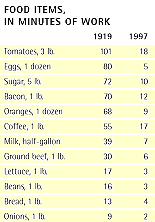
CYCLES
OF LIBERALISM AND CONSERVATIVISM
In his The
Cycles of American History (H. M., 1986), A. S.
observes American cycles of "reform," with
renewed dedication to "public purpose," and
"conservativism," featuring withdrawals to
"private interest." Bursts of governmental
energe have occurred roughly every thirty years
(T. R. in 1901, F. D. R. in 1933, K. in 1961)
alternating with the conservative restorations
of the 1920s, the 1950s and the
1980s.
One force
undoubtedly underlying such shifts is economic.
K. P., in The Politics of Rich and Poor: Wealth
and the American Electorate in the R. Aftermath
(Random House, 1990), notes how
these
times of private interests lead to increasing
inequalities,
leading to depressions, Populism, and demands
for wealth redistribution. Consider the
parallels between the 1980s, the 1920s, and the
Guilded age:
* conservative
Republican Presidents who bring tax cuts that
lead to a major redistribution of wealth, with
high concentrations in hands of top 1% and
especially to tenth of the top one percent.
* extremely
pro-business eras featuring the themes of less
government is better, greed is okay, and
disbelief in labor;
* substantial
reorganization of business and finance
institutions;
* periods of
economic disinflation featuring the bust of the
commodities market (e.g., TX & LA oil) and
boom in finances;
* two-tier
economy with strong regionalism;
* record
levels of debt and speculation.
Click here to
see
*
Americans' political leanings,
1952-92
*
Intensity of Americans' partisanship, 1952-
92
DAYLIGHT-SAVINGS
TIME
More
successful have been political attempts to
implement daylight-savings
time,
but not without a battle. In 1996, after 70
years of local experiments, considerable
controversy, and as a condition of the North
American Free Trade Agreement, Mexico finally
went on daylight-saving time.
For the United
States, it was the energy conservation needs of
two world wars (R. called it "War Time") that
provided the incentive to spring ahead an hour
in April and to fall back an hour in October.
But "Standard Time" often returned with peace.
People complained, for instance, that the
government was tampering with "God's time," that
the extra hour of sunlight was upsetting
livestock and burning yards! A
Congressional
two- year experiment with year-round
daylight-saving time, beginning on January 6,
1974, lasted only one complaint-filled
season.
The months falling within daylight-saving time
were reduced between 1975 and 1987, when
Congress passed an amendment to the Uniform Time
Act that gave most
Americans the current seven month
daylight-saving time.
In
September
of 1991, Soviets turned their clocks back an
hour to correct a Stalin era
mistake--officials
had failed to return to winter time after six
months of daylight-saving time. When the country
reintroduced daylight-saving time and set clocks
ahead an hour in the spring of 1981, summer
civil time became two hours ahead of solar-based
time.
DST
page from University of Illinois
Urbana-Champaign
Other
topics in political
temporalities:
* The
inevitable life-cycle of the rise and fall of
regimes, "injured by time" as Aristotle put it.
* How voter
apathy derives from high expectations and
perceptions of the slow pace of social change.
For instance, some women complain about the pace
of change in female rights in the workplace and
some African-Americans complain about their pace
of assimilation into the American mainstream.
* How needs
for short-term payoffs (e.g., representatives
having to have something to show their
constituencies every two years) have damaged
long-term political goals, undermining the
values and institutions of stable democratic
regimes.
The
movement toward setting term-limits for elected
officials.
* The use of anniversary rituals to legitimate
beleaguered regimes (e.g., the Shah's
celebrations of Iran's 5,000th anniversary, or
the bicentennial hoopla in this country in the
wake of Vietnam and Watergate).
* The
public-relations value of dispensing bits of
time to special interest groups (i.e., National
Realtors Week, Grandparents' Day, National
Nursing Home Residence Day, National Family
Week, and National Amateur Wrestling
Week).
A.
B. 's "I'm Dreaming of a White National Cheese
Day: The Selling of the American
Calendar"
Presidential
Proclamation
Days/Weeks
TEMPORAL
PERSPECTIVES OF THE
SCIENCES
Science gives
us the ultimate
of temporal
perspectives,
ranging from the billion-year time frames for
grasping the birth and death of the entire
universe to the nanosecond frames for grasping
the the birth and death of subatomic processes.
UCMP
Geological Time Machine
Spacetime
Splashes: Catching the Wave in E.'s
Equations
I.D.
and the End of the World
N.'s
Timelines and Scales of Measurement
List
National
Science & Technology
Week
DEALINGS
WITH THE PAST AND FUTURE
The world of
my young sons features two working parents, day
care, Nintendo, shopping malls, microwave meals,
and a suburban neighborhood filled with kids.
They are raised to assume that if one pushes the
right buttons the garage door will open or the
television comes on, that Dad can be talked
to--even though he is miles away--from Mom's car
phone, that Grandma can be visited in two hours
even though she lives 600 miles away, and that
people have walked on the moon and returned home
at speeds of 25,000 miles an hour.
Their
grandparents were raised in a society of farms
and small towns, in which children often worked
to help support the family by milking the cows
or selling loaves of bread for a dime apiece.
They were raised to assume that the human voice
can travel via radio waves, that some people
have telephones but must wait until others are
off the community line to place a call, that
grandparents living 600 miles away can be
reached in a day and a half by train, and that
speeds of 200 miles an hour have been reached in
airplanes.
Then there's
the perspective of the boys' great-grandparents,
who were born in the late nineteenth century
when V. was the queen of England, or in the
early twentieth century during the presidency of
T. R.. Most people entered the world not in
hospital delivery rooms but in the family home
by the light of a kerosene lamp. Most were
raised on remote farms on the plains and in the
Far West, where they played with imaginary
friends, socialized during weekend visits to
town, and received their formal education from
their parents.
Over the past
few centuries humanity has witnessed the most
dramatic and rapid cultural transformations ever
known. So great, in fact, has this rate become
that each generation now alive absorbs within
its lifetime an amount of technological and
social change that traditionally occurred over
the course of many centuries.
What
are the social and psychological implications of
such rapid rate of social
change?
How does it affect our orientations to the past
and to the future?
COLLECTIVE
REMEMBERING AND FORGETTING
Those who
cannot remember the past are condemned to repeat
it.
--G. S.
Whoever
controls the past controls the future. Whoever
controls the present controls the past.
--G.
O.
[paraphrase]
History is the playing of tricks on the dead.
--V.
History is the
ship carrying living memories to the future.
--Sir S.S.,
British poet and critic
The nature of
collective memory and the processes of
historical revisionism have intrigued me for
some time. For instance, consider the
proposition that it is at the age of nine when a
public event creates a lasting impression on a
person's memory. If this be the case then in
1998: * 98.5% of Americans are too young to
remember the first time women could
vote;
* 86% do not
remember the ending of World War II (in fact 77%
of living Americans were born after this
watershed event);
* 79% cannot
recall the 1954 Supreme Court ruling that began
to outlaw racial segregation;
* 73% of
Americans do not remember Russia's launching of
Sputnik I;
* 68% do not
recall the assassination of President
Kennedy;
* 48% cannot
remember the 1974 Arab oil embargo against the
U.S.;
* and 45% are
too young to recollect the American Bicentennial
(in fact, slightly less than one-third of
Americans were born since that event)
.
For an example
of the kind of inquiries that I am engaged in
(pardon the academic prose) click
here for explorations into the implications of
historical
ignorance.
Some Web sites
capturing this idea:
Calendar
Zone
CalendarHome.com
440
International's Those Were the Days (a "this day
in history" format)
History
Channel's This Day in
History
Today
in History
Yahoo
- Arts:Humanities:History:Today in
History
Historical
Recreations in Art from the National Museum of
American Art
Kearl's
History Page
USE
OF HISTORY TO LEGITIMATE
SELF
Yahoo
- Social Science:Women's
Studies:History:Women's
History Month
National
Women's History Project
Herstory:
Une Exposition
Education
First's Black History Month
Website
The
Universal Afrocentric Events
Calendar
Cinco
de Mayo.
This
Week's Queer
USE
OF HISTORY TO LEGITIMATE
REGIME
Mexico's
Cinco. de Mayo observances
USE
OF HISTORY BY CITIES &
COMMUNITIES
Through their
museums, monuments, historic districts, and
street names, cities commemorate their heroes
and preserve memories of their collective pasts.
Of the urban renewal campaigns of the immediate
postwar era, S. K. observed (in PBS's "America
By Design: Public Places and Monuments," Fall,
1987):
Destroyed were
old buildings which told us who we are, what
we've been through, what we are apprised or
allowed. They are a tangible record of our
existence as a people. We erase that record bit
by bit, and in so doing we deny ourselves the
comfort of our collective past. We Americans
have been enthusiastic destroyers. Our new
towers deny tradition. There are no
story-telling declarations. ...Most of us demand
sign posts that remind us where we came from and
that lead us toward our identity.
Currently,
historic preservations are on the rebound. As
cities become indistinguishable with their malls
and national franchises, it is their pasts that
make them unique.
National
Trust for Historic Preservation
Wichita,
Kansas
Western Heritage
Tour
RECREATIONS
OF THE PAST
Just as
individuals need a sense of order in their
biographical experiences, there are both
personal and social needs for individuals to
transcend their own lives and to understand
their own biographies within the context of
those of their ancestors and successors. The
experience of community, for instance, has a
retrospective aspect, involving "a tradition
carried from generation to
generation...[wherein] the living
acknowledge the work of the dead as living on in
themselves forever" (M., 1949:160). Then there's
the prospective aspect, described by B. R. as
"making part of one's life part of the whole
stream and not a mere stagnant puddle without
any overflow into the future." The symbolic
representations of such continuity are deeply
woven into the fabric of religious symbolism
(B., 1964), inculcating a trust in the
continuities of life, of one's people, of one's
works for others, and
allowing
one to see them comprising a long chain of
meaningful being.
One way humans
have attempted to participate in this sacred
time is by replicating the activities of their
ancestors. What
is sacred is the order that links our activities
with an overarching meaning. Sacred time is the
collapse of the past and future into an eternal
now so that the heroics of our ancestors and our
descendants are forever part of the
present.
To accurately repeat the rituals of one's
ancestors, as in a traditional ceremonial dance,
is to participate in sacred time. In this sense,
the expeditions of T. H. and the duplication of
the voyages of the Godspeed (the ship carrying
tradesmen and farmers to Jamestown in 1607) and
the Mayflower, while being scientific and
historical enterprises, may also be religious
rituals.
The Civil War Reenactors Home
Page
NOSTALGIA
The word
"nostalgia" was coined by an Alsatian medical
student from the Greek words for "home" and
"pain." In short, homesickness. Nostalgia for
older values may well represent a natural
response to major social upheaval.
It seems as
though retro
has become the leit motif of popular culture in
the 1990s. In 1992 there appeared in my mailbox
the Pastimes catalogue featuring fifties-style
bikes, models of autos from the 1920s on, models
of WW II aircraft, Roman numeral clocks, Civil
War vessels, sailing vessels in bottles, paper
models of Wrigley Field, quilt designs, and
Victorian rocking horses. "Adult rock"--e.g.,
the moldy oldies--fills the radio spectrum. The
proliferation of "Classic" labels: Classic Coke,
Classic Rock, Classic Dinners, Classic baseball
fields, etc. Of the shows opening on Broadway in
1995, fully one-half were revivals. Television
shows of the fifties and sixties have become big
screen movies in the nineties. Have you wondered
what is going on? Among the suspected forces:
*millennial
dynamics,
when forward looking has been put on hold until
we pass the great threshold;
* the entry of
the massive Boomer generation into midlife, a
life-cycle time of retrospection, biographical
assessment, and idealization of the past (a
related thesis: the phenomenon involves
generational reaffirmation, whereby dominant
midlife generations assert the ethos of their
early adulthoods in reaction to that of
generations coming of age--hence the "Trumania"
of the late 1970s when the Silent Generation hit
midlife);
* a cultural
backlash to the dramatic social upheaval and
technological change which undermined Americans'
psychic moorings.
Hype's
Nostalgic Wave - A Continuing Search for Pop
Culture Icons from the
Past!
Digital
Nostalgia
Yesterday
USA and Heritage
Radio
Theater present old time radio shows
A.
& A. Show
Nostalgia
ChannelProgramming
INTERESTING
IDEAS
Fifties
Website Home
Page
Rewind
the Fifties The
50's
Lorraine's
Sixties Page
Crunch
- Cereal Box
Collection
FUTUROLOGY
If men could
foresee the future, they would still behave as
they do now.
--Russian
Proverb
The ability to
predict what is going to happen (and, ideally,
when and where), to anticipate challenges to
one's intended goals, is the core strategy of
human endeavors. From the divining from sheep
entrails to the readings of computer-generated
weather forecast simulations, humans have always
attempted to plan for (and hence be able to
affect the course of) future events. Of course,
acting on such predictions has led to
self-fulfilling prophecies and to unintended
consequences.
When you think
about it, an impressive portion of the labor
force is involved in the business of futurology.
There are, for instance, the:
*
meteorologists, such as those who successfully
forecasted the 1993 Midwest floods and made
killings in the futures markets by predicting
crop destructions;
* geologists
who forecast earthquakes;
* the
economists, those who, as the line goes, have
supposedly given soothsayers a bad name. These
folks extrapolate from their special collection
of "leading indicators" to divine short- and
long-term economic trends;
* political
analysts who predict voter trends in forthcoming
elections or the stability of foreign
regimes;
* military
strategists, who anticipate the actions of
adversaries and allies;
* various
stripes and breeds of social forecasters, such
as the demographers whose forecasts show future
needs for more schools, highways, or nursing
homes;
* cultural
forecasters who attempt to divine future trends
in fads, fashions, and viewing and listening
preferences;
* sports
analysts and handicappers, who make the
beginning-of-the-season projections of winning
teams;
* and, of
course, those involved in astrology (in addition
to N. R., some 7% of Americans say they have
altered their plans because of astrological
reports) and other parapsychological
projections.
Futureweb:
Website of the Future Program at the University
of Houston
Time
magazine's "Visions of the 21st
Century"
Messages
from the Future Page
Predicting
the future using internet Delphi
methodology
UTOPIAN
(AND DYSUTOPIAN)
ENVISIONMENTS
With the
conclusion of the Twentieth Century, it is
fascinating to compare life now with what was
prophesized by such writers as E.
B.and
H.G.
W..
What faulty assumptions or unexpected
developments account for their predictions that
failed? What principles of historical processes
permitted accurate extrapolations of the future?
Center
for Utopian
Studies--with
links to 1893, 1934 and 1939 Worlds Fairs, and
to works of A. W. and E. B.
TIME
TO GET A LITTLE CRAZY
You have
undoubtedly heard the poem ascribing personality
characteristics given the day one was born:
"Monday's child is full of grace, ..." To what
extent does the crisis of leadership in the
United States owe to the birth days of recent
Presidents? Click below to find out:
Fate
determined by birthdate