Contents
Part II: the principles
'We
do not appreciate time
objectively as a physical thing;
that it is simply a pure form
of sensible intuition.'
Immanuel
Kant
Introduction
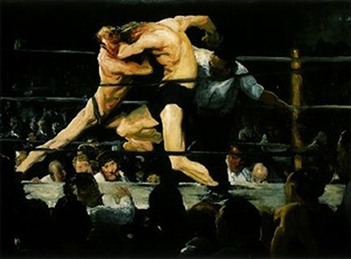
Wrestling,
authority
and the duality
Science develops
certitude concerning facts, certain
knowledge that is verifiable and
refutable. The division of the human
being striving for results,
expresses itself therewith in an
endlessly branching of sub-sciences,
which among themselves are not
integrated and thus can also
be denoted as ignorant. Intelligence
is not yet the sacredness. Being
materially motivated for the fruits
of labor, easily the full scope of
things, the integrity of the
universal, filognostic
scholarship, is lost, and thus one
is, just as easily politicized like
boxers, at odds with one another.
One is even at odds that way with
the mutual reproach of
pseudo-science, with the mistaken
path with which one undermines one's
own scientific status, the respect
one needs towards the rest of
society to be respected oneself.
And, frankly said, that also
confirms the argument of science
critcism, since a science that is
divided, a science that cannot get
itself in line anymore and position
itself as being of leadership and
responsibility in society, is in
fact no real science at all. Law,
economy, history, philosophy,
literature, engineering and the
human sciences e.g., seem, with this
dividedness, to be more like
political parties, which, aiming at
status and income, rule each other
out in their competitive drive. But,
if we consider
everything that is taught at
universities as
being science and
describe the differences of opinion
about power and status as a kind of
self-hindrance and deficiency, as a
kind of neurosis of no longer as a
unity being able to perform
effectively, it is evident that,
with the fall of the original
gentleman's agreement of science, a
principle has been lost: the
principle of association.
Association is the art, and
association one may consider the
purpose of filognosy.
In part
one we saw the philosophy of
it coming about, resulting in the
lead of a certain order of time. The
calendar
we now have, next we,
all
together, have to manage finding a life with
it.
To the practice, the
manifested reality, of association,
belongs the analysis, the analytical
approach as a concrete way to help
people, to confront people, to
motivate people or put them in their
place and admonish them. Once the
association, the realization of
concurrence and accord,
philosophically, with respect for
what is factual, is achieved and it
next, analytically responsible, has
been employed, we thereupon arrive
at what in the following section, in
this section here, is discussed: the
spirituality. For solidarity and
concurrence as yet do not
implicate purity.
The analysis is rather
creative and adaptive, and expresses
itself often in a form of art: in
songs, paintings and stories. With
those harmonies, narrations and
images the material is
carried
with which we actively can oppose
the world of illusion. From the
literature of Miguel de
Cervantes
(1547-1616) e.g. we learn that we,
like a Don Quichotte together with
the common man that is Sancho Panza,
in stead of fighting with each other
over a woman, have to fight the
windmills of the bewildered state;
with W. A.
Mozart (1756-1791) e.g. we
learn to put the classical harmony
in front that reminds us of the
needed harmony with nature; and with
the art of painting with e.g. Rembrandt van Rijn (1606-1696), we learn to keep an image in
mind that figures as a nuclear idea
to which we may return time and
again. In the analysis the focus is with the emotional
man who firstly is but a man, and
then we also see the practical
problem along with it: the knowledge
of the science is not yet the wisdom
of a stable practice. A school of
learning is needed to transfer the
knowledge, a form of know-how is
needed on how to proceed, which is
something one, not rarely, only by
trial and error may manage to
control. One discovers that there is
a master and a slave. And of course
does everybody, like a bunch of
wrestlers again, want to be the
master of the game. 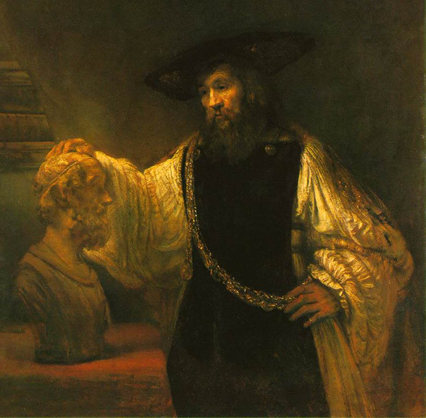 And if one manages to
solve that problem, with the insight
that not the control over others but
the control over oneself constitutes
the art and the challenge, it
becomes clear who is the slave and
who the master: the spirit is the
master, the body is the slave. The
soul is the little prince, the
physical frame is the dog that has
to obey, and that dog one has to
offer some chow regularly - take
care, not too much - as also take
for a stroll regularly - at the
right time -, or else the excrement
of excess and toxic waste is
delivered at home. One thus studies
the teachings of being the master,
while at the same time being subdued
like a trained dog, and has material
success that way, but a harmonious
society or meaningful and just world
order, is not as easily attained
with it. One may be of knowledge,
but one is not directly versed in
the science of solving the problem
of the conflict of authority about
who, or what, one would have to
serve in the outside world. The
philosopher/psychologist Karl R. Popper (1902-1994) e.g.
spoke of three
worlds - the world of the
self, the body and the culture -,
but he was in his structuralism
missing the essence, not being
capable of making up where the
authority would lie in that order.
In that position of indecision, one
then next encounters the problem of
blocked progress, a problem that can
manifest itself as a physical or
mental, individual or collective,
disease. Philosophically
spoken progress is
truly not a simple concept. To be
more concrete (in Sanskrit called
avaroha) in one's engagement,
to come down to the material level,
means one is of progress, and to be
more abstract (or âroha), or rise up to an
overview, also
means to be of progress, so we
already saw in the
charter of order with the Escher
staircase. In order to put
science into practice, one
inevitably has to contemplate the
principles of emancipation and
progress. The student in love with the
science
enjoys his/her
freedom, but the graduate needs the
necktie so to say, to make his/her
living and found a family.
Meditating on that reality, with the
unity in mind of the soul, the
conscientious self one does not want
to lose in the concreteness of
science and the complex of economy
thereabout,
and that one has with the civil
virtues (which in the Vedic
order are called the purushârtha's
of the kâma, artha, dharma and
moksha, or the virtue
concerning one's desires, economy,
religion, and liberation), that
higher self is then found to be
present as the spiritual unity of
the transcendent, metaphysical
position in the beyond that,
personal and religious or not, has
to demonstrate the science of the
soul, the rules and order of the
game. From a scientist free from
duality and sober with the facts,
one is all of a sudden a meditator.
All of a sudden one is someone of prayer, or
of a scientific aphorism from a
school of thought, as also of
courage, of a plan and of
faithfulness, of belief, hope and
love with religious values,
standards and rules, and/or of a
political party that also turns out
to be necessary.
And if one manages to
solve that problem, with the insight
that not the control over others but
the control over oneself constitutes
the art and the challenge, it
becomes clear who is the slave and
who the master: the spirit is the
master, the body is the slave. The
soul is the little prince, the
physical frame is the dog that has
to obey, and that dog one has to
offer some chow regularly - take
care, not too much - as also take
for a stroll regularly - at the
right time -, or else the excrement
of excess and toxic waste is
delivered at home. One thus studies
the teachings of being the master,
while at the same time being subdued
like a trained dog, and has material
success that way, but a harmonious
society or meaningful and just world
order, is not as easily attained
with it. One may be of knowledge,
but one is not directly versed in
the science of solving the problem
of the conflict of authority about
who, or what, one would have to
serve in the outside world. The
philosopher/psychologist Karl R. Popper (1902-1994) e.g.
spoke of three
worlds - the world of the
self, the body and the culture -,
but he was in his structuralism
missing the essence, not being
capable of making up where the
authority would lie in that order.
In that position of indecision, one
then next encounters the problem of
blocked progress, a problem that can
manifest itself as a physical or
mental, individual or collective,
disease. Philosophically
spoken progress is
truly not a simple concept. To be
more concrete (in Sanskrit called
avaroha) in one's engagement,
to come down to the material level,
means one is of progress, and to be
more abstract (or âroha), or rise up to an
overview, also
means to be of progress, so we
already saw in the
charter of order with the Escher
staircase. In order to put
science into practice, one
inevitably has to contemplate the
principles of emancipation and
progress. The student in love with the
science
enjoys his/her
freedom, but the graduate needs the
necktie so to say, to make his/her
living and found a family.
Meditating on that reality, with the
unity in mind of the soul, the
conscientious self one does not want
to lose in the concreteness of
science and the complex of economy
thereabout,
and that one has with the civil
virtues (which in the Vedic
order are called the purushârtha's
of the kâma, artha, dharma and
moksha, or the virtue
concerning one's desires, economy,
religion, and liberation), that
higher self is then found to be
present as the spiritual unity of
the transcendent, metaphysical
position in the beyond that,
personal and religious or not, has
to demonstrate the science of the
soul, the rules and order of the
game. From a scientist free from
duality and sober with the facts,
one is all of a sudden a meditator.
All of a sudden one is someone of prayer, or
of a scientific aphorism from a
school of thought, as also of
courage, of a plan and of
faithfulness, of belief, hope and
love with religious values,
standards and rules, and/or of a
political party that also turns out
to be necessary.
Section 2a: the
analysis
Mistakes,
devotion
and the humaneness
'From error to error
one discovers the entire truth.'
Sigmund
Freud
Analysis is
an absolute necessity. Without it,
illusions cannot be uncovered and
peace cannot be found by sound and
reasonable argumentation and accord.
About illusions one will never agree
because, with the reference lacking,
the faith cannot be sustained. One
may confirm oneself in illusion,
compensate temporarily in agreeing
about a self-made reality, but one
fails by lacking in physical
evidence falling down,
de-compensating in a burnout or
nervous breakdown. Analysis tells
you what your illusions are. There
cannot be any progress building on
error. Human tears are the proof of
that. One cannot advance but to hell
and chaos when one is not in touch
with reality. Building on error one
builds on illusion. Building on
illusion one becomes a psychotic
patient. The psychotic person is a
person at war with himself because
of false premises, because of
misconceptions that distort his
vision of reality. So too, we have
warfare between nations, as a
collective psychosis, building on
paradigmatic fallacies. Capitalists
being paranoid and
fundamentalists projecting e.g.,
suffer the same psychological
problem; they are in illusion, they
are not aware of the common error of
the ruling paradigm and can, most
tragically, not believe in each
other, with their rhetoric and
propaganda in the style of the pot
that blames the kettle. Where two
are fighting, two are guilty. The
systematic, paradigmatic error we
refer to here, is the denial of the
ether and the order of natural
time belonging to it, so
typical for the Einsteinian fallacy
associated with the pragmatics of
the immoral, or impure, capital-motivated
standard time management well-known
from the twentieth century. 
The
Iranians, conforming to the system
of American
time zone, are
blaming America for their own
illusion of adhering to them. That
is the effect, the reaction, of the
denial of something as fundamental
as the ether. Those who follow
Allah, Christ and Krishna must in
fact negate Einstein as the Lord of
Relativism who denies the ether.
They have to acknowledge the other
Einstein who corrected this mistake
in discussing the ether as a concept
of space with material qualities - a
forcefield thus - and who very
filognostically said that science
without religion is lame and
religion without science blind. Not
doing so one will be inconsistent,
in conflict with oneself, for on
earth not proceeding as it is in
heaven, the measure of time is
impure and
the impersonalality of the Lord is
denied, and so one is, in the end,
of madness. In repression we, afraid
of the fall-down, do not know this.
We, filognostically
analyzing, therefore as a premise
have to say, in accord with section I-A: the
ether exists and it is proven
by not just classical
scriptures and philosophy and the
continence of its cultures
which offer us the identity of this
and that Lord or prophet, nay, it is
also very concretely proven by
photographs of the galaxy
center showing how stars are
spinning around in a force field
defining the galaxy as a flat disc,
with a mountain of stars in the
middle heaping around a black hole.
This movement of the stars observed
is the proof of the force field that
we in effect as human beings always
have known as the ether, the element
of that force which defines our
medium of the spirit, our mind in
material identification, our oneness
of life. To be sober, we have to be
prepared to be in touch with this
force and thus control ourselves by
this connecting element, in which we
define our material reality as being
conditioned by it in a certain
cyclic order of time. One should, in
that sense, then not be disheartened
and of disbelief about the but
subtle, unsatisfactory differences
in the light speed found in the M.
& M.-experiments (see introduction) for the
ether. Only acknowledging the ether
as being the life experience
of that force field will give that
control, and not the denial of it by
relativism, postmodern philosophical
pessimism and other politically
minded forms of flippancy
(reductionism, nihilism, cynicism,
etc.). From relativistic notions in
denial of the ether we do not know
the authority of the natural order
of time anymore and then, as a
consequence, we suffer the illusions
of the cultural neurosis of being
out of touch and ineffective with
the natural reality. As the Dutch
philosopher B. Spinoza, following in
history directly after René
Descartes, has said: nature is
God; and hence we say: the
ether is a fact, a basic
element of natural reality. It is,
analytically, all a matter of
cognition, of how we label, of how
we define and manage our reality
without repression. After all, the
failure to deliver definitive
experimental proof of the ether
still, by the grace of the physical
research design itself, involves a
paradigmatic definition of it we can
work with. And at that moment we,
from the perspective of those
systematics, then find our proof in
observations of orbiting stars and
of historical facts like the
sustainability of world cultures, as
with Hinduism, which center around
the concept of the ether. What is
important in our filognosy
is to define matters in such a way
that we get hold of the complete,
that we arrive at a comprehensive
vision of the order of things and
find our happiness therein.
Errors
require self-correction. It is
better to correct one's own mistakes
than leaving it to others.
Classically from the Vedic point of
view the error is called bhrama.
Man has four major weaknesses: first
to make mistakes, second to cherish
them with illusions (pramâda),
thirdly has man the propensity to
cheat himself and others with it (vipra-lipsa)
and finally he, fourth, as a culture
easily ends up with an incorrect
perception of reality, like one has
with standard time e.g. (karanâpâtava).
Thus
we know our cultures as compensatory
phenomena, as giant cover-ups of
collective lies inherited as
original sin, that, as an
aberration, are built into our
cultural genes. We know,
technically, from neural feedback
loops in our body and from modern
systems theory, that systems only
stay effective on the basis of being
tuned to the time and place by
feedback loops
that facilitate course corrections.
But we also know this in a social
sense by the self-critical nature of
democratic debates and, more
individually, by the dialectics, in
accord with the socratian principle,
of the psychoanalysis of Sigmund
Freud, who this way did an extensive
study of the phenomenon of human
error. From that study we still
speak of freudian slips of the
tongue when repressed materials
surface breaking through the barrier
of ego defenses.
From him also we realize that being
problematic with Father Time just
might be a classical complex: the
so-called Oedipus-complex. So, in
order not to fall into mad psychotic
warfare with each other and oneself,
is it of importance, analytically,
to uncover this commanding fatherly
aspect of time - so closely
associated with the concept of the
ether - as being the analytical end
conclusion, and thereby study the
person of S. Freud as being a
key-figure in the history of science
and philosophy.
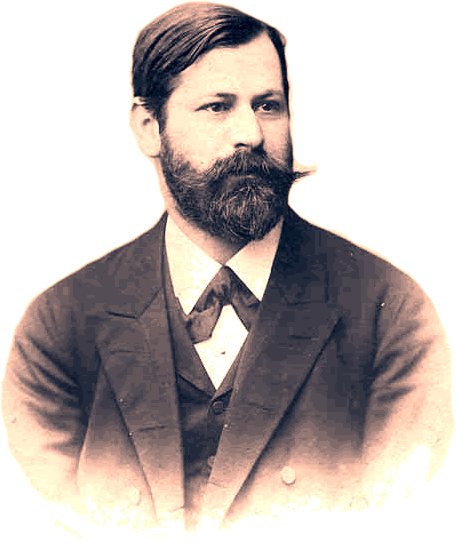 Sigmund Freud, an
austrian physician from the
nineteenth and twentieth century
(1856-1939), developed a method to
analyze the psychic complaints that
troubled his patients. Initially he
attempted to hypnotize them and thus
find out and fight what was
bothering them, but leaving aside
that method, as being too far
removed from the will of the patient
and the integrity of personal
relating, he in stead of that had
them in a later stage freely associate on a sofa.
He analyzed that material patiently
with order and regularity, and
offered so now and then an
interpretation. He spoke of the
conscious and the subconscious, the
es, the ego and the superego, the
Oedipus-complex, repression,
projection, transference, and the
lust- and reality-principle. The
interpretations that were adopted,
that were effective with his
patients, he then, with in mind the
essential dictum of the Buddha 'true
is what works', presented as his
science of psychoanalysis. He was
one of the founders of the modern
psychotherapeutic approach, the way
a westerner, as a 'client' to a
'therapist', with the by himself
elected spiritual teacher or guru
searches for himself, for his
identity. To his own opinion he had
not so much the helping of people in
mind as the uncovering of what the
nature of the individual and
collective problem was; what, as it
were, went on in the 'black box' of
the human mind. As for him, it was
more a way of arriving at self
knowledge thus. What he did was
afterwards by other scientists not
really considered a form of
philosophy or science, but more an
art form. How can, in abstract
terms, be expressed what essentially
goes on
in man, in oneself as a human being?
At the end of his life he had to
conclude that his analysis was
inconclusive and that the struggle
for the sake of the a priori truth
of the human being was not yet over.
In India though, we know now, was
long before his time already known
the philosophy of sânkhya, or
analysis, of a certain incarnation
of the Lord known as Kapila, who
meticulously dissected man into his
different composite elements. The
analytical approach is, as seen from
his perspective, primarily a
dualistic matter in which the soul
is set apart from an in twenty-four
elements divided material nature.
This soul strives for liberation
from misery in its material
existence, like also Freud was
striving for knowledge of the self
in the search for the alleviation of
the suffering of himself and his
patients. Kapila so states: 'It
is so that the consciousness of him,
who in bondage is after the freedom
of the self, is under the spell of
the modes of material nature, but
when one is moved in attraction of
being conditioned to what is the
mother of virtue, one is of
liberation.' (S.B.
3.25: 15). In other words, it
is the
consciously lived love for the
(moral) knowledge - or our filognosy
- which, with respect for the truth
of the soul, grants the liberation.
This happens, analytically, in a
process of devotional service to His
person of whom he, in a later
chapter, says that the influence of
the Original Personality of Godhead
Sigmund Freud, an
austrian physician from the
nineteenth and twentieth century
(1856-1939), developed a method to
analyze the psychic complaints that
troubled his patients. Initially he
attempted to hypnotize them and thus
find out and fight what was
bothering them, but leaving aside
that method, as being too far
removed from the will of the patient
and the integrity of personal
relating, he in stead of that had
them in a later stage freely associate on a sofa.
He analyzed that material patiently
with order and regularity, and
offered so now and then an
interpretation. He spoke of the
conscious and the subconscious, the
es, the ego and the superego, the
Oedipus-complex, repression,
projection, transference, and the
lust- and reality-principle. The
interpretations that were adopted,
that were effective with his
patients, he then, with in mind the
essential dictum of the Buddha 'true
is what works', presented as his
science of psychoanalysis. He was
one of the founders of the modern
psychotherapeutic approach, the way
a westerner, as a 'client' to a
'therapist', with the by himself
elected spiritual teacher or guru
searches for himself, for his
identity. To his own opinion he had
not so much the helping of people in
mind as the uncovering of what the
nature of the individual and
collective problem was; what, as it
were, went on in the 'black box' of
the human mind. As for him, it was
more a way of arriving at self
knowledge thus. What he did was
afterwards by other scientists not
really considered a form of
philosophy or science, but more an
art form. How can, in abstract
terms, be expressed what essentially
goes on
in man, in oneself as a human being?
At the end of his life he had to
conclude that his analysis was
inconclusive and that the struggle
for the sake of the a priori truth
of the human being was not yet over.
In India though, we know now, was
long before his time already known
the philosophy of sânkhya, or
analysis, of a certain incarnation
of the Lord known as Kapila, who
meticulously dissected man into his
different composite elements. The
analytical approach is, as seen from
his perspective, primarily a
dualistic matter in which the soul
is set apart from an in twenty-four
elements divided material nature.
This soul strives for liberation
from misery in its material
existence, like also Freud was
striving for knowledge of the self
in the search for the alleviation of
the suffering of himself and his
patients. Kapila so states: 'It
is so that the consciousness of him,
who in bondage is after the freedom
of the self, is under the spell of
the modes of material nature, but
when one is moved in attraction of
being conditioned to what is the
mother of virtue, one is of
liberation.' (S.B.
3.25: 15). In other words, it
is the
consciously lived love for the
(moral) knowledge - or our filognosy
- which, with respect for the truth
of the soul, grants the liberation.
This happens, analytically, in a
process of devotional service to His
person of whom he, in a later
chapter, says that the influence of
the Original Personality of Godhead
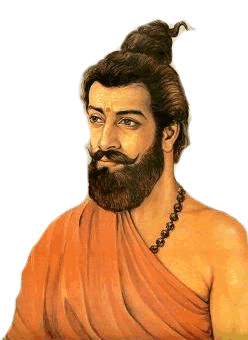 is said to be the
time factor (S.B. 3.26: 16). What it in the end
thus all is about in the analysis,
is the, with devotion, serving of
the original person we know by the
grace of the factor of time, or, as
Freud stated it time and again
succinctly at the end of his
sessions: 'Your time is up'. The
personal, virtuous or not, one
reaches by the impersonal of time,
and the other way around. Freud
said: it is about the (oedipal)
relation with the father, and in
this case it concerns our father
time as we
already saw in section number I. This is the duality
of the analytical approach. The
devotion therein is then, elevated
above criticism and praise, a matter
of being social, as was
understood in the previous section, and that demands
also an effort in the sense of, as
Vyâsa calls it, the hearing and
singing' on the path of the
Fortunate One (the so-called bhâgavata
dharma, see S.B. 7.5:
23-24).
One must ultimately,
to the desire of reaching the
perfection of the soul, listen at
and sing about that classical
wisdom, but an individual way of
philosophical speculation and
creative selfrealization, being
on one's way for it, is also
indicated. There is the choice of 1)
the fast lane of the direct
submission as a novice in a
religious context and 2) the slow
path of individual realization in
selfrealization, as an artist and
freethinker, in which the ego but
gradually loses its falsehood of
being identified, and finds its true
self (svarûpa) and servitude
(svadharma).
is said to be the
time factor (S.B. 3.26: 16). What it in the end
thus all is about in the analysis,
is the, with devotion, serving of
the original person we know by the
grace of the factor of time, or, as
Freud stated it time and again
succinctly at the end of his
sessions: 'Your time is up'. The
personal, virtuous or not, one
reaches by the impersonal of time,
and the other way around. Freud
said: it is about the (oedipal)
relation with the father, and in
this case it concerns our father
time as we
already saw in section number I. This is the duality
of the analytical approach. The
devotion therein is then, elevated
above criticism and praise, a matter
of being social, as was
understood in the previous section, and that demands
also an effort in the sense of, as
Vyâsa calls it, the hearing and
singing' on the path of the
Fortunate One (the so-called bhâgavata
dharma, see S.B. 7.5:
23-24).
One must ultimately,
to the desire of reaching the
perfection of the soul, listen at
and sing about that classical
wisdom, but an individual way of
philosophical speculation and
creative selfrealization, being
on one's way for it, is also
indicated. There is the choice of 1)
the fast lane of the direct
submission as a novice in a
religious context and 2) the slow
path of individual realization in
selfrealization, as an artist and
freethinker, in which the ego but
gradually loses its falsehood of
being identified, and finds its true
self (svarûpa) and servitude
(svadharma).
Analytically
the balance of filognosy is attained
with a certain harmony in the
duality of the master and the slave,
the soul and the body. This spirit
of culmination in the harmony of the
Tao ('the
way') is, according the chinese
philosopher Mencius (or Meng
Ke 372-282 B.C.), a matter of
morally perfecting oneself by 1)
cultivating the goodness, and 2) the
waiting for opportunities to
exercise the four human virtues: a)
the compassionate humaneness, b) the
dutifulness, c) ceremonial behavior
(decorum), and d) insight. To be
compassionate implicates a sense of
duty, which again constitutes the
nucleus of ceremonial, formal
behavior to which that what deserves
approval or should be rejected,
constitutes the basis for the
insight. With the Chinese we see the
growth of an integration of
analytical insight in the duality of
yin
and yang, movement
and rest, from within the soul of
the humaneness which has its source
in the taiji, the
'Great Culmination' of the primal
state of the universe we already
know as the pradhâna with Vyâsa.
 This was in partocular,
in relation to the
concept of the ether, defended by
the neo-confucianists who relativize
the action through 'non-action' of Lao Tzu (6th
century B.C.) - from which
everything finds its (natural)
order, as he explains in the Daode Jing (Tao Te Ching)
(I-3) - with a less
aloof point of view, where they by Zhuangzi (369-286)
were criticized for the fact that
one with Confucius (551-479
v. Chr) would be too moralistic and
of too little relativization. The
neo-confucianist Zang Zai
(1020-1077) states that the ether (qi),
through contraction, brings forth
everything, and that everything also
dissolves in it again as being the
great primal void or primal reality
of space, in which one with the
ether factually may not speak of
non-being, but only of an amorphous
primordial condition. That taiji
is troubled in material existence
and we must manage to clear the qi,
the ether, the mixture of forces,
thus says Zhu Xi
(1130-1200) after him, who founded
the confucianistic teaching by the
state of China. The ether is for him
the basis of the principles of man
and the elementary reality of nature
originating from it. It is enfolded
in it as a pearl. The way of Zai's
'Great Harmony ', then constitutes
the primal directive for the
relations between the sovereign and
the minister, the father and the
son, to the 'principles of heaven'
of the four virtues. The Buddhists,
who reduce everything to nothing,
are thus the 'great malady' leading
to false theories; a notion we also
find with Vyâsa. The Vaishnavas call
the Bhuddhists 'illusion workers',
mâyâvadi's, and oppose their
impersonal voidism. But here, in I-B, we see them more as
a sobering part or aspect of our filognosy.
This was in partocular,
in relation to the
concept of the ether, defended by
the neo-confucianists who relativize
the action through 'non-action' of Lao Tzu (6th
century B.C.) - from which
everything finds its (natural)
order, as he explains in the Daode Jing (Tao Te Ching)
(I-3) - with a less
aloof point of view, where they by Zhuangzi (369-286)
were criticized for the fact that
one with Confucius (551-479
v. Chr) would be too moralistic and
of too little relativization. The
neo-confucianist Zang Zai
(1020-1077) states that the ether (qi),
through contraction, brings forth
everything, and that everything also
dissolves in it again as being the
great primal void or primal reality
of space, in which one with the
ether factually may not speak of
non-being, but only of an amorphous
primordial condition. That taiji
is troubled in material existence
and we must manage to clear the qi,
the ether, the mixture of forces,
thus says Zhu Xi
(1130-1200) after him, who founded
the confucianistic teaching by the
state of China. The ether is for him
the basis of the principles of man
and the elementary reality of nature
originating from it. It is enfolded
in it as a pearl. The way of Zai's
'Great Harmony ', then constitutes
the primal directive for the
relations between the sovereign and
the minister, the father and the
son, to the 'principles of heaven'
of the four virtues. The Buddhists,
who reduce everything to nothing,
are thus the 'great malady' leading
to false theories; a notion we also
find with Vyâsa. The Vaishnavas call
the Bhuddhists 'illusion workers',
mâyâvadi's, and oppose their
impersonal voidism. But here, in I-B, we see them more as
a sobering part or aspect of our filognosy.
In this section is
dealt with the latter path of the
freethinker. Agnostic and skeptical
in the first place about all that
duality of matter and soul,
one finds oneself, analytically,
placed before the duality of the
personal and the impersonal, the
soul and the gross matter, with the
demand to answer the question what
that person or soul would be who one
is oneself, being a freudian or
chinese, and... how one should live
with that. Thus we in this section
of filognosy arrive at an
understanding of that duality in the
form of an analysis of the
individual and collective dreams and
fantasies of movie
stories; of images,
representations and works of
art self created and created
by others; and the
analysis in emotional terms of that
what we know as the lyrical and the
poetic which is associated with the
music of songs, and instrumental music
modern and classical. The analytical thus,
understood in
combination with the art
of shaping and publishing, constitutes a
necessary emotional and personal
counterweight to all the rationality
of the science of the factuality of
part I, that so much tends
to atheism and impersonalism. Or: in
the analysis of this art-minded
division insight is offered in the
structure, the operation and the
emotional experience of filognosy.
Herein one learns to know the writer
of this, as being a singer
of his his own songs, as being an
artist to his own art, and as a
writer of his own story on the one
hand, but also, as an analytic of
the modern spirit of the time, the
way it is expressed in movie
stories, paintings and songs of
others.