>
Info:
I
Methodical preliminary exercises:
an introduction
'With
something being contradicted
it is not proven that it is untrue,
just as not being debated
would prove that someting is true.'
B.
Pascal. Thoughts
Einstein,
the
ether and relativism
To figure out the
truth about the facts that make up
our reality, we must first
determine how to proceed. In
ancient India, this method is
called Nyâya. According to the
Sanskrit dictionary, nyâya
means method, standard, rule,
axiom, plan, right manner,
justice, logical argument, or
inference. Our planned approach
yields an image of reality and a
standard way of operating in the
right manner, so as to arrive at
the proper inference. This logic,
called nyâyika,
consists of five parts:
1
General thesis.
2 Doubt.
3 Counterargument.
4 Conclusion.
5 Summary.
Of course, we
could call on the philosopher
René Descartes (1596-1650) and
his similar method, as well as
the philosophers Immanuel Kant
(1724-1804) and Georg Wilhelm
Friedrich Hegel (1770-1831). We
could also consult Sigmund Freud
(1856-1939) for an analysis and
Friedrich Nietzsche (1844-1900)
to help us realize ourselves.
However, this would be like
building one house with many
master builders. After all,
there is also the philosopher W. v.
Ockham(1285-1349),
who, with his well-known "razor"
argument, asks why we would use
different elements when one
would suffice. To prevent
subsequent master builders from
tumbling over one another in the
construction of our filognostic
mansion, we will limit ourselves
to the Vedic vision in relation
to Descartes for the first half
of Part I, since he specifically
has the method as his subject.
However, we will ultimately have
to abandon him as well, since he
was not familiar with the
non-Western tradition prior to
his time nor the empirical
science that came after him,
despite his
diligence.Rationality is
beautiful and good. Reason is
essential. The method is
important, but, as he states
himself, it is also vital to be
comprehensive in the end. The
general thesis is that India, as
the oldest known culture,
provides a philosophical
foundation to address the
problems of modern man and
develop a syncretic approach to
science, spirituality, and
religion. Contrary to Descartes,
the Vedic sages demonstrate
respect for scientific facts,
such as the existence of a
galaxy amidst other galaxies,
and provide clear descriptions
of problems that we recognize as
modern. It is important to work
toward a coherent paradigm that
can properly cover the entirety
of our reality, do justice to
matters of the spirit and gross
matter, and accommodate
everything and everyone, so that
each person's full identity is
respected.
As the
preface
points out, we must link our
love of knowledge to a certain
order of time if we want to live
with it. Therefore, we will also
involve a physicist like Albert
Einstein
(1879-1955), as he was the
figurehead of modern
intelligence and promoted the
concept of relative time. Let's
start with him to demonstrate
the method. According to his
theory of relativity, the speed
of light (c) is a constant in
the dynamic universe of time and
matter. According to Einstein
and many others who claim to
understand him, time is always
different and depends on the
frame of reference. His theory
implies that the absolute value
of time computations is illusory
and that we, politically,
therefore can regulate, settle,
and control time however we like.
Newton
(1643-1727) was wrong about his absolute
idea of natural
time as a measure of our
material existence. That
would be a position all too
deterministic. So be it, but the
problem is that we end up with a
couple of conflicting
ideas if we give Einstein the
advantage of doubt in determining
what is absolute. Firstly it is so
that we might not understand
Einstein quite right. Time and space
are according to his theory not e xactly the same, viz.
they do not entirely team up.
According his theory there is a
difference between the time
indicated by an atomic clock that in
an airplane flew around the world
and the time of a similar atomic
clock that was kept in its place.
This was tried, and one indeed found
a very minute
difference between the atomic clocks
the way the theory predicted, even though this
experiment from 1972 according to
some was thus unsatisfactorily
conducted that factually no
definitive conclusion should have
been attached to it (see A.G. Kelly:
Hafele
& Keating Tests; Did They
Prove Anything?). Is Einstein
therefore correct in saying that the
time of a certain place must be
taken relative? If so, does this
minute difference, which astronauts
would also have to consider when returning
home, justify the difference in time
and space between standard time and
the time indicated by sundials? At
the beginning of the 21st century,
that difference in China amounts to
about three hours. In western China,
this has led to civil disobedience,
with peasants adamantly ignoring the
state's imposition when they
regulate their daily business with a
clock set to local time. When
Einstein thinks he has found an
exception to the Newtonian link of
time and space, does that not
factually imply that the connection
is thereby confirmed? Doesn't folk
wisdom still defend the idea that
the exception confirms the rule?
Then why should we reject Isaac
Newton, who had a devout, religious,
and classical respect for the
natural measures of time as they are
for normal people and planets? xactly the same, viz.
they do not entirely team up.
According his theory there is a
difference between the time
indicated by an atomic clock that in
an airplane flew around the world
and the time of a similar atomic
clock that was kept in its place.
This was tried, and one indeed found
a very minute
difference between the atomic clocks
the way the theory predicted, even though this
experiment from 1972 according to
some was thus unsatisfactorily
conducted that factually no
definitive conclusion should have
been attached to it (see A.G. Kelly:
Hafele
& Keating Tests; Did They
Prove Anything?). Is Einstein
therefore correct in saying that the
time of a certain place must be
taken relative? If so, does this
minute difference, which astronauts
would also have to consider when returning
home, justify the difference in time
and space between standard time and
the time indicated by sundials? At
the beginning of the 21st century,
that difference in China amounts to
about three hours. In western China,
this has led to civil disobedience,
with peasants adamantly ignoring the
state's imposition when they
regulate their daily business with a
clock set to local time. When
Einstein thinks he has found an
exception to the Newtonian link of
time and space, does that not
factually imply that the connection
is thereby confirmed? Doesn't folk
wisdom still defend the idea that
the exception confirms the rule?
Then why should we reject Isaac
Newton, who had a devout, religious,
and classical respect for the
natural measures of time as they are
for normal people and planets?
The
situation is even worse with
Einstein's theory, which is
fundamental to our modern,
relativistic mindset and our
aversion to personal absolutes.
Recently, in the summer of 2005,
the theory of the Italian
physicist Maurizio Consoli was
questioned due to  experimental
findings in an experiment
performed by the German
physicist Stephan Schiller in
Düsseldorf on the speed of
light. According to Consoli, who
interpreted the data with
greater scrutiny and detachment,
the speed of light would not be
uniform in all directions. Thus,
it would be directional, and there
would be a certain order of
light, a framework, in the
universe. A paradigmatic clash
of this sort has happened
before. In 1933, a researcher
named D.C. Miller claimed that Michaelson
and Morly,
the physicists who initiated the
idea of a constant light speed
in 1887, had made mistakes when
working with averaged values for
the rotational speed of the
Earth. Before
him, Ernst
Mach
(1838-1916) concluded that there was no
definitive proof of the
existence of the so-called
"ether" as a fixed frame of
reference for variable light
speed in a vacuum. According to
Miller, the measurements of
light speed differed relative to
the position of the Earth.
Nevertheless, the Earth would
move at a speed of eight
kilometers per second through a
medium similar to the ether. All
scientists before Einstein
believed that the ether was the
medium through which light
vibrated its waves. After
Miller, Yuri M.
Galaev,
among others, conducted many
more tests with the M&M
experiment, yielding varying
results. In 2005, scientists
discovered the same type of
deviations while conducting the
M.&M.-experiment. However,
they could not accept their own
findings because they could not
believe that Einstein's theory,
which states that such findings
cannot be right, would be
incorrect. Therefore, they
attributed the deviations to
systematic error. From a human
point of view, this is
understandable since the
consequences for our currently
dominant way of thinking about
time and space are difficult to
grasp. experimental
findings in an experiment
performed by the German
physicist Stephan Schiller in
Düsseldorf on the speed of
light. According to Consoli, who
interpreted the data with
greater scrutiny and detachment,
the speed of light would not be
uniform in all directions. Thus,
it would be directional, and there
would be a certain order of
light, a framework, in the
universe. A paradigmatic clash
of this sort has happened
before. In 1933, a researcher
named D.C. Miller claimed that Michaelson
and Morly,
the physicists who initiated the
idea of a constant light speed
in 1887, had made mistakes when
working with averaged values for
the rotational speed of the
Earth. Before
him, Ernst
Mach
(1838-1916) concluded that there was no
definitive proof of the
existence of the so-called
"ether" as a fixed frame of
reference for variable light
speed in a vacuum. According to
Miller, the measurements of
light speed differed relative to
the position of the Earth.
Nevertheless, the Earth would
move at a speed of eight
kilometers per second through a
medium similar to the ether. All
scientists before Einstein
believed that the ether was the
medium through which light
vibrated its waves. After
Miller, Yuri M.
Galaev,
among others, conducted many
more tests with the M&M
experiment, yielding varying
results. In 2005, scientists
discovered the same type of
deviations while conducting the
M.&M.-experiment. However,
they could not accept their own
findings because they could not
believe that Einstein's theory,
which states that such findings
cannot be right, would be
incorrect. Therefore, they
attributed the deviations to
systematic error. From a human
point of view, this is
understandable since the
consequences for our currently
dominant way of thinking about
time and space are difficult to
grasp.
"...the
failure of the world's
physicists to find such a
(satisfactory) theory,
after many years of
intensive research," says
Dirac, "leads me to think
that the aetherless basis
of physical theory may
have reached the end of
its capabilities and to
see in the Aether a new
hope for the future".
Paul
Dirac, the Nobel
Prize winner in physics in
1933
Scientific
American, The
Evolution of Physicists
Picture of Nature,
May 1963
|
Regarding the
speed of light, which seems to
have dethroned time as an
absolute measure, there is
another remarkable issue to
consider. Light exists that
travels three hundred times
faster! Since the end of the
twentieth century, scientists
have thought nothing of it. How
can that be? According to
Einstein in 1905, nothing could
travel faster than the absolute
speed of light. However, since
the mid-1990s, light has been
capable of traveling 1.7 times
faster through a special fiber
optic cable and even 300 times
faster when driven through a gas
cloud. The solution to this
riddle has existed since 1910:
the speed of light limit only
applies to coded
light, not light itself. In
2003, physicist Daniel Gauthier
confirmed this remedy for saving
Einstein's theory of relativity
by stating that, according to
his findings, the speed limit of
light is indeed true for coded
light carrying information but
not for uncoded light. Thus, the
speed of light is an apparent or
conditional constant, not an
absolute one. Depending on the
medium and type of light, light
may travel infinitely fast.
Thus, Einstein's formula, which
is based on a speed limit or
absolute constant in outer
space, may actually be
incorrect. In normal
circumstances on Earth, the
speed of light seems constant.
However, in special
circumstances involving other
conduits and/or fields, it
appears that we are dealing with
a theory of constants rather
than a theory capable of
declaring time relative.
Einstein himself preferred the
formulation "a theory of
invariants." It's no surprise
that virtually no one
understands Einstein, save for a
couple of zealous scientific
fanatics. From the perspective
of our modern options, he does
not quite compute.
The proof
is piling up. In an article
titled The
Speed of Gravity
& What the
Experiments Say
(Physics Letters A 250:1-11,
1998), physicist Tom Van
Flandern states, "Recognition of
a faster-than-light propagation
of gravity, as indicated by all
existing experimental evidence,
may be the key to taking
conventional physics to the next
plateau." The effect of gravity
propagates many times faster
than light. This is also
incommensurate with Einstein's
theory.
Another matter of
dispute among physicists,
concerning the speed of light,
is the deviance in the
fine-structural or nuclear
constant, akin to the speed of
light, found in 2002 by the
internationally acclaimed
physicist, author, and
broadcaster Paul C.
W. Davies
in Australia. This deviance
would prove that the speed of
light has gradually decreased
during our cosmic ontogenesis.
João Magueijo also states in
Faster Than the Speed of Light
(2003) that if light had been
faster in the beginning, that
would offer a better explanation
for the facts of the currently
maintained theory and the
research data. However, the
magazine Nature responded to his
inquiry by stating that,
although he had found an
explanation for some
cosmological matters, he still
had no comprehensive solution
and thus had to be turned down.
Are Einstein and his followers
not also searching for the
"Theory of Everything"? Do we
have to accept him
then?
It seems that,
having arrived at this point, we
are ready for the psychologist
who studies the phenomenon of
rationalization and repression
in relation to systems of
thought. We are thinking of the
analogy of analytical
psychologist Carl Jung
(1875-1961), who, like Consoli
in his relationship with
Einstein's constants, called
Sigmund Freud (1856-1939) - the
original psychoanalyst, father
of the science, and notably a
friend of Einstein - a complete
neurotic. Let's be honest: Is
relativism really effective in
ensuring the progress of
humanity toward peace and
justice? The atomic bomb and
nuclear power plants, which
effectively convert mass into
energy, do not seem to be
succeeding. Perhaps we must
reconsider our "Father of Time"
and accept that Einstein may not
have been correct in every way.
Science consists of trial and
error; that is the power of its
progress.
There
is plenty of doubt with the
existing relativistic paradigm.
You don't have to be a rocket
scientist to see that. In 2005, a
lay discussion could be followed
on the Dutch science forum wetenschapsforum.nl
between enthusiasts interested in
physics arguing about the particle
of light. Their guesswork makes it
clear how difficult it is to
understand all of Einstein's
theory's peculiar conclusions.
Light would also be measurable in
photons. A light particle with a
base mass of zero, when moving,
would be a package of energy that
has mass. However, if such a
package of energy moves at the
speed of light, according to the
theory, the particle would have
infinite kinetic energy and
experience a gravitational effect
toward a black hole, such as the
center of the galaxy. This, by the
way, is also one of the
implications of Düsseldorf. To
maintain Einstein's theory, the
particle of light cannot have
mass, even though it has energy.
According to Einstein, energy and
mass are equivalent to the speed
of light, according to the formula
E = mc². This would imply that
there is energy that cannot be
mass, which would mean that the
formula is wrong. The Dutch pop
group Doe Maar sang, "E=mc²...before
the bomb drops," at the end
of their
song with that name.
That is what laypeople think about
it and even sing about it in
Holland.
And they
allowed Apollonius to
ask questions and he
asked them what they
thought the cosmos was
composed of.
But they replied:
"Of
elements."
"Are
there then four" he
asked.
"Not
four," said Iarchas,
"but five."
"And
how can there be a
fifth," said
Apollonius,"alongside
of water and air and
earth and fire ?"
"There
is the ether", the
other
replied,"which
we must regard as
the stuff of which
gods are made, for
just as all mortal
creatures inhale the
air, so do immortal
and divine natures
inhale the ether."
Apollonius
again asked which was
the first of the
elements, and Iarchas
answered:
"All
are simultaneous, for
a living creature is
not born bit by bit."
"Am
I," said Apollonius,
"to regard the
universe as a living
creature?"
"Yes,"
the other said,
"if you have a sound
knowledge of it, for
it engenders all
living things."
The
Life of Apollonius
of Tyana,
Philostratus,
220AD.
|
However,
it can also be stated
philosophically. In the Vedic
literature, in the
Rigveda, verse 1.50 the
philosopher Sayana writes: "Thus
it is remembered: You, O Sun,
traverse 2,202 yojanas
in half a nimes'a."
According to S.B. 3.11:3-10, a
yojana of 31 km closely
describes the speed of light,
which is approximately 300,000
km/s (see Wikipedia).
However, upon closer examination
of the Vedic reference in the
same Bhâgavatam of Vyâsa, it is
revealed that the yojana in
verse 5.25:1 also represents a
measure equivalent to a light
year on the scale of the galaxy.
In the Purâna, the Milky
Way is referred to as the s'is'umâra,
or "dolphin." In other words,
according to a coordinated Vedic
vision, the speed of light is
variable depending on the frame
of reference. For the
philosopher Aristotle
(384–322 BCE), two forms of time
were sufficient to describe the
cosmos: the linear and cyclic
movement of the universe. This
sufficed to describe a finite
universe divided into two
realms: the unchanging, unique
celestial sphere of the
ether, which leads to the
cyclical reality of creation -
perfect - and the realm of
earthly matter, characterized by
linearity and imperfection. René
Descartes picked up on this
division of space and the
element of ether. According to
him, there is no such thing as
empty space or a real vacuum.
Rather, there is a universe full
of interaction. Consequently,
there would never be a constant
speed of light, but rather a
speed limited by the medium
through which it moves.
Consequently, we observe light
impulses traveling three hundred
times faster through a gas
cloud. In the first edition of
the Encyclopedia Britannica in
1875, the physicist J.C.
Maxwell ,
in respect to his philosophical
predecessor, initially described
the problematic and mysterious
medium of the ether as follows:
"Whatever difficulties we may
have in forming a consistent
idea of the constitution of
the æther,
there can be no doubt that
interplanetary and
interstellar spaces are not
empty, but are occupied
by a material substance or
body., which is certainly the
largest and probably the most
uniform of which we have any
knowledge." This
substance, present in space, is
the primal state of matter from
which the stars and planets
formed. It is always present as
their basis, a complete whole of
potential space-time, and the
potency of the ether. It is the
effect of a coherent force
field, which was noticed by
Aristotle in western philosophy.
The ether is the formative basis
for all that exists.
Einstein in the 1922
Britannica edition defended the
notion of a relativistic
four-dimensional
space-time - the
normal "Euclidean" space linked
to the dimension of time -
resulting in a non-Euclidean
curvature of space.
However, Einstein could not
ascribe an absolute value to the
simultaneity of occurrences
because he could not acknowledge
such an ethereal, absolute, and
momentous drive. Carl Jung, for
example, calls this drive
"synchronicity." Thus, due to
the relativity of the medium, we
do not really know exactly what
we are dealing with concerning
the speed of light. The results
of the measurements diverge;
that much is certain.
Even Einstein who, facing
the constancy of light
speed, was credited with
disproving the existence
of the ether, later devised a
new theory based on a different
concept of the ether (see Ludwik
Kostro: Einstein
and the Ether).
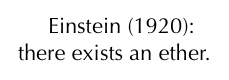
In 1920, he stated the following
about the ether: 'There can be
no space nor any part of space
without gravitational
potentials", and
next concluded with: "Recapitulating,
we may say that according to
the general theory of
relativity space is endowed
with physical qualities; in
this sense, therefore, there
exists an ether.
According to the general
theory of relativity space
without ether is unthinkable;
for in such space there not
only would be no propagation
of light, but also no
possibility of existence for
standards of space and time
(measuring-rods and clocks),
nor therefore any space-time
intervals in the physical
sense. But this ether may not
be thought of as endowed with
the quality characteristic of
ponderable media, as
consisting of parts which may
be tracked through time. The
idea of motion may not be
applied to it.' (lecture,
University of Leyden). General
relativity thus implies the
existence of an ether. However,
Einstein disagreed with the
absolute concept of time
associated with the ether as
described by Hendrik A. Lorentz
(1853-1928). Before Einstein,
Lorentz had said, "One cannot
deny the bearer of these
properties [the ether] a
certain substantiality. If so,
one may modestly call the time
measured by clocks fixed in
this medium true time and
consider simultaneity a
primary concept." The
ether is actually just empty
space, which we normally know as
a limited gravitational force
field, such as that of the Sun
("curved space"), the
Milky Way ("ethereal space"
or "the Force"), or the special,
unlimited, and, according to
Hubble's so-called redshift of
the light spectrum, endlessly
expanding intergalactic space ("spacetime,"
or the original space or ether -
without the time differentiation
of linear versus cyclic time -
of undifferentiated matter just
after the Big Bang; in Sanskrit,
according to the oldest
traditions, called pradhâna).
Thus, there are different types
of relativistic ether and space.
The three main forms of ether,
which differ by locality, are
known in the Vedas as the three
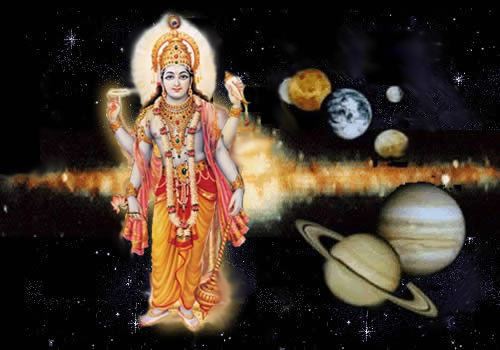
forms of Vishnu:
Kāranodakas'âyī Vishnu,
Garbhodakas'âyī Vishnu, and
Kshirodakas'âyī Vishnu. With
this, our primary thesis that
derives from the Vedic concept
of order has been confirmed.
Before this, Empedocles
(490–430 BCE) said, "By the
aether, the aether
divine ,"
but the truth of this element
being essential
to the concept of the
soul
was already acknowledged in
Sanskrit culture. Now, enough
about this.
Considering
the community of physicists who
were in denial about the
relativistic ether as Einstein
later stated it, it can be
concluded that there is a lot of
neglect of Einstein's theory
among natural physicists, even
using his name to defend their
denial. Einstein evolved as a
good, self-critical scientist
should, and thus, we can accept
him in the end, filognostically,
knowing the error as a challenge
for self-improvement. He did not
succeed in formulating a "theory
of everything" and had to
contend with internal
inconsistencies, as did we after
him. The inability to detect
deviations in the speed of light
thus may also be caused by the
earth's movement through the
'ether's energy stream'.
According to Descartes, the
element of the ether would lead
to energy vortices, which, like
something floating down a river,
would not result in relative
motion between the ether and the
Earth. Therefore, there would be
no effect on the measured speed
of light. This position is
defended by people on the fringe
of science who are often
portrayed as pseudoscientists: Nikola
Tesla
(1856–1943), Viktor
Schauberger
(1885–1958), Wilhelm
Reich
(1897–1959), and John John
E.W. Keely
(1827–1898). The latter
one wrote in 1893: 'There
is no dividing of matter
and force into two
distinct terms, as they
both are one. Force is
liberated matter. Matter
is force
in bondage'.
These
scientists tried to demonstrate that
ethereal energy, or "orgone energy,"
as Reich explained to Einstein, is
very real, even though it is
invisible (see also J.
Medeo).
Considering the modernity of quantum
physics, which also speaks in terms
of indeterminate energy, we may ask
ourselves what factually real
science would be. There is a
paradigmatic struggle, but only time
will tell what is true. Error can be
terrifying (E = m.(T)error²).
Science and politics, like religion
and the state, are only separated by
principle, not in reality. We are
warned about error in science and
matters of the ego, especially in
mathematics, which can stem from
possibly incorrect assumptions, such
as the non-existence of the ether or
imaginary constants. In the
nineties, for example, there was a
news item about astronomers who
thought they had discovered planets
around a star. They later did, but
at that time, the deviation in their
parallax measurements was wholly
attributable to their failure to
consider the equation of time, which
results from the earth's oblique
axis and noncircular orbit around
the sun. Thus, they embarrassed
themselves with a false alarm of
significant results.
The basic
idea behind this doubt is that the
mathematical angle is a reductionist
way of reasoning, in which one can
never be certain of one's subject. since information was
lost in the reduction. In an
equation, the term "A" is not
necessarily the same as "A"
elsewhere in the same equation or in
a different equation. This is also a
matter of relativity and lawfulness.
When A is not equal to A, the
illusion of order suggested by
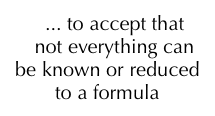
mathematics ends. As psychologist B.
F. Skinner (1904-1990)
states: "One will have to accept
the complexity of the universe and
admit that not everything can be
known or reduced to a formula."
Whether
Einstein is correct or not, and
whether the doubt and
experimentation are justified,
one thing is certain: time, as
the controlling factor linked to
place in what we call
space-time, must be relatively
dependent., the same way
the speed of light depends on
the medium through which it
travels. This constitutes a
second argument against the
politicized relativistic
justification of time zones, in
which time is separated from
place. In other words, using
Einstein to reject the
absoluteness of time, then
declaring that time depends on
the frame of observation or
place, and then using the same
relativistic argument to arrange
time zones that break with
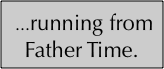
dependency on place is, more
than anything else, an exercise
in fearful, neurotic, and
compulsive behavior to escape
Father Time. Lorentz must have
been right with his local, true
time clocks directed at the
ether, which we at this site
respect, and not
Einstein with his
exception resulting from
the denial of the ether.
One could argue that time
is absolutely relative and
that there is a law of
time stating that time and
everything related to it
must always be different
because of the element of
movement inherent to it.
However, simply
manipulating time
endlessly as a dependent
variable must certainly be
regarded as a form of
denial concerning the fact
that everything, including
matter, is subject to time
as an independent variable
- an agent that, apart
from being creative and
maintaining, is also
evidently destructive.
If we take the
criticism seriously, the
Einsteinian fallacy seems to be
confusing speed with change.
Speed is not an absolute value
like the three sacred basic
elements of physics: space,
time, and matter.
Space-time, which manifests
matter, offers these three
elements, which, as the physical
trinity of God, define each
other and cannot be reduced to
something else. Philosopher D. Hume
(1711-1776) calls them extension,
motion, and solidity in An
Enquiry Concerning
Human Understanding.
Vyâsadeva calls them akâs'a,
prakriti, and kâla.
They constitute each other's
condition of existence in
creation; one cannot think of
one without the others. Time
is the life and movement of
matter in space. Space
is the distance of time,
the phenomenon of gravity.
between material objects. Matter
is the electromagnetic
effect of the influence of
time on the potency of expanding
space; time, which from being
linear, by the law of reaction
became cyclic and thus, in
opposition, transformed gravity,
the primal potency, into solid
matter (be it not
complete, as evidenced by the
inability to find the so-called
invisible "dark matter," which,
according to S.B. 5.20:
38,
covers three-quarters of our
creation).The entire creation is
a permutation of the concepts of
time, space, and matter. For
example, energy is an
electromagnetic phenomenon of
spaced-out matter. This matter
began as hot, energetic plasma,
then condensed into gas and
vapor. Next, it became fluid,
and finally, it solidified into
matter. Light is the least dense
and fastest form of matter. In
the Vedas, it is called "the
glance" of the Lord (S.B. 2.1: 31)),
and Genesis says that there was
light in the darkness. Space is
a gravitational phenomenon that
sets limits to matter, such as
stars and planets in curved
space - the ether that our
radios cover - or the Milky Way
in ethereal space that we can
see with the naked eye in the
celestial sky. With a telescope,
we can see the cosmic time ball
of expanding galaxies grouped
together in the primal realm of
time and space. There, one does
not find actual matter, but
rather the energetic potency for
it. Time is also known in three
dimensions, just like space and
matter. There is the linear
movement of the primal
substance, which we find in the
expansion of the cosmos; the
movement of matter, which spins
around mutually attracted in a
galaxy; and the movement of the
"timeless" but living soul
through space-time, which
constitutes the negation of
matter. False identification
with the inauthentic person
forms an ego. Space, the
relative phenomenon of
gravitation, is the ether.
Matter is the electromagnetic
manifestation. Time is the life
of it all. This is the physical
basis of a perceivable, complete
whole for all our arguments.
- "Thus
he then classified
living creatures
into genera and
species, and divided
them in every way
until he came to
their elements,
which he called the
five shapes and
bodies, aether,
fire, water, earth
and air."
Xenocrates
on the life of
Plato
|
As
for Einstein's erroneous
supposition, the speed changes
as everything else does when
subject to time. That is the
law of time: change is
absolute, not what changes.
Change stays change, even though
it changes. Space or ether stay
space or ether, even though they
are situated elsewhere. In the
end, matter also turns out to be
absolute as an electromagnetic
phenomenon of energetic
contraction. Without this
phenomenon, the first two carry
no meaning, even when it is as
thin as light. Something that
appears to be invariable and
constant, such as a quasar, is
an illusion. It once came into
existence and, according to the
law of time, will cease to exist
at some point, so it does not
exist absolutely. Therefore,
even though we accept Einstein's
commitment to the relativistic
ether, he cannot lead a
responsible philosophical plea
for a certain order of time. We
must build on the absoluteness
of time and change, which exist
as the eternal life of all
matter in space.
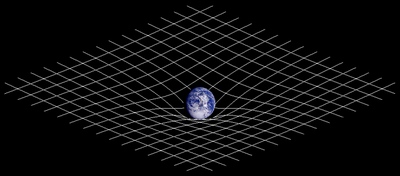
The
reasoning is methodical and
consistent. The counterargument
to the idea that time is
absolute is that declaring time
to be relative and dependent
does not exclude the possibility
of its absolute reality as an
independent variable. Or,
as Immanuel
Kant
(1724-1804) would say in a
dualistic manner, time itself,
unknown in its full glory, is
not factually dependent on your
existence to exist, according to
the French philosopher Henri
Bergson(1859-1941).
Time itself, as you experience
it, is essentially
uncontrollable, despite all
politically and pragmatically
inspired manipulations, as
discussed by the existentialist
Martin
Heidegge
(1889-1976). Time, when lived
and controlled, implies, as
Hegel knew, the realization of
estrangement when one must abide
without the scientific virtues
of validity and reliability.
This is evident in the modern
arbitrariness of standard time
since the French Revolution and
its failed time reform. In
conclusion, time is an absolute
of change and a determinant of
the ether as a form
of God, as the oldest
culture of India has
axiomatically defended. Our
general thesis is that the
self-determined conditioning
order is naturally relative and
possibly of a good or bad
quality, which we can discuss.
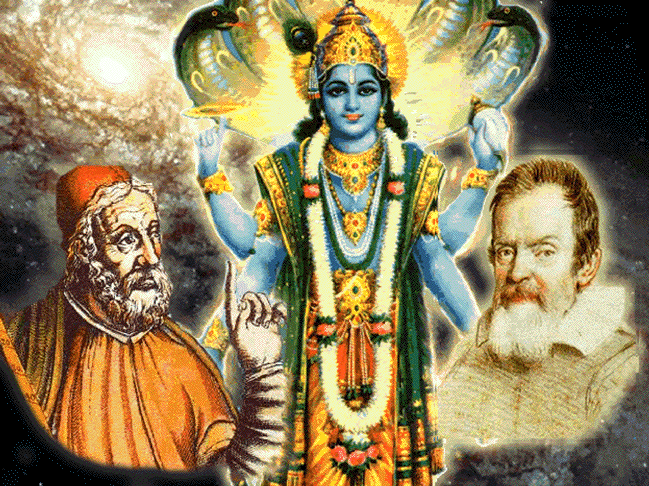
Summarizing the general thesis
of filognosy then amounts to
time as an independent godhead,
force or order, that since the days
of yore, the way we know it from
India, is present as a, for the
creation, maintenance and
destruction, all-determining factor
in our lives. The antithesis of
relativism concerns the pragmatical
need for a knowable, existentially
livable, controlled time, we have to
consider as being relative. Facing
the two positions of the natural
absolute of time and the cultural
relative maintained thereto, we thus
arrive at the insight that we are
dealing with a paradigmatic matter
which compares to the classical
difference between geocentric and
heliocentric thought. First we
thought that we according Ptolemaeus (87-150), with God
and Jesus on earth, were the center
of the universe, and then we
thought, since the bravery of Galileo
Galilei (1564 -1642) who to
the ideas of Copernicus (1473 - 1543)
contested geocentric Rome, that the
sun was the center of the universe,
and thus found our new era of
scientific enlightenment. With the
progress of astronomy we next discovered
our place in the galaxy, and now,
being tired of the politically
divided and quarreling - but still
predominantly - heliocentric
oriented sciences with their
compensatory relativism, it seems
that with us taking seriously the
differences of the light speed that
in inconclusive experimenting were
found in the absence of a conclusive
paradigm, we, together with the sun
indeed are moving through a medium
called the ether. May the Force be
with us, for we have arrived at
galactocentric thinking - the
new paradigm of the 21st
century. This paradigm defines
us as beings moved by an
all-powerful force that controls
the Earth, the Moon, the Sun,
and the rest of the stars. This
force moves us in a galactic
whirl about the black hole at
the center - the mountain Meru
of Vishnu and Brahmâ - the eye
of the universal storm created
by the holy and absolute Force.
This Force is the Absolute of
Galactic Cakra (cyclic) Time,
and it is known as the ether -
the first effect of creation (Brahma
Sutra Adh2.P3:
1-7).
Sage Vyâsa describes the
evolution of the ether as
follows: "From identification
with the darkness of matter
and transformation to that
mode, the first element of
ether developed with its
subtle form and quality of
sound, indicative of both the
seen and the seer" (S.B.
2.5: 25). In S.B.
11.15: 19,
he states that the Lord is the
personification of the ether. In
S.B.
3.5: 32,
he states that the ether is the
symbolic representation of the
Supersoul, God's localized form,
who is impersonally known as
Time. Regarding the concept of
time, he states in S.B.
3.26.34, "As for its
action and characteristics the
ether is described as the
element internally and
externally giving room to the
living beings and as the field
of activities of the vital air
[prâna], the senses and the
mind.." According to
Vyâsa, the ether refers to the
"timeless" self of consciousness
and the time-bound reality of
the outside world.
Therefore, also
in consideration of the
spiritual department, there isa
relative ether.
'For
a
truly
joyful and auspicious
human work to
flourish, man must have
the capacity to climb from
the depths of his
attachment at home up to
the ether. Ether here
stands for the high flight
of the high heavens, the
open real of the spirit.'
Martin
Heidegger,
'Treatise
on human thought'
|
 With this
paradigmatic shift, we are
faced with the counterargument
that the order of time can now
be discussed in terms of its
paradigmatic qualities and
effects. Just as geocentric
thinking was proven to be
inferior to heliocentric
thought, heliocentric thinking
may now be inferior to the
galactocentric paradigm in
revealing knowledge. In this
and the following sections, we
will explore our filognosy
concerning the order of time
and the ether. This new
paradigm considers the
circular movement of the
stars, Earth, and Sun through
the basic element of the Vedic
culture, of kha or
akas'a, which represents
the force field of the galaxy,
primal space-time, and local
order. This force field may
result in variations in light
speed found in different
experiments. Around 1920,
Einstein said that he had made
a somewhat radical judgment in
1905 about this phenomenon.
When, with scientific
experimentation, we sum up and
comprehend the entire problem
of modern man, we will have
succeeded in our methodical
purpose and arrived at a new
paradigm for the twenty-first
century. This paradigm resets
world culture to its classical
values and cures postmodern
man of his bewilderment. With this
paradigmatic shift, we are
faced with the counterargument
that the order of time can now
be discussed in terms of its
paradigmatic qualities and
effects. Just as geocentric
thinking was proven to be
inferior to heliocentric
thought, heliocentric thinking
may now be inferior to the
galactocentric paradigm in
revealing knowledge. In this
and the following sections, we
will explore our filognosy
concerning the order of time
and the ether. This new
paradigm considers the
circular movement of the
stars, Earth, and Sun through
the basic element of the Vedic
culture, of kha or
akas'a, which represents
the force field of the galaxy,
primal space-time, and local
order. This force field may
result in variations in light
speed found in different
experiments. Around 1920,
Einstein said that he had made
a somewhat radical judgment in
1905 about this phenomenon.
When, with scientific
experimentation, we sum up and
comprehend the entire problem
of modern man, we will have
succeeded in our methodical
purpose and arrived at a new
paradigm for the twenty-first
century. This paradigm resets
world culture to its classical
values and cures postmodern
man of his bewilderment.
'Therefore
I
thought
in
1905 that in physics one
should not speak of the
ether at all. This
judgement was too
radical though as we
shall see with the next
considerations about the
general theory of
relativity. It moreover
remains, as before,
allowed to assume a
space-filling medium if
one can refer to
electromagnetic fields
(and thus also for sure
matter) as the condition
thereof.'
A.
Einstein in
'Grundgedanken und
Methoden
der
Relativitätstheorie
in ihrer Entwicklung
dargestellt'
|
See
also: references

2-
The Order of Time: structure of
the content
If we
want to discuss the
qualities and effects
of the order of time
methodically, stated in the
preface,
we must pay attention
to science, as well as
spirituality and
religion, out of a
love for knowledge and
syncretism. Syncretic
thinking is the
essence of the concept
of gnosis and teaches
us classical Christian
spirituality. The
online encyclopedia (en.wikipedia.org)
states that, according
to the authority of Gilles
Quispel
(1916), a renowned
Dutch researcher of
classical and
Christian gnosticism,
gnosis is considered
the "third component
of Western culture,"
alongside reason and
belief. Along with
Greek philosophy and
Christianity, gnosis,
which we have known
since the second
century in a Christian
sense, has also
contributed
considerably to
Western European
culture. In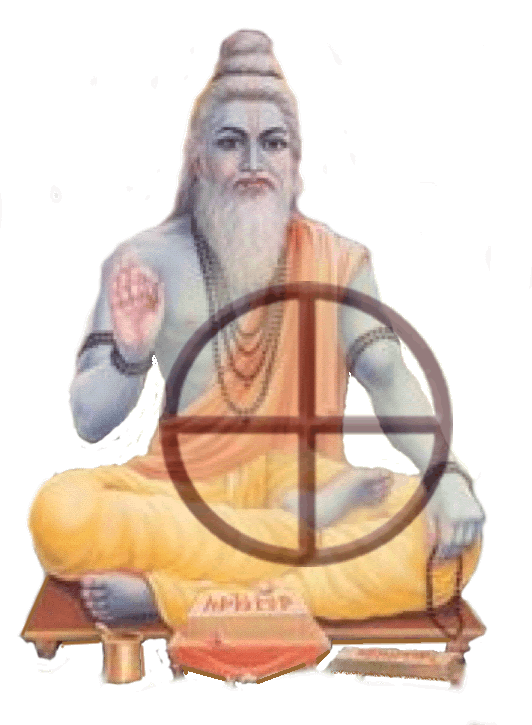 his
Theological-Political
Treatise, B.
de Spinoza
(1632-1677) states,
"Reason rules the
domain of truth and
wisdom; theology rules
the domain of piety
and obedience." He
rejects the idea of a
mutual obligation
between the two, but
we filognostics defend
the notion that reason
and belief are
mutually obligatory.
In gnosis, the bridge
between science, which
methodically uncovers
truth, and religion,
which strives for
piety, is formed by
the interplay of
analysis and
spirituality. Science
determines which facts
and paradigms are
important, while
religion, through the
political
representation of the
populace, enforces
obedience. By linking
the concept of Gnosis
to Vedic culture, we
will present a
worldview that
reconciles all
cultures without
becoming compromised
by any particular
Gnostic tradition. A
gnostic person is
typically described as
someone who seeks an
intimate relationship
with God through
self-knowledge or
self-awareness. A
filognostic person is
someone who loves this
from the point of view
of Vedic truth.
Contrary to the
Western classical view
of gnosis, filognosy
is not secret. On the
Vedic ground of the
succession in a
so-called paramparâ,
however, a personal
transfer of love for
knowledge is
considered conducive
and advised. It is
also important to
maintain
confidentiality and
discretion concerning
the science of the
person. Filognosy is
not polemic or
anticlerical; it is
based on scientific
facts and the Vedic
tenet that human
recollection and the
ability to acquire and
process knowledge are
always limited, so
scriptural authority
is necessary. Contrary
to classical gnosis,
there is no propensity
for anarchy. Rather,
there is a certain
degree of docility
concerning a specific
person of spiritual
authority: the
philosopher of
philosophers,
Vyâsadeva
(c. 3200 BCE). In the
West, he is sometimes
denounced as anonymous
because his name
represents a
collection of sages,
each of whom assembled
the Vedic verses in
turn. Although he
unifies the entire
field of philosophy
and religion, the
evidence to deny his
name is inconclusive.
Likewise, there is
insufficient evidence
of the so-called Aryan
invasion of India,
which would place the
source of Vedic
civilization closer to
us. On the contrary,
it is the Vedic
civilization that
spread to the West.
However, regarding
Vedic culture, we work
with critical
docility.Rather than
simply adopting that Far
Eastern culture uncritically,
we should incorporate it into
our lives in a simple and
unambiguous way, guided by
certain principles, without
losing sight of ourselves as
Christians, Muslims, or people
of other faiths and
worldviews. For some, this may
take on a very traditional
Hindu character; for others,
it may be more of a pleasant
and inspiring philosophical
exercise; and for still
others, it may enrich their
spiritual or political life.
The intention is that none of
our talents or ways of uniting
science, spiritual life, and
multicultural faith should be
lost his
Theological-Political
Treatise, B.
de Spinoza
(1632-1677) states,
"Reason rules the
domain of truth and
wisdom; theology rules
the domain of piety
and obedience." He
rejects the idea of a
mutual obligation
between the two, but
we filognostics defend
the notion that reason
and belief are
mutually obligatory.
In gnosis, the bridge
between science, which
methodically uncovers
truth, and religion,
which strives for
piety, is formed by
the interplay of
analysis and
spirituality. Science
determines which facts
and paradigms are
important, while
religion, through the
political
representation of the
populace, enforces
obedience. By linking
the concept of Gnosis
to Vedic culture, we
will present a
worldview that
reconciles all
cultures without
becoming compromised
by any particular
Gnostic tradition. A
gnostic person is
typically described as
someone who seeks an
intimate relationship
with God through
self-knowledge or
self-awareness. A
filognostic person is
someone who loves this
from the point of view
of Vedic truth.
Contrary to the
Western classical view
of gnosis, filognosy
is not secret. On the
Vedic ground of the
succession in a
so-called paramparâ,
however, a personal
transfer of love for
knowledge is
considered conducive
and advised. It is
also important to
maintain
confidentiality and
discretion concerning
the science of the
person. Filognosy is
not polemic or
anticlerical; it is
based on scientific
facts and the Vedic
tenet that human
recollection and the
ability to acquire and
process knowledge are
always limited, so
scriptural authority
is necessary. Contrary
to classical gnosis,
there is no propensity
for anarchy. Rather,
there is a certain
degree of docility
concerning a specific
person of spiritual
authority: the
philosopher of
philosophers,
Vyâsadeva
(c. 3200 BCE). In the
West, he is sometimes
denounced as anonymous
because his name
represents a
collection of sages,
each of whom assembled
the Vedic verses in
turn. Although he
unifies the entire
field of philosophy
and religion, the
evidence to deny his
name is inconclusive.
Likewise, there is
insufficient evidence
of the so-called Aryan
invasion of India,
which would place the
source of Vedic
civilization closer to
us. On the contrary,
it is the Vedic
civilization that
spread to the West.
However, regarding
Vedic culture, we work
with critical
docility.Rather than
simply adopting that Far
Eastern culture uncritically,
we should incorporate it into
our lives in a simple and
unambiguous way, guided by
certain principles, without
losing sight of ourselves as
Christians, Muslims, or people
of other faiths and
worldviews. For some, this may
take on a very traditional
Hindu character; for others,
it may be more of a pleasant
and inspiring philosophical
exercise; and for still
others, it may enrich their
spiritual or political life.
The intention is that none of
our talents or ways of uniting
science, spiritual life, and
multicultural faith should be
lost 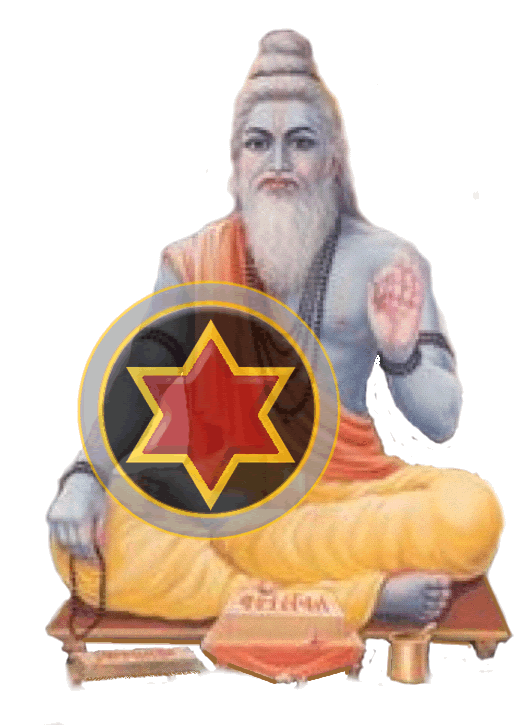 by recognizing
Vedic science as a source of
inspiration and the root of
human civilization. The
doctrinal effort of the
philognostic worldview, as
outlined on this site,
involves, in part, combating
all possible forms of
distortion—or false
unification of the ego—whether
this involves the distortion
of class consciousness,
political consciousness,
religious consciousness, or
the more scientific forms of
arrogance, narrow-mindedness,
and alienation. By the, with
this postmodern restart, of
gnosticism therein having
envisioned a constructive
spiritual reconciliation of
science and religion, there
for each of the three holy
subjects of science,
spirituality and religion
mentioned - which respectively
deal with the facts, the
principles and the respect for
the person - is a duality
which thus at this site
results in a division of six
sections. These six sections
correspond to the darshanas
- or six classical schools of
thought - practiced in India,
which exist to combat the
human tendency to distort the
soul’s sense of self - and
thus also a certain order of
time in relation to the ether.
The Nyâya,
representing the logical
approach in India, was
translated into the
methodological and structural
philosophical considerations
of this section; the Vais'eshika,
representing the more
atheistic Indian philosophy of
unity, was translated into the
figures and terms of sober
natural science; the Sânkhya,
representing analytical
philosophy, was translated
into an analytical section
focused on art; the yoga
of attaining absorption was
translated into the
spirituality of developing a
certain capacity for
abstraction; the Mimâmsâ
of the culture of rituals was
translated into personal and
religious reflections, and the
vedânta culture of
commentaries was translated
into a spirit of political
reform. These perspectives
have the following in common:
1) a continuing self, 2) a
workload, 3) liberation
through service, and 4) a
culture of reference. The
identity and integrity of
filognosy are thus described
in terms of six aspects, much
as the empiricist D.
Hume
(1711–1776) classified
knowledge in his own way (see
further the definition). by recognizing
Vedic science as a source of
inspiration and the root of
human civilization. The
doctrinal effort of the
philognostic worldview, as
outlined on this site,
involves, in part, combating
all possible forms of
distortion—or false
unification of the ego—whether
this involves the distortion
of class consciousness,
political consciousness,
religious consciousness, or
the more scientific forms of
arrogance, narrow-mindedness,
and alienation. By the, with
this postmodern restart, of
gnosticism therein having
envisioned a constructive
spiritual reconciliation of
science and religion, there
for each of the three holy
subjects of science,
spirituality and religion
mentioned - which respectively
deal with the facts, the
principles and the respect for
the person - is a duality
which thus at this site
results in a division of six
sections. These six sections
correspond to the darshanas
- or six classical schools of
thought - practiced in India,
which exist to combat the
human tendency to distort the
soul’s sense of self - and
thus also a certain order of
time in relation to the ether.
The Nyâya,
representing the logical
approach in India, was
translated into the
methodological and structural
philosophical considerations
of this section; the Vais'eshika,
representing the more
atheistic Indian philosophy of
unity, was translated into the
figures and terms of sober
natural science; the Sânkhya,
representing analytical
philosophy, was translated
into an analytical section
focused on art; the yoga
of attaining absorption was
translated into the
spirituality of developing a
certain capacity for
abstraction; the Mimâmsâ
of the culture of rituals was
translated into personal and
religious reflections, and the
vedânta culture of
commentaries was translated
into a spirit of political
reform. These perspectives
have the following in common:
1) a continuing self, 2) a
workload, 3) liberation
through service, and 4) a
culture of reference. The
identity and integrity of
filognosy are thus described
in terms of six aspects, much
as the empiricist D.
Hume
(1711–1776) classified
knowledge in his own way (see
further the definition).

As
stated in the preface,
this linear presentation, which is
required for a book, implies a
causal relationship that must be
put into perspective. In reality,
one thing does not strictly follow
from another. This is why the
interface on the
site’s index page has a more
intuitive layout. Reasoning from
beginning to end, a book and a
website create a perfect illusion
of causality based on a classical
layout. This illusion is not so
much incorrect as it is an
exclusive way of speaking. There
are multiple equally valid lines
of reasoning using the same
elements. Auguste
Comte
(1798-1857), the f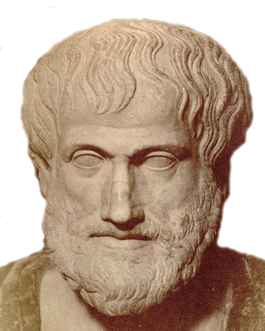 ather of
positivism, reasoned
precisely the opposite of
the filognosy described
above, which resembles Søren
Kierkegaard's
(1813-1855) more.
Kierkegaard's filognosy goes
from the aesthetic to the
ethical to the religious.
According to Comte, one
progresses from theology to
the metaphysical stage of
principles and the concept
of "nature" to the positive
stage of factual reality,
which knows no origin or
purpose. However, the law of
life and time has more
causal directions than the
lines of Comte and
Kierkegaard. As we indicated
in the preface, the end of
one cycle of knowledge makes
way for a new beginning and
the way back: reasoning from
the end to the beginning
constitutes an order found
in intuitive arbitrariness
and an argument that
dissipates from a nucleus,
like a tree structure. These
are equally valid forms of
progressing in causal
reasoning. The Greek
philosopher Aristotle (384–322 BCE)
distinguished four types of
causality in his Physics: substance,
as in "the bronze precedes
the bronze statue"; form,
as in "the form of a horse
is essential to all horses
and the cause that we name
them thus"; doer, as
in "the artist constitutes
the cause of his creation";
and norm, as in "I
stroll for my health, and
that is the cause of my
strolling." ather of
positivism, reasoned
precisely the opposite of
the filognosy described
above, which resembles Søren
Kierkegaard's
(1813-1855) more.
Kierkegaard's filognosy goes
from the aesthetic to the
ethical to the religious.
According to Comte, one
progresses from theology to
the metaphysical stage of
principles and the concept
of "nature" to the positive
stage of factual reality,
which knows no origin or
purpose. However, the law of
life and time has more
causal directions than the
lines of Comte and
Kierkegaard. As we indicated
in the preface, the end of
one cycle of knowledge makes
way for a new beginning and
the way back: reasoning from
the end to the beginning
constitutes an order found
in intuitive arbitrariness
and an argument that
dissipates from a nucleus,
like a tree structure. These
are equally valid forms of
progressing in causal
reasoning. The Greek
philosopher Aristotle (384–322 BCE)
distinguished four types of
causality in his Physics: substance,
as in "the bronze precedes
the bronze statue"; form,
as in "the form of a horse
is essential to all horses
and the cause that we name
them thus"; doer, as
in "the artist constitutes
the cause of his creation";
and norm, as in "I
stroll for my health, and
that is the cause of my
strolling."
In
Vedic logic, we find all four of
these forms of causality embodied
in the purusha as
the soul—the essence of the person
as the principle of creation,
which precedes the ego in creation
as its substance—in the avatâra,
the god who took on human form and
thereby liberated, in kâla
as the doer who moves, created,
and conditioned all things, and in
dharma, the norm of
the necessity of God’s justice,
which is the cause of piety and
the pious person of knowledge.
Likewise, from a filognostic
perspective, it is not simply
stated that (normatively) only
religion - or dharma -
leads to the knowledge of the
spiritual person, since,
conversely, the purusha -
or the (original) person of
knowledge - is itself the cause of
this, according to the illusion of
(substantive) causality that we
here maintain in a linear fashion.
Likewise, the avatâra is
ever-present as a tree of
knowledge from which (formatively)
- as seen on the site’s index-page
- all philosophy, spirituality,
and religion sprout. with Him as
the trunk and core; and there is
also the impersonal aspect of
spirituality in relation to the
temporal factor kâla,
which, as applied in the
standalone articles on this site,
constitutes the (constructive)
cause of intuitive learning. A striking example
of reasoning backwards, in this
case more symbolically, to what
would be the beginning for others,
is offered by the Renaissance
painter, inventor, and scientist Leonardo
da Vinci(1452-1519).
As a principle combining aesthetic
and intellectual motives in an
inventive way, he habitually wrote
and read books, sentences, and
words backwards. This did not, of
course, cover the double sense of
the ambiguity of the four causal
lines of reasoning. Another
example can be seen in movies that
begin with the denouement and use
flashbacks and double plots. These
movies are sometimes cut in a way
that resembles the experience of
someone with a deficient
short-term memory, who does not
know the order of time anymore, as
in Christopher Nolan's 2000
movie Memento.
Contents of part I:
the factual
The first of the
three basic dualities of
filognosy concerns the rational
method versus the empirical
science, to cope with the facts
of life. One speaks of
methodical science: first one
makes up one's mind and next one
engages in an empirically
responsible fashion. In this
department the agnostic element
is stronger
than the gnostic one. With
reason and the experiential data
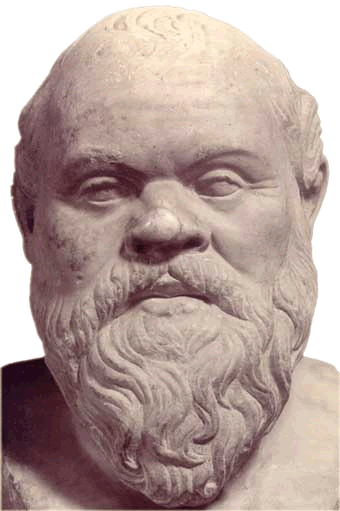 we herein
gradually arrive at the basic
attitude and structure
facilitating a, more to the
principles directed, spiritual
life and a society more
conscious of the person. The
agnostic basic attitude of being
open and neutral to, or else
staying skeptic, as in modernity
is defended by the biologists T.
H. Huxley (1825 -1895), Charles
Darwin (1809-1882) and
the philosopher Bertrand
Russell (1872-1970),
can, in her servitude being just
as commendable as the other
visions, more or less be
considered a precondition to
arrive at essential,
filognostical, knowledge or
knowledge of the complete whole.
It was also Plato (428-347 B.C.)
who, as one of the first greek
philosophers, by mouth of Socrates (470-399 B.C.)
in allegiance to this principle
of science in his discourse The
Defense of Socrates,
managed to state that he was
only sure not to know. It was
that honesty that resulted for
Socrates, as an early Christ of
philosophy, in a cup of poison,
because he, spoiling the young
with it, thus demonstrated that
the power of rule, in spite of
their pretenses, actually also
did not know, and thus was less
wise than he who did know this. we herein
gradually arrive at the basic
attitude and structure
facilitating a, more to the
principles directed, spiritual
life and a society more
conscious of the person. The
agnostic basic attitude of being
open and neutral to, or else
staying skeptic, as in modernity
is defended by the biologists T.
H. Huxley (1825 -1895), Charles
Darwin (1809-1882) and
the philosopher Bertrand
Russell (1872-1970),
can, in her servitude being just
as commendable as the other
visions, more or less be
considered a precondition to
arrive at essential,
filognostical, knowledge or
knowledge of the complete whole.
It was also Plato (428-347 B.C.)
who, as one of the first greek
philosophers, by mouth of Socrates (470-399 B.C.)
in allegiance to this principle
of science in his discourse The
Defense of Socrates,
managed to state that he was
only sure not to know. It was
that honesty that resulted for
Socrates, as an early Christ of
philosophy, in a cup of poison,
because he, spoiling the young
with it, thus demonstrated that
the power of rule, in spite of
their pretenses, actually also
did not know, and thus was less
wise than he who did know this.
Contents of section
1a: the method.
The
method first of all consists
of the charter, which is
described on the
previous page. There, we
become acquainted with the
principles of systematic
proceeding: doubt, division,
complexity, and completeness.
Based on our general
thesis that we can perfectly
depart from the Vedic concept
of order, we then divide this
site. These last paragraphs
are part of the division, and
the elements will later be
subjected to the method. With
this method, we must draw up a
plan of action to investigate
all possible aspects of our
problem in order to
responsibly sustain life with
the ether. After clarifying
this, we must also introduce
the dialectical approach.
The
dialectical nature of the
game of questions and
answers is not just a
fundamental principle of
the philosophy we know
from Socrates and Plato;
it is also a fundamental
Vedic principle of
questioning and answering
in relation to spiritual
authority. In the Bhagavad
Gita (10:
32),
Vyasa, by the words
of Lord Krishna,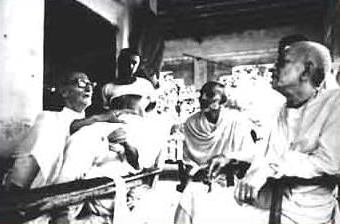 states
that for him, it is all
about identifying with the
dialectics of all
argumentation. In short,
he believes that a person
should be properly
respected with a Socratic
game of questions and
answers. The entire Bhâgavata
Purâna,
the Hindu equivalent of
the Bible, also called the
S'rîmâd
Bhâgavatam
(hereafter S.B.),
consists of a frame story
presented dialectically.
The message here is less
monologue and more
conversation. In a
presentation of a site
that, in response to a
general call for
knowledge, tends to
monologues and discourses,
we present some
correspondence that was
written in response to the
internet presentation of
this knowledge, whether
self-initiated or not,
such as an email-exchange.
The knowledge on this site
also exists in response to
what was presented on the
internet. For this reason,
sometimes more popular
themes, such as those seen
in cinema or politics,
prevail over more
academically demanding
themes. states
that for him, it is all
about identifying with the
dialectics of all
argumentation. In short,
he believes that a person
should be properly
respected with a Socratic
game of questions and
answers. The entire Bhâgavata
Purâna,
the Hindu equivalent of
the Bible, also called the
S'rîmâd
Bhâgavatam
(hereafter S.B.),
consists of a frame story
presented dialectically.
The message here is less
monologue and more
conversation. In a
presentation of a site
that, in response to a
general call for
knowledge, tends to
monologues and discourses,
we present some
correspondence that was
written in response to the
internet presentation of
this knowledge, whether
self-initiated or not,
such as an email-exchange.
The knowledge on this site
also exists in response to
what was presented on the
internet. For this reason,
sometimes more popular
themes, such as those seen
in cinema or politics,
prevail over more
academically demanding
themes.
Next
is a page that clearly answers
the most obvious questions
about the order of time as a
social interaction game. This
game allows us to respect
others in their different life
stages (see the GameWiki
for more information). There
is also a page on the site
with job
openings where different
volunteer opportunities are
offered to serve
filognosy.
As a direct
result of these classical
dialectics, this first section
of the site must offer a social
definition.
What good is all the knowledge
brought together here if we
cannot use it to find our
fellow man in the first place?
For this reason, there is a
separate page dedicated to our
thoughts on what it means to
be social beings.
In
general terms, the cultural
content of The Order of Time
is summarized in this
introduction and the others to
the different sections. Each
section is summarized
on a page containing six
dialogues, which
highlight the most important
issues to remember. To quickly
orient oneself to the subject
matter, it is best to begin
with this "'level
one"
by reading these pieces first,
and then studying the separate
articles. The introductions
have a more general character
and, as preparation for the
specific studies per chapter,
offer broader references to
present-day and historical
societal views and people. The
site itself was intuitively
built up from the different
sections, as if chiseled out,
and can thus be read one step
at a time, like gently sitting
down in a hot tub.
Relevant links:
- Quantum
Aether dynamics Institute by Jim D, Bourassa:
the present day revival in modern
physics concerning the ancient ether.
This site presents the Aether Physics
Model as the third great breakthrough
in science after Dalton's
Atomic-theory and Einstein's
Relativity Theory.
- Modern
Theories of the Ancient Aether : a collection of
articles by maountain man graphics
site.
- Anti-relativity.com: A careful examination
of experimental evidence for and
against special relativity.
- The
Neutral Center and the Aether
Spectrum: This file describes a
long standing view of how aether
creates and sustains all matter and
energy manifestations.
-
Zero-point energy: tapping energy from
the ether with devices. The troubles
of scientific progress; see in this
respect also Equinox:
It runs on water.
- Rethinking
Relativity: by Tom Bethel: 'the speed with
which the force of gravity
propagates must be at least twenty
billion times faster than the speed
of light'.
- Gary Novak,The Truth
about Relativity: 'Relativity is
religion, not science. Physicists
admit there is no logic to it. No
logic; no science.'
- Carel van der
Togt (site): Stellar
Aberration and the Unjustified
Denial of Ether (Pdf)
- Ivrvin
Laszlo: founder of
the Club of
Budapest, wrote the book
Science and the Akashic Field: An
Integral Theory of Everything
posits a field of information as the
substance of the cosmos. Using the
Sanskrit and Vedic term for "space",
Akasha, he calls this information
field the "Akashic field" or
"A-field". (see also videospeech)
- Neutrinos
Prove Einstein Wrong: 'this proved
relativity wrong, because the
neutrinos could change into other
types while traveling at the speed
of light.'
- Yuri M.
Galaev, Two papers (pdf) on
ethereal wind and ether drift.
- Tom Van Flandern:
The
Speed of Gravity &endash;
What the Experiments Say:
Physics Letters A 250:1-11 (1998) This
article
states:
'Recognition of a
faster-than-lightspeed propagation
of gravity, as indicated by all
existing experimental evidence, may
be the key to taking conventional
physics to the next plateau.'
- Albert Einstein: Ether and
the Theory of Relativity an address delivered
on May 5th, 1920, in the University of
Leyden.
- Albert Einstein: Zur
Elektrodynamik bewegter Körper, Analen der Physik 17
30 june, 1905 (pdf-file). English: On the
Electrodynamics of moving bodies.
- Albert Einstein: Relativity:
The
Special
and
General Theory, Einstein's own
popular translation of the physics
that shaped our "truths" of space and
time.
- Albert Einstein: Space-Time - his article for the
Encyclopedia Brittanica in 1926
- (anonymous) Imminent
falsification of Special
Relativity? Article at
ZPenergy.com.
- C-ship:
Relativistic ray traced images: relativistic site
about the Lorentz-contradiction and
the dilation of time.
- Does
Time Fly? Critical article on
relativity and time in general by
Antti Roine, January 15 - December 10,
2005, published in hypography science
forums.
- Hafele
& Keating Tests; Did They
Prove Anything?
- Harry Collins: What's
wrong with relativism? (April 1998) -
Physics World - PhysicsWeb
- Laughing
at the emperor: An education in
theoretical physics today is an
obstacle to thought outside the box.
- M. Consoli and E.
Costanzo, The
motion of the Solar System and
the Michelson-Morley experiment (pdf-file, 26 Nov.
2003).
- Michaelson and
Morley: On the
Relativity Motion of the Earth
and the Luminiferous Ether. American Journal of
Science. Pdf-file of the 1887 paper
presenting the results of the
Interferometer experiment.
- The
ether rediscovered!An article that
resurrects the Michaelson-Morley and
others, interferometer experiments. It
mentions Consoli and is also
suggesting that Einstein nicked
Lorentz's theory. New Scientist
Magazine April 2005.
- Relativity
Challenge: Reveals mathematical
mistakes in Einstein's Special
Relativity equations. It also presents
the theory of Complete and Incomplete
Coordinate Systems.
- Relativity
in islam: site claiming that
the Quran has defined the speed of
light, time dilation, black holes and
wormholes.
- Paul
Davies: the website of the
australian astrobiologist claiming the
light speed would have decreased in
our cosmic history.
- Wikipedia on the
Michaelson-Morley experiment.
- Physics -
On Absolute Space (Aether, Ether, Akasa)
and its Properties as an Infinite
Eternal Continuous Wave Medium.
- Aether
Theories - Collation of Modern
Scientific Theories of the Ancient
Aether
- FAQ on
the Aether
- R.F. Norgan: Einstein
was
wrong:
the Aether Theory argument
- Alfred Evert
Ether
Physisc and Philosophy: an alternative view
considering evrything a transmutaion
of the one original element of the
ether.
- Vortical
Dynamics: ether - page on an
alternative view of vortexing ether
explaing why there is no effect
measurable in the lightspeed and
cyclic time is essential to it.
- James
Medeo, A
dynamic and substansive
cosmological ether (pdf).
- Prof. Fred L. Wilson
(Rochester Institute of Technology )
Science and Human
Value: Aristotle. Page at Windows
to the Universe, describing the
inference of ether as known from
Aristotle.
- Aristotle-
on the soul
- Matter is
made of waves: site building on the
concept of the aether.
- Space-time
distortion proven: a recent
article by Anushka Asthana and
David Smith, Sunday April 15, 2007
in the The Observer.
Off-line:
- M. Consoli, E.
Costanzo: From classical to modern
ether-drift experiments: the narrow
window for a preferred frame.
Physics Letters A, Volume 333, Issues
5-6, 13 December 2004, Pages 355-363.)
- Einstein's
1912 Manuscript on the Special
Theory of Relativity.
- Ludwik
Kostro: Einstein and the Ether: Although
Einstein is widely credited with
abolishing the ether concept, he
actually introduced a new relativistic
ether in 1916, developing the idea in
his later works.
- Articles in the dutch
newspapers:
- Sneller
dan de Lichtsnelheid: Artikel
over Daniel Gauthier door Anouck
Vrouwe 29-10-'05, Algemeen Dagblad.
- Een tegenwind
steekt op voor Einstein. Een
artikel door Martijn van Calmthout
over Maurizio Consoli en het
experiment in Düsseldorf.
Volkskrant, 6-08-2005.
- Albert Einstein
gaf de natuurkunde in 1905 met de
beroemde formule E = M x C2 een
geheel nieuw fundament.
Maarten van Rossem naar aanleiding
van het Einsteinjaar 2005. 7-1-2005,
Het Parool.
- Lichtsnelheid.
Prof. dr. C. Dullemond preciseert
het argument van de koppeling van de
lichtsnelheid aan de
fijnstructuurconstante. 24-08-2002,
NRC-Handelsblad.
- Albert
Uiteraard (Gerectificeerd):
artikel van Martijn van Calmthout
met een overzicht van Einstein's
leven en zijn ontdekking van de
relativiteits-theorie. 22-1-2005 de
Volkskrant.
- Wat was de
vraag ook al weer? Martijn van
Calmthout schrijft 11-06-05 in de
Volkskrant over de moderne fysica
die de weg in feite kwijt is.
- Een grote bek
tegen Einstein en de rest. Een
artikel door Martijn van Calmthout
over de strijd van de natuurkundige
João Magueijo tegen de
lichtsnelheids-mythe. Volkskrant,
17-5-2003.
- (Dutch) Vincent
Icke: Niks Relatief:
Het verhaal van een gelovige die
nogmaals probeert de theorie van
Einstein uit te leggen. Gepresenteerd
in korte bondige taal en even zovele
formules. Uitgeverij Contact dec 2005.
To the
images:
-
The two half photos of Albert
Einstein with a question- and
exclamation mark: Einstein more or
less clear in his mathematical
formulations, but questioned by the
research findings.
-
'A Philosophers Lesson' ca 1766
Oil. The painting pictures the lesson
of the philosopher always referring to
the truth of the measurable universe
and it's time. It is of the englishman
Wright of Derby (Joseph Wright),
1734-1797 (see
further discussion).
-
The Vishnu between the planets
signifies the relationship between the
vedic point of view and the modern
concepts of a threefold relativistic
ether
-
The little ball in the net is an image
of the earth making a curve in space-time;
the earth is thus also influenced by
the primordial ether.
-
The collage underneath shows
Ptolemeus of the geocentric paradigm,
left, with Galileo Galilei on the
right who brought the heliocentric
perspective, and in the middle Vishnu,
the Hindu-godhead who is seen as
Vâsudeva, the god of the celestial
sky, with the cakra in His hand, the
order of cyclic time as one of His
weapons. Ptolemeus refers to it,
Galilei found in his truth his support
and Vishnu himself stands for the
classical truth of the galactocentric
way of thinking.
-
The whorl is a photo of a galaxy in
cosmic space.
-
The two pictures of the sage show Vyâsadeva,
the Lord of Philosophy, who first
together with the writer of this takes
up the gnostic cross: the burden of a
conscious confession to a certain
order of time, with next Vyâsa with
the Cakra-symbol representing the
order of time and the six points of
view of the filognosy as the result of
the order found.
- The first bust is of
Aristotle, the second is that
of Socrates.
-
The photo underneath is of Swami
Prabhupâda, the preacher of
vaishnavism, the vishnu-order, in the
West, seen conversing with his
godbrothers from India.
Click on the white triangle below to
proceed with the interface for this
section, or use the red arrow button
to have a linear walk through the
site.
|



|