Synopsis
The Order
of Time Summarized
René
and
the Time of His Life
'Six dialogues
between René, the seeker of happiness
and Aadhar, the teacher of filognosy.'

 Introduction Introduction
So
René went to the Scientific School of Magic and learned many
spells and skills to be in control of his life and destiny. But he was
dissatisfied. There were a few things he still didn't know. He didn't
really know how to sustain his happiness or to find a lasting closure.
He didn't know how to be fearless either, nor did he really know about
his own name. In other words: René, though being challenged for
his skills by his education, still had to find the Time of His Life.
So let's start with the name. The
seeker of happiness asks the questions and Anand Aadhar, his alter-ego
in the form of the in the West raised yoga practicioner, gives the
answers.
What does my
name René mean?
René, a french word for being reborn,
is called dvija in Sanskrit, which as well means the being
reincarnated as the having started a new life within this life. Having
a new life also implies that one reorients. For that purpose we have
these conversations.
And now fearlessness.
How does
René become fearless?
Taking initiation by this inquiring with a
representative of the yoga discipline like me, has he, in order to
become fearless, to develop another state of mind. In fact he needs to
find comfort within himself in such a manner that he sees that to the
basic three of the reality of the soul making up 1) the fields of his
action, 2) the principles of his conduct and 3) his life game within
the societal order, all people properly coordinate in leading to a more
stable form of consciousness. To be fearless he has to find the peace
of that state of mind that to actions, thoughts and words 1) doesn't
let him down in action doing his thing, 2) doesn't leave him in the
dark of ignorance in times of trouble, and 3) doesn't betray his
confidence, not even upon death. In other words: he must find a time of
living that cannot be defeated by anything. Thus he finds meaning and
is he, rid of his fear, capable of facing any challenge.
Next happiness.
So how is
René happy then?
For the sake of his happiness he needs to
follow a post-graduate course with the Master of Filognosy named
Aadhar, his alter ego, a spiritual teacher representing the Lord of
Yoga who helps him to find his way in society with the magic of his
science and be comfortable with himself and others. Filognosy
constitutes the to the western mind adapted science of finding and
keeping love for that type of knowledge which makes oneself, being
engaged in service, happy and makes others, that are of a likewise
respect, happy too. In fact the two cannot be separated. Filognosy
defines the reality of the soul, and concerns not just the knowledge of
school books, wisdom, spells and ancient arts. No, it is the science of
finding love for the method, the facts, the art, the transcendence, the
person, and the defense of the cause of having a good time with all
people together as a society.
The course 'Filognosy or
the Order of Time'
So what does
the curriculum consist of?
René, it is divided in three with each
two sections.
-
I Science:
- Section
a: Sobering-up; to become free from illusion in facing the
essential facts of time.
- Section b:
Field-control; to develop balance in the different fields
of action.
-
II Spirituality:
- Section
a: Emotional
Expression: to manifest
himself analytically responsible with a proper insight in matters so
that he with an art-form like singing or painting thus also may find
his inner balance.
- Section b:
Value
control: to control basic
spells - also in the sense of periods of time - for personal stability
and well-being and meet the conditions for endurance in function.
-
III The person
- Section
a: Identity
control: to play the game
of order so to find and live your life's mission.
- Section b:
Rhetoric: what you must say to others in order to
promote and defend the cause.
Are you ready? Pick a section, and I, Aadhar,
will explain it to you, René, in the dialogue to it of us
discussing the duality of the threefold of filognosy as mentioned,
which constitutes the comprehensive approach of spiritual knowledge
that vedically is called the 'darshanas' of the 'âtma-tattva':
the
visions of the reality of the self, the perspectives on the
principle of the soul, the six forms of spiritual love for the
knowledge that you need to be happy and lead others to that happiness
too.
 Dialogue one I-a: Sobering up Dialogue one I-a: Sobering up
To be free from illusion
René, you have to face the facts of life and the material
universe. You have to see them as they are. Before doing anything,
before taking a decision, just take a good look to make sure what you
are dealing with.
So what
about the subject of illusion and time?
Dear René, time is the life of the
universe consisting of the holy trinity of physics: time, space and
matter. Time makes dull matter alive. In fact is everything in
existence alive, not only moving beings and nonmoving one's like
plants, but also stones have a life although it's a bit of a dull life.
If you take a careful look deep into so-called dead matter you'll
discover that it is just hard energy, energy frantically buzzing in
itself so that it is hard. Soft matter of living beings is more
dynamic, more relaxed, more vital, more responsive, but also of a more
temporary form: it obeys the laws of time in a certain way; a way that
is programmed not just by an eventual culture, but that is built into
the genes of all beings, into the very cells of all the bodies, just
like a program is installed in a computer. This programmed life we call
conditioned life because it was generated and fixed by conditions in
the past and so constitutes the adaptation of the organism to it's
environment. Part of the conditioning belongs to the hardware of the
body and cannot be changed, it is responsible for the form of your body
and the basic functions. Another part, the cultured part, of it was
learned during one's lifetime and is more amenable, like it is with
taking cereal or a roll each morning; you have the choice. Nature
controls you, nurture you can control. Thus are, to a certain degree of
our own control, all of our lives conditioned, from the lives of single
plants to the lives of entire planets. But we are not simple machines
that are preprogrammed and self-programmed. There is position of a
certain indeterminacy in our material existence too. We so thus have
some freedom to oversee our lives and intervene on that level of norms
and standards. We at any moment may decide to what lead we take with
our for the rest pretty much in behavioral patterns fixed vital matter
and genes. We may so be concrete as material forms doing material
things or we may be engaged in more abstract matters that lie closer to
the behavioral program and the authority of the programming that has
control over us. The latter position of the core-interest we call
metaphysical, transcendental or risen above or beyond and with that we
will deal in the next set of sections of part two of our curriculum
concerning the spiritual. Let us first take a look at the ways and
problems of our straight material existence.
What are
these problems?
Dear René, we like to be alive and move
around, but because of our free will things are not as certain as we
would like. Your fellow man may distance himself or have an accident or
end up in jail doing the wrong things, or may not be that good as a
fellow man at all: he may abuse or neglect you and not treat you
respectfully or accept you the way you are. And also your friends and
intimates may betray you out of selfishness or give you trouble with
lies, violence, greed and abuse. Of course you must be educated and
capable of meeting challenges, and thus you are in need of support, and
that need to be in control from your side is one problem. Another
problem is that relatives, friends and outsiders on their turn also
need to be educated and thus are in need of support to be in control
with acting properly and respectfully. And so do these lessons also
apply to them. On top of that does the greater of nature also give
problems like with heat, cold, floods and earthquakes, and so must also
that problem also be accounted for.
What causes
these problems?
Dear René, the problems we human beings
may have are there because of illusion: we do not see the things of
matter and life always as they are. We do not right away see that just
serving the body and not the soul of the metaphysical nuclear interest,
means that one has no good direction then of one's behavior and that
one neither has a coordinated and safe society of self correction one
may thus rely upon. The reason for this thus is the material desire;
people want to have it different as is indicated from the nuclear
interest. One is then, with the superficial of only living by the
matter missing the quality of the soul, dissatisfied or bored, annoyed
or lusty and so we may find ourselves doing things that we shouldn't
do. Of course should wrongs be corrected, and so can dissatisfaction,
boredom, annoyance and lust be justified. Sometimes it is good to do
things different and correct oneself, but sometimes is it, bewildered
by the material interest forgetting to what norm we would have to
correct, not so good and leads it to disaster, chaos, mayhem and even
war; to even more dissatisfaction, boredom, annoyance and lust. Thus
humanity can find itself on a downward course leading to hell. One can
go from bad to worse or find the right path back again. So, not to end
up wrong, we must be sure of having a good plan to serve that nuclear
interest of the soul, to be sure that we see things correctly so that
we may respect the facts of life as they are and so are able to take
the right decisions.
What is the
correct way of looking at the things of life then?
Dear René, we have scientific
guidelines, moral guidelines and religious and political guidelines. In
these first two sections we deal with the scientific ones. There is, in
science, first of all a method we need to follow to make sure what the
truth of things is. This method consists of first determining a subject
of study, let's say dogs: 'I like dogs' e.g. You can next say what the
problem is with dogs, e.g. that they bite and bark and have to eat
other animals. These are called the thesis and the antithesis exposing
the problem we want to study. Next there is a counter-argument needed
to solve the problem: dogs must be on the leash and cannot be allowed
to kill for their food, we must do that for them. Then we may draw a
conclusion: yes it is possible to love dogs and keep them as pets,
provided they are properly taken care of with you having nothing
against killing other animals for their food. Next we can summarize
that that is maybe so for all other animals: yes we can keep animals in
general provided we take proper care of them, but dogs and cats
actually not thus if we are vegetarians that do not want to kill
animals. Thus have we by weighing arguments and counter-arguments found
out about dogs. So let's now extend this argument of the method of
arriving at the truth to the subject of life in general. Life in
general, we saw already with the first question, is characterized as a
function of time. Time tells whether we have a life or not. No time, no
life at all. Time is thus fundamental to the matter of life. So to
answer the question of looking at life correctly we engage in a
systematic fashion along the lines of the method we discussed with the
dogs. So first we say time is life. The problem is that time also puts
an end to our lives and because of that we have to live in fear of
dying and thus eventually hate and fear time. The counter argument now
is that time is not just linear from one moment to the other leading to
death, it also makes patterns: the conditionings we talked about
previously. These patterns, laid down as records of time in our genes
and our cultures, show that time is not just a killer but also a maker,
a creator; time is like a form of God responsible for the order of life
of all living beings. This is classically respected with the dictum 'as
above
so below'; as the order of time is in the sky, thus is it
created on earth. We must also add to that that time linear and cyclic
as it is, also has an opposite of timelessness which we call the
experience of time or the consciousness of time. The conclusion then,
to make from a thesis/antithesis and counter-argument the following
third step in the method, is that time is indeed destructive and
fearful, but that we can live with time for its positive properties of
conditioning and consciousness offering us the certainty of structure
and the awareness to make choices. The summary to conclude the method
is that time and life can be appreciated with a proper division of
respect, if we properly discriminate between the different forms of
time. Not doing so we would be in the illusion that time and life just
being linear are useless and all bad meaningless would be leading to
death only. Not seeing the reality of this threefoldness of time we
would have to suffer in the fear and darkness of ignorance. And now we
can cope with our times of living as they are, free from illusion. We
sobered up by the methodical respect for the full reality, the truth of
the matter.
Is that all
we have to?
Well, no
René. There is much more about illusion concerning the subject
of time and also more outside of it. But what we now said about time is
the most basic. To conclude to the reality of cyclic time and time
consciousness we have a few more things to investigate with our method.
We didn't talk about the order of time yet. We only concluded to three
different types of time, not to any schedule for respecting the time.
If we want a society of people living in service we need schedules,
agreements on our times of working and sleeping and such. At night for
instance we want no noise and during the day we want our actions to be
useful and effective like taking diner together e.g. Thus we need
clocks and calendars that tell us what date it is and how late it is
with the cyclic of time so that we can coordinate our actions and make
appointments.
So how are
we in illusion or else in respect of the truth with our schedules?
Dear René, to the order of time of the
humans on this planet we have different cultures that complicate the
matter. That is one side of the coin of order. At the other side we
have different references for respecting the cyclic of time as it is
from nature. We can set our days to the moon, to the stars or to the
sun. All these natural phenomena together make up, with the forcefield
of the ether, the complete of the natural pattern of linear/cyclic time
and consciousness we cannot really deny not to be beaten by a
meaningless exitence.
So what is
the truth of the cyclic of linear time and its consciousness?
Dear
René, let us apply the method again. Like we did with the dogs
and the division of time in three. Now as our thesis we have the order
of time as our culture of respect and that's what we like. The problem
posed to it in opposition is that that culture of our calendar and
clock might be of illusion since we deviate from other cultures and
from nature with it, and that we thus are not firmly rooted and engaged
down to earth and to our fellow man with the matters of time on this
planet as they are. The counter-argument next is that it is not such a
problem at all since we can tell the difference, correct a clock and
leap a calendar, talk it over in politics, or perform a ritual of
respect to fight the offense of disrespect. The conclusion we then may
draw is that our preferred order of time it's possible illusory effect
can be fought with a clock running to the sun and a calendar running to the moon, as well
as by political or philosophical debate, by religious exercises of
respect and by the conscious comparing of two calendars and clocks or
by comparing those indications to the actual positions of sun, moon and
stars. The summary is following that all the cultures of time on this
planet with each their own habits of time management may find a common
order in science offering clocks that run to the sun for the sake of
validity, in religions that remind us constantly of the original nature
and the necessary morality to it, in political debates that fight
illogic, unreason and estrangement in compensation and by multicultural
tolerance and mutual respect that permits Muslims to bow to the sun and
Hindus to celebrate to the moon while the Christians celebrate the
dates of Christmas and other holidays on the solar calendar. In the
last section we will further expound on the subject of time politics.
As for now have we with this methodical investigation into the truth of
the order of time thus uncovered the way to fight illusion in general
and live in peace despite of our differences.
And how
about the timelessness in experiencing time?
With that subject we will deal in the next
division of spirituality and the person, dear René.
How exactly
should we do this what you told us without a scientific training in
astronomy, theology, philosophy and politics?
Dear René, to check the time of nature
we have sundials and a tempometer on the internet to check the position of sun out, we have
calendars that tell the lunar phases so that you can be regular to the
moon if you want, and to the stars we have a time on the calendar -
which at the moment GMT is the night from the 6th to the seventh of
July - demarcating the dynamic point in the celestial sky around which
all the stars revolve in the galaxy. This time on the calendar that can
be called the galactic new year of the time at which the earth is
closest to the galaxy center, shifts with about 20 minutes a year ahead
through the calendar (the so-called precession of the equinox). The
stars can thus be celebrated with an annual holiday collectively or
individually with your birthday that each galactic year then falls
about twenty minutes later. Thus we can be of an astronomical respect
for the sun, the moon, the stars and the force field of the ether
keeping them together. As for theology we have churches, temples and
mosques with trained theologians to tell and teach you all about the
respect that would be needed in this to live for God. Concerning the
philosophy we have paradigms or thought models of science ruling the
universities and other institutes of education and for the political
respect we have political parties to organize the debate about this all.
And are
these different option of time-management all equally good or is there
a certain preference?
To accord with nature, the original reality of
time that by evolution shaped our life, saves one the energy of the
compensation needed in case one does not accord. Think of work-shifts
in commerial enterprising that allow people in a family or early
relationship less of a life together when there's someone snoring all
the time, or that exhaust someone sooner if one must change from a
day-shift to a nightshift. But to have more energy doesn't mean that
one is better in dealing with it. So did e.g. Islam not succeed in
conquering Europe at the end of the Middle Ages, while they did accord
better with the sun and the moon than the Europeans did who christian
wise burned heretics of sun- and moon-worship at the stake. It is so
that in compensations like bridging matters religiously, politically or
scientifically, with rituals, discussions, and paradigmatic treatises,
one may develop a lot of good qualities and efectivity. But given a
certain uniform, good will with the options available in timemanagement
and the need of an efficient approach, one could say that - like
preventing being better than finding a cure - to accord is better than
bridging and that, to stick to our examples, Christianity is not as
easily done with Islam in this respect as it might wish.
What's the
magic I've learned here?
Dear René, that you don't have to
perform any magic trick to be in control with yourselves and with the
matters you have to deal with, but, better engaged, can experience
great satisfaction in filognosy, the love to know, comprehend and act
to the benefit of all living beings.
Can I be
happy simply countering illusion this way?
Dear René, life can offer you
challenges and make it difficult for you to be happy, but holding on to
this lesson for yourself is happiness within reach, provided your
acceptance that in this filognosy, this love for knowledge, there are a
few more lessons to learn indeed.
Dialogue
two:
I-b Field-control
This is a
scientific class about facts. The fact that matters after the
methodical concerns about time in the previous section in filognosy is
the fact of the so-called fields of action. To fill your calendar it is
important to develop knowledge of and balance in the different fields
of action.
What are
those fields?
Dear
René, please take a good look around you. Observe the facts of
material life. As you see there are private homes and there are shops,
theaters and pubs down town. There are also meeting places ruled by a
certain concept of association: clubs for sport, houses of prayer, song
and music, respecting nature a certain way and so on, and there are
also offices, schools, factories and other places where people do their
work. These different material buildings in your town are thus
recognized as the four fields of action that you have to count with in
your life.
Count with?
You have to
literally count with them. You have to figure out on the clock and the
calendar when to do what since you can't afford to miss and fail in any
of them of you want a full life. The idea is that in your life, in
order to be full and complete, you must consciously plan your actions.
This is because you live with others. Alone you can be spontaneous,
together you must manage to appointments of time. That is the so-called
mûrti, cross, the trouble, you have to carry as a sacrifice for
your own good. It is required for your filognosy, your physical and
mental happiness and health to the different perspectives of life thus,
that you will not be frustrated missing anything of life. Let no one
tell you that any of these fields would be bad, off limits or condemned.
What is the
order behind it, what is the essence of each of these fields?
There is the oneness of life and the manifold
of forms. This is a fundamental twofold division of truth we call the
'basic reality' we have to respect with the ancient dictum of 'oneness
in
diversity'. Just like in the previous class the dictum ruled 'as
above so below' to be in full respect with the facts of life and time,
is this section ruled by this dictum. It is also called the duality of
quantity versus quality. Oneness or to be unified is a quality of
fundamental importance. To be divided within oneself and therefrom in
the community estranged, belongs to the terminology of the
psychiatrist. Now will we further expound on the order of managing the
time in respect of the different fields. The two aspects of the
quantity and the quality of life are known by the two dualities
shipping with it. For the quality there is the oneness in abstract
thought like the idea of God or a shared spiritual ideal opposing the
oneness in the engagement in the concrete of matter and material
actions as the being engaged in activities during the holidays or
actions of one's work. From the quantity there is a likewise duality of
the diversity of the individual of being on oneself opposing the
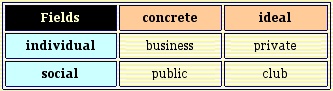
diversity of the social interest of being together. Putting the thus
found four factors in a table you will see the four fields appearing
that we have assigned the four labels business, private, public and
club.
1) The business
field (individual/concrete). As a child your business is attending
school. When you're older your business is making money or doing a
volunteers job in charity to be grateful living on the dole. Whatever
you're good at, this is how you serve or plan to serve your fellow man
and the society at large. This is a cornerstone of your life from which
you find your self-esteem and your sanity. Not being able to act in
this field, people speak of unemployment or else godlessness. Somehow
you must make sense with your servitude to express your gratitude for
what others, including your forefathers, did for you. This is where
you, for a good conscience, even the balance to individually enjoy the
things of life. This interest in the individual of concrete matters is
also called 'the field of the elements of matter'.
2) The private
field (individual/ideal). Sitting at home is an individual position
in which you seek a certain quality in escaping from influences from
the concrete outside world that entices you into competition and
accomplishment. It is the private field that belongs to the ideals of
freedom with which you counter the concrete pressures of a material
life. There you enjoy your family relations, your hobbies and do you
seek and give love, confidence, support, familiarity, and security. In
this individual field interest is where you, with the help of a
religion or philosophy, develop your individual quality: your
intelligence. This individual interest in the ideal is also called 'the
field of intelligence'.
3) The public
field (social/concrete). This is the field of free association. You
go downtown to the market, to go shopping and to sit in a restaurant,
go to the cinema or a theater and meet the people also living in your
community. This binds the people in the society best: to be equal,
moving freely and reciprocally enjoying the services of each other. How
can one serve and expect to be appreciated if one doesn't appreciate
the service of others oneself? This is where the money made is spent
and the friends and acquaintances are made and met. This is where you
party and celebrate in all freedom going wherever you want like during
your vacation. This is the local, national, continental and worldly of
the concrete social interest of you and everybody else. This is also
called 'the field of the false ego' or the, socially confirmed,
personal identification with material matters and communal presence.
4) The club
field (social/ideal). Together with others you need to feed and
strengthen your soul, your reason and moral fiber too; together is the
spirit maintained stronger as doing it all alone, one straw breaks
easily, but a bundle can wipe the streets making a broom. This is the
spiritual, the by a certain set of rules determined, field where people
find the meaning of life in the togetherness of exercising respect in
singing and praying, listening, speaking, eating, dancing, strolling,
sporting and remembering and such. This is where the control is found
from the definition of one's favorite association as being sportive,
artistic, cultural, religious or alternative spiritual. This ideally
conceived interest in social matters is also called 'the field of the
non-manifest' since it is not so clear in what form the spiritual
principles should be respected, because the soul, just as God being the
supreme of it, is found always beyond all material grasp as a presence
in the beyond.
So how do
these fields add up with the order of time we discussed?
Most
importantly, René, one should remember that in order to be
hearty and hale one must keep balance. From the fields above one may
surmise that business matters must be weighed against religious matters
or club matters and that private matters must be contrasted and
counterbalanced with public matters. They both form a contrast of
incompatible opposites. These two dimensions defining the separation of
the fields in time, that together make up the basis of all the fields
of action, thus require that those basic fields are assigned a separate
position in time if we want to put ourselves comprehensively on the
calendar and have an according fullness of life together.
Now we have
two dimensions with one calendar....
Well,
René, actually our calendar is set up dually. Culturally we have
the days of the week contrasting the dates. In filognosy though we
build on certain knowledge, validated scientific knowledge, so that the
days of the week are replaced by likewise days fixed to the moon.
Weekdays as we know culturally are commercially conceived in political
debate and thus uncertain. They do not directly refer to natural
happenings. That is the distinction we have to make in order to be
certain. Though derived from the moon are normal weeks not leaped to
the moon and thus do they not constitute a natural, independent
variable we can count upon. They are, being subject to political
decision making and economic ulterior motives, in fact uncertain in
being manmade and part of a materialistic consciousness that, with only
the pretense of a freedom of choice, constitutes bondage and is thus
not fit for the stability of happiness. We go for the filognostic
consciousness of the scientifically certain knowledge of the positions
of the sun and the moon as they are. We so to speak worship God
preferably directly, rather not by means of 'political demigods'
telling it us different to prove themselves or the money useful. But
still it is, as said with the four options of time-management,
scripturally allowed to worship time by mediation of the at times so
very ugly 'demigods' of the 20th century materialistic and commercial
standard time like there are the warlords Hitler and Napoleon, who are
the 'champions' of respectively taking around and instituting zone time
and mean time in Europe e.g.
Sun and moon
and the fields, how do they add up?
The matters of
the false ego and the private life are associated with the sun. Out in
the bright light of the day one manifests one's body in respect of the
true (demi-)god of that order, the god of the sun. Defying that
divinity one is an heretic of that order and doomed to suffer
instability of motive and consciousness, and that we don't want. So are
private and public matters best settled by the order of the sun, viz.
settled by the dates on the solar calendar. Think of the private and
public birthdays and holidays. Equally are the other two polar fields
of one's business- and club-life best settled to the order of the moon.
The moon is there as a fixation in the sky. It is always fixed on the
earth as the first devotee and leading godhead of that order. Matters
of
club-life are all fixed. A club cannot change its rules lest it becomes
another club. So it resists change and has to be taken as it is or else
be denied. The same way it is with businesses. Each business, each job
agreement is ruled by contract and a business plan. Another plan is
another business. Also that department is as fixed as the moon is. Thus
are the two contrasted on the lunar calendar just like the previous two
fields of the sun were contrasted on that calendar. So we have a type
of order in which business days never coincide with club-days and
private days never coincide with days of public socialization. Playing
golf or tennis together as a business meeting is simply an association
in sport to cover the lunar dimension better; one still separately has
to sit down in an office to check and talk over contracts and sign
papers then. The two dimensions of sun and moon by nature having a
different discrete rhythm do coincide though. Thus can business be
mixed with socializing in public and can the private interest be mixed
with club-life. Also can the business interest be met privately and the
club-life coincide with public socializing intentions. Thus we have a
variegated, dynamic life covering all fields in a stable,
nonmaterialistic but certain respect of time. In the last section will
I also dilate on the timing of your life with these fields in the
context of the regulation of the civil virtues.
And what if
I don't care about that?
Neglect of this necessary balance will go at
the cost of your physical and mental well-being. You will be troubled
by the psychology of consonance that says that all you do is good. Thus
you will defend your imbalance and thus you will politicize going crazy
saying that club-life is bad or that going out is bad or that all
business is bad or that all private matters are corrupt. You then, to
check your madness with your resentment against the balanced life, will
find a political party of nepotism to it that possibly cheats you into
a fake life of living in enmity opposing others that are possibly
equally disturbed in their field control another way. Thus you will
debilitate and lose your synergy, your ability to cohere socially. Kind
seeks kind and in the will for power born from that you will, with the
wrong friends getting entangled, slide down, being tempted into
injustice and make yourselves enemies which will shorten your life
span, steal your luster, and make your phony one-sided life a hell. In
other words you will fall in ignorance and suffer all kinds of
psychological symptoms. Public personalities e.g. often suffer from
this in the loss of their free association; they start hating the
public that they serve but that doesn't allow them a full life.
So all
politicians are wicked asses?
No of course not. The politicians get the
blame because they are responsible for the order in the society. But
the problem is found with everyone. There are good and bad people in
this as you know, but the majority lives a not so pure mix of that
materially motivated ego-passion that may carry such a malicious shadow
and the by the principle motivated soul-given goodness. The politicians
mediate between the wanted and the viable in society. The so often
inevitable problems of the impurity of compromises are professional
hazards, calculated risks to them; but certainly is this problem not
conducive to their stability in office. The democratic rule that mostly
misses the less compromising nobility of a more scientific, personal
and enduring systematic respect for God and His time can also be
regarded as a necessity. We need the democracy in order to neatly rid
ourselves of the less conscientious 'nobles', politicians and parties
who for a while with populism managed to cheat the voters into consent.
The integer ones neatly serve, for as long as they can, a certain
purpose of public interest despite of all kinds of party interests and
other setbacks of being an ego-target. The integer ones do not confuse
the membership of a political party with a function in one of the to be
expected election groups filognostically set up to study, discuss, make
and amend laws for a certain state department or sub-department. The
real purpose of political parties is to serve the filognostic order and
not to confuse the issue by living in secret and overt envy, enmity and
feeble-minded debility on the one-sided options derived from their
imbalanced lifestyles and ulterior motives.
Expected
elections groups?
We will
discuss this option for the legislative order, associated with the
identities of man in his societal game of order, in the later section
of the rhetoric class. As for now you should remember that imbalance in
the fields of action leads to the illusions of political nepotism or to
other kinds of false oneness in pathology or neurosis. The pathology
takes it out at the cost of others, the neurosis doubts itself into an
ineffective spirit missing a firm ground in the full of the human
reality as well as a proper discipline with the soul. The
psychopathology creates victims on a battlefield and the neurosis ends
raving mad being psychotic in an asylum. Thus in order not to harm
yourself or others: always keep the balance in respect of the fields of
action.
O.k.
understood, but, scientifically, how about that leaping with the order
of time?
Leaping is important to keep the schedule of
time tuned to nature, without it one loses touch with the force field
of the ether and becomes one invalid in one's time-respect. One is not
of this planet anymore if one doesn't respect it's order. So, in order
to be firmly rooted here and stable in consciousness, are calendars
leaped, the lunar as well as the solar ones. But filognostically with
the lunar calendar leaped to the sun we have to admit that the solar
year, itself being leaped every four years when necessary, is decisive
and that the lunar year as such does not really exist in the sky.
Therefore we do not leap the lunar order, just like Islam does, but we
either make for a lunar year other than for the socalled lunation of
four lunar phases. 29.5 days is the length of the lunar cycle and its
signal days are traditionally the new moon (roman: kalends),
the full moon (ides) and the half moon (nones), and no
other. That is what happens to be the astronomical agreement called a
lunation. The solar calendar is filognostically, viz. according the
vedic scripture and also according the classical roman order from
before Constantine AD 325, divided with the divisions of the moon.
Twelve months are divided in 24 15-day fortnights which each for
themselves, to our traditions and to the moon, may be divided in two
weeks as we are used to with the addition of an extra day of leaping at
the end of each fortnight. This day we call a cakra day of study and
fasting (next to the other cakra days of labor and free association in
the public sphere) on which it is inauspicious to plan for any material
endeavor because of breaking with the regular order of the week. Thus
do we with the solar order, which we thus call the cakra order, match
with the order of the moon, not having more divisions than are needed
or are provided by nature. One is called a fool when one goes beyond
necessity.
No
foolishness sticking to the bare necessities of a stable consciousness
of time?
Exactly, that
concludes our second talk.
Dialogue
three:
II-a Emotional Expression
It is important to express yourself. Mere
study and knowing give no stability or proper learning. It is the
practice that makes perfect.
Is that why
we talk?
Yes, but talking is not enough. Talking is
very cortical, viz. of the higher regions in the brain, and is ruled by
the repression of emotions from the lower centers of the brain.
Emotions in the mode of passion taking over reason ruin the
understanding if we do not consciously control them beforehand by song
and exercise. It is an individual responsibility of not just
politicians.
The
philosopher must sing?
Right, so it is. There will only be stability
of consciousness if we do not just balance our activities in the fields
of action in the outer world, but also to the internal fields of the
different functions of our brain. Our own body with all its functions
of action and senses of perception requires a balancing in all its
three dimensions: the cortical as opposed to the emotional (the
vertical dimension) the spatial or parallel against the time-sense or
the serial (lateral/ temporal) and the initiative as opposed to the
receptive functions (frontal/occipital regions).
Is that also
associated with the order of time?
Yes René that is so, but this concerns
more your activities with the clock than with the calendar. The day is
naturally divided in a light and dark period. During the light period
we are active and during the night we rest. So there are twelve hours
of action and twelve of rest on the average. The twelve of action need
to be balanced in six hours of service to others and six hours in
service of your own interests. The nighttime is divided in six hours of
sleep, rest for the body, and six hours of doing something at home, to
have no stress for the spirit. Thus is initiative and reception
balanced following the light of the day. This covers the frontal and
occipital regions, the front an back-portion of the brain.
Insufficiently being of action as with unemployment or else
godlessness, may lead to an overactive back-brain which is a mark of
schizophrenia: the brain may then in a psychotic break or
decompensation invent its own illusory action or seek forgetfulness in
intoxication, but then does the imagined not compute with the reality
in the actions: one is factually crazy. Or either too much actions lead
to, as we already saw, pathological abuse of other people or the
greater society; respectively known as psychopathy and sociopathy with
the types of crime belonging to that. Therefore: never meditate by
prolonged watching television during the day. Never, as an adult, sleep
more than six hours. And never work for others more than six hours each
day (36 hour working week of six days of labor is ideal), nor engage in
hobbies or household chores for more than six hours a day. Thus you
will lead a balanced, stable life conducive to happiness.
Conducive?
That itself doesn't make me happy?
Well of course, the order of time, which you
need to be in control and of respect with the force field of the ether,
is just one of the conditions to meet. Let's first try the healthy and
sane of coping with the tricks and pitfalls of time in general and
modern time especially. Culturally we were, in the twentieth century,
not directly prepared for clocks and schedules defying the commands and
dynamics of mother nature who gave us birth from father time, so we
understandably had some historical difficulties with our self-control.
How about
the other two internal dimensions then?
As said is the intellectual of the cortex
functionally poised against the emotional of the lower centers. This
can thus be actively and receptively be experienced as I explained
above. This extra dimension so complicates the matter of keeping
balance, so that one, counting with several factors, easily loses sight
of their coherence. Mentally one can be receptive and active and
emotionally one can be receptive and active. For the quality of higher
thought you therefore must as well read as write and as well listen to
someone as speak to someone, if you want to keep balance. It is like
with the computer: uploading and downloading (or broadcasting and
watching t.v.) or also as a kind of digestion like one has with
breathing in and out or with drinking and eating and then frequenting
the toilet. And emotionally operates the reciprocity command just the
same: you must as well listen to music as go sing yourself or control a
musical instrument, you must as well appreciate another's artistic
accomplishments as go and dance or compose or paint yourself. Not being
successful in keeping balance with this second dimension, will give
rise to problems that manifest as a conflict between your feeling and
your thinking self. Being too active in your mind you may expect
eruptions of your emotional nature, as you can have in a nasty dream
e.g. or, being stuck in lies and excuses, you can have in a fight with
an 'hour of truth' or with an emotional burnout; and the other way
around, when you delve too deep and long in emotions, can that give
rise to mental confusion and compromise your integrity and even lead to
your getting entangled in doing things you never actually thought of
doing - as if you're drunk or when you can't be yourself - because you
insufficiently count with the factual and too much act on your
impulses, nor weigh your arguments properly then. So is it, with the
fourfold division we discussed the other minute, wise, for this extra
dimension of being physically/emotionally and mentally engaged, to
further divide your day. And so you may picture yourself a fourfold
division of as well your active as your receptive period:
receptive/reactive and actively of initiative for six hours reserved for
yourself
to the nature, six hours for your body to the form,
six hours for the spirit to the person and six for the
others being to the doer, is following your day filled with in
principle three hours reserved for each of the thus formed parts. To
fight the confusion of the mixing up of these things you for a moment
so have to contemplate the basic notion of your life. The basic logic
concerning the passive/reactive and actively being of initiative of
your life, is that you to the nature, respect the form of the
person as the doer. The being receptive/reactive resorts under the
nature and form (dharma and rûpa in yoga), as the
cause of your actions and the being active resorts under the person -
the self of logic and reason - and the doer - the self subject to, but
being of initiative with, the time and your fellow man (kâla
and purusha, see also info.html
about
causality). Thus you
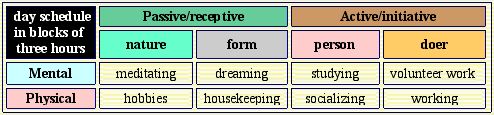
arrive at eight periods of three hours for the day with which you then
may set up your calendar. To the ideal takes such a timetable
consequently the following form:
What is the
argument behind that table?
You are, receptive/reactive living to the nature,
mentally
engaged with meditations and to the form in this respect busy
with dreams in your sleep. Next to that must you being more physically
reactive to your own nature, do your hobbies to counterbalance your
obligations and with that also in reaction to the needs of the form of
the body again take care of your own matter in doing your household
duties.
Being active on the mental plane, you take as
a person, as a being of reason and logic, up a study or are you
at the other hand stimulated by the time as the doer, mentally
then engaged for God, as one says or pro deo, laboring on a voluntary
basis. Next to that you must, being more physically motivated, show
initiative to entertain personal relations and must you positively as a
more materially motivated doer be committed to delivering service for
the sake of others to make a living or deserve your bread as one could
say.
What you, less ideal reasoning from the way
things fare, may say is that you, globally being of balance with this
vision, living normally like an adult on working days, in reaction,
then sleep for six hours to meditate on your dreams, and six hours for
the fine order keep yourselves occupied with household chores, eating
and your hobbies, to which the conscious meditating and contemplating
are easily neglected. Actively engaged on normal working days you
physically deal with other people and do you do your job, with six
hours left for being spiritually motivated to engage yourselves in a
more voluntary way with others and for the purpose of studying, with
the help of books, t.v., the computer and other media. Also concerning
this, one tends to work more than one socializes and watch more t.v.
and/or use the computer than busy yourselves with voluntary labor.
Because you thus factually reserve too little time for studying,
charitable work, and socializing in this modern society tending to
materialism all the time, must, for the balance of a good life, for
that purpose days of compensation be intersected in your calendar to
account for the damage; days thus of study, socializing and a
selflessly motivated contemplation, that factually, from the logic of
the balance, constitute a real necessity and, with you being conscious
to it, even are a real need in your life. But more about that in the
next dialogue about value-control.
The blocks of three hours do not necessarily
have to follow in a tight order of time. They are but a general measure
of balance with which you can move back and forwards in finding your
own daily schedule. Thus you meditate during the day regularly for some
time to have a quality moment of peace and are you in the evening
mentally occupied with the media - especially the t.v. most of the
people. It is thus not so that you'd be strictly active during the day
and completely passive or that homely during the later hours or at
night.
What is of interest, is to realize that a
balanced schedule for the day during a working week of six days of
work, gives you 6 x 6= 36 hours of work. A forty hour working week of
five days of eight hours, can be done, but shifts the emphasis
concerning the being active, this way seen, more to the physical plane
with you having to face the reactions to that. The propensity to
imbalanced action concerning your orientation in time and space that is
built into our society, manifests itself in this following as a lateral
disturbance, between the right and the left side of your brain. The
lateral constitutes the third dimension in the operation of the brain
we have to consider.
How does one
control the lateral the way it should? One has to serve the time system
and you're neither always in control of the space you have.
Indeed constitutes the time system a maddening
barrier between you and the natural world we live in, which calls for a
conscious approach. For this purpose you must train the body to be
independent of the cultural time-system and thus manage to save your
lateral integrity. Materialistic society has separated the time from
the place and estranges you easily from yourself and from others by
diverting you with a mind directed elsewhere. The clock which, missing
a cogwheel to account for the tempo of the passing sun, in fact is
outdated, ran amok and now carries wheels, wings, a screen, a keyboard,
loudspeakers, and a microphone, and grew so into a system in which you
never know where you are with your mind. This breaking with the place
or this dislocation of your time consciousness is a characteristic of
individual mental illness or at least of a commonly shared cultural
neurosis. Even the spirit of the timeless self and wisdom of eternity
that we in meditations share in the knowledge of the soul, demands a
correct orientation to time and circumstance: the consciousness of the
moment. Psychiatrists always check the sense of time and place of
patients which is typically disturbed with them. The cure consists of
offering people settled daily activities, to offer them 'structure' as
it is called, with a tight schedule of work, to restore their
orientation to the time and place. But before it went that for you, can
you avert the danger of a split mind directed at a time separated from
the place, by three times a day engaging in yoga-exercises with the
help of mantras for the sake of the expression of your emotions: in the
early morning before breakfast, in the evening before dinner and at
night before you go asleep, so that you purify yourself for the
different activities of the day and are able to delimit them. Do âsanas
like the sûrya-namskâr, the greeting of the sungod,
and do the pranava, by nasally vibrating AUM ten times, concluding the
exercise with the gâyatrî mantra to reset your brain to respectively
the primordial sound of God that unites all other sounds in the ether
and to the original order of the nature of the sun. The filognostic
builds on the existence of the ether and thus sounds a version of the
vedic three-foot-mantra, the gâyatrî, like this:
'Aum...,
earth,
the ether, heaven;
that vitality we pray for;
the grace of God for everyone;
the mind pure in harmony.'
The gâyatrî-mantra
itself
is more specifically directed at the divinity and the order of
the sun, but since we respect the sun already with a tempometer, applies this version more generally to the
entire order of time for reconciliation with God and oneself. Of course
should you for that purpose, to do it without a computer, set
a
clock for meditation to the sun,
because the social times turned against nature and that
ether will lead to the forgetfulness of not respecting that nature
essential to your soul as its ground of being. Also of importance is it
to find a quiet and sanctified place to do your exercises. This is not
always as easy. In case of being disoriented and disturbed beyond your
control, can you force the spirit and the body into obedience with the
help of the so-called mahâmantra, defended by the factually not that
sectarian, but indeed very traditional Hare Krishnas, that mediates the
controllers of the vedic philosophy of Lord Krishna and Lord
Râma. Also other bhajans to the honor of the holy name
and their respective cultures of knowledge are effective. With the holy
names you also find the true meaning of your being incarnated, of being
René, of having begun a new life in relation to Hari, the
Fortunate One, the Lord or the Supreme Personality of Godhead: He, the
field in all fields, is the one who time and again is present to put
things right so that you never stand alone in this. It is with Him that
you have to manage to cooperate in each life. He is the one to say I to
the impersonal as the greatest sacrifice possible, so that nothing is
impersonal anymore. A good scientist knows that all is claimed after so
many ages of civilization - even the mistakes - and that reference is a
basic duty of validation, of declaring something valid.
The musical exercises in this department of
emotional control must, as I told you earlier, however authentic they
are, always be directed at towards the solution of the soul and its
agents, because directed at the worldly you will get entangled as a
stimulus-response junkie and fall from your discipline. Be in the
world, not of the world.
So
remembering and working for my integrity with yoga restores the lateral
balance lost in materialistic, cultural engagement?
Yes, provided you watch the time carefully
thus. On top of that is the yoga also conducive for the control of the
so-called small brain, the cerebellum in the lower back of your brain,
that regulates the physical control you have over your body. It is good
to train that center to be independent of the storms that might go on
in the emotional and cortical centers. The consciousness that is stable
is that of the times set to the signals of nature; that of culture
depends on politicians, bosses and intimates that are materially
motivated and thus may burn down; the materialistically motivated
consciousness is not stable. So you can materialistically either forget
your discipline of integrity and emotional expression messing it up
with nature yourself, or you can be messed up by others disturbing in
that relation. And you must count also with the third disturbance that
is there from the modes of nature like summer and winter, natural
calamities like floods and earth quakes, and general changes in the
weather. The purpose of yoga in general is to be independent of these
modes in the stability of one's consciousness and physical control,
even though - or rather because - they exert great influence. So don't
sleep too little during the summer nor too much during the winter time.
Sometimes you rise in the dark, sometimes in the light living on the
latitudes at a greater distance from the equator. It must not be so
that your yoga is lost if you change the clime or when the seasons
change on you.
Is filognosy
a type of yoga?
Yes and no. The yoga you know as a physical
exercise of meditation and postures is but a part of it, so you may say
so. You may call it filognostic yoga or Aadhar yoga, the syncretic yoga
of your basic interests of mental, societal and physical well-being.
But not being turned away from society doing a normal job and being
engaged in activities directed at the person with it you may call it
just gnosis: spiritual knowing embedded between, and connecting, the
interests of the impersonal of science, the argumentation and facts at
the one hand and the personal of religion and politics at the other
hand. It is a syncretic approach of different overlapping domains of
knowledge that covers the most important visions of life. You may also
call it a vedic concept of reform or the cultural restoration of
classical values and actions. We only incidentally, though regular,
turn away from the world in an exercise of yoga to counterbalance and
restore the lateral functions, but we do not turn away from the world
at other times or the other fields of action. So in general we are
filognostics and incidentally we are yogîs in the strict sense.
We promote the wholeness of life, not any isolated exercise that then
would constitute escapism. Of yoga we scripturally know the yoga of
work (karma), of thought (jñâna) and of
devotional service (upâsana), so we say work and pray, but
also love the knowledge. Then you have the yoga complete as a
filognostic, as an âdhara-yogî, a yogî
covering all the fundamental interests.
You say we,
are you not alone as an independent authority?
No, the enlightenment of working with an
adaptation to ones own reckoning, and the being liberated in the
service of and attention for the traditional is combined, as you
realize from my advise to you to do yoga-exercises. But with this we
shall be more extensively engaged in the identity-control dialogue of
section 5.
So to sum up
this conversation: we stay healthy by balancing not just the fields of
action for a week, but also the three dimensions of the brain
functioning during the day in respect of one's initiative/receptivity,
emotionality/rationality and one's time/space laterality?
Yes right you are René, you've
understood the kernel of the analytic discipline of discriminating
between the interest of the body and the soul, in relation to the
individual and the social, the concrete and the abstract of the fields
of action.
Is there
much more about this or not?
This sums it up nicely as far as your
expression in the material world is concerned, but there is a whole
culture behind it dealing with much more, with a type of Bible called
the Bhâgavata Purâna or the Story of the Fortunate One.
For the sake of filognosy assumes that devotion analytically and
lyrically adapted to our culture and our notion of God, a somewhat
different form. Sanskrit names and words are a concept in India, but
over elsewhere strange to the people. We thus have to, vedically
reformed adapted to time and circumstance, form our own english
understanding of the matter. The original hymn in Sanskriet stays
therewhith as a 'mass in latin', as an option to the more traditionally
advanced ones and the monks. This transformation, this filognostical
bridge built to reach out to the classical culture, expresses itself
e.g. in a version of the so-called 'Great verses' (in stead of the
sacred, and thus factually not translatable mahâmantra) in which one then sings:
With the
Ether, with the Time,
with each other, free sublime
Sing together, listen, partake
talking, down town, working, awake.
proper weighing,
non-illusion,
getting art, above confusion,
know the Best One, free expression,
all the six, is my confession.
Or an 'In the
name of...' in stead of the so-called pranâti which stands for a tribute to the spiritual
master:
In the name
of Graces' Keeping,
all the Love of Happiness,
did the past defeat the sleeping,
for 'I' and 'mine' is no progress.
Love of Truth,
pure, share and helping;
the values of the godliness,
impersonal no, not estranged,
are we the soul with the fearless.
Thus can, for the
sake of our emotional expression and togetherness as sung in
association, the filognostic devotion which is of a vedic origin, still
very much in English appear in a form of piety that to our culture is a
correct, understandable and recognizable notion of the Person of God.
In dialogue number five we will further expound on this in fact also
importantly identity-conscious matter.
Dialogue
four:
II-b Value control
René, for the stability of your
consciousness you have to associate and in order to keep that
association you have to be united. Thus is yoga, or the science of
uniting the consciousness, essential to your happiness. The issue of
time and th ether is also important here thus: you have to keep
yourself with the control of forces in your yoga on the calendar.
You call it
value control, isn't yoga more a matter of self-control?
The self of the body and the self of the
principles are not the same. The self of the principles we call soul is
what we have in common, it doesn't die when the body dies. Therefore is
that master of the value control. Your individual style of relating to
it is your individual soul that is remembered when the body has
deceased. In the previous dialogues you learned about the method, the
facts and the analysis of the time-factor involved so that you can plan
your actions, have a full life, but still keep the balance. But it is
only your time of life if you manage to stay united in the ether,
associated and endure with it in fortitude.
What do I
have to endure?
Apart from simply
holding on to the discipline, you have to bear with the operating modes
of matter exerting their influence from the outside. There are three
modes in nature that might bewilder you, they constitute the illusory
effect of the material universe. It is the ignorant, the passionate and
the good. Your stability with them is what counts. Detachment is the
way to the soul. The detachment is remembered in four basic principles
of conduct that make up the nature of the continence of the soul. With
these regulative principles you can contain yourself, irrespective what
happens in the universe or what others say and do. The idea is that the
eternal self of the original soul cannot be lost, you only need to
follow its principles to keep to it.
Modes and
principles, the bad and the good?
No. Modes are not bad, the modes are natural
and the principles too. But one is needed to cope with the other. The
modes of passion, associated with movement; the mode of goodness
associated with knowledge and the mode of ignorance associated with
slowness challenge you as the soul to keep to the principles that
assure your transcendence and stability.The Hindus recognize in them
their gods S'iva (ignorance), Brahmâ (passion) and Vishnu
(goodness).
I attain to
objectivity as it where?
You could say
that, but the look is more turned inward than outward. You better watch
your happiness, the soul is the firm basis of knowledge and the seat of
consciousness and happiness. So in the exercises you always turn
inwards away from the operating modes to retrieve, consolidate and
remember your happiness. It is your moment of filognostic prayer
wherein the mind finds its basis. Let the movement of your body be for
what it is, you are the witness now and not the one, the false ego,
identified. Let the goodness also be for what it is then, it shouldn't
so much depend on actions but more inspire actions, it is as the good
Lord in heaven, present in the beyond, but also possibly manifest
before you as a defense of the soul it's interest. Let the ignorant be
for what it is, do not manipulate matter any longer, dare to be
fruitless for some time. Thus you meditate three times a day beginning
as said with the common postures and the pranava, saying AUM
ten times.
So what
about these principles, how do they assure stability?
The principles
are that of truth, of purity, of detachment and of compassion. The
vedic word states they is are the four legs of the bull standing for
what the Indians call dharma, religion or naturalness or right
conduct; they are respectively: satya, s'auca, tapas, and dayâ.
These
are your basic commandments. Not the usual ten commandments thus,
but just these four will do for starters; these are the basic ones. The
first principle of truth, satya, is a matter of respecting the
facts of the creation as they are. Non-illusion is the purpose of the
science and in that context we already discussed the issue of the time
you need to be in control with yourself. It also implies that you do
not flee from the truth in taking to alcohol, drugs or other
intoxicants. Even caffeine coffee and black tea, brown chocolate and
soft-drinks containing stimulants should be checked. You have to see
things as they are, not have any artificial stuff manipulate you into a
fake happiness. Let your bliss be real. It is also wise to read the
scriptures regularly like listening to the Bhagavad Gîtâ
each morning before you do your job. Do follow the lead of the
classical truths of wisdom. Lasting they proved to be eternal. The
absolute and lasting eternal truth of the reality that you can't
change, of souls, the material elements, the ether and the time,
outweighs the relative truths of the cloud of thoughts to the matters
and forms that depend on your control. Thus we already arrived at the
respect for the natural order as the way of transcending the times of
fruitive labor that were conjured up by man. The ancient wisdom is all
based on that natural order.
So what does
purity actually mean?
The second rule is that of purity, s'auca.
It
usually means the acceptance of sexual frustration or celibacy,
whether you're married or not; but it is also synonymous with dâna:
sharing,
communicating and donating. Sexual frustration is a normal
thing, not just for human beings. Animals grow horns and bushes of
feathers with it and human beings develop culture with it. But don't
get me wrong, sex is not bad. You simply have to keep that dog and
apelike body on the leash. First of all you are a human being or
individual soul in respect of the Supersoul of God above that is above
all that, that is the purity to share. But purity is more than celibacy
and sharing. It also means that you keep the mind focussed with the
mantras we mentioned. Beware of the ulterior motive. Lust inspires too
and distracts the mind. Lust requires regulation, denial doesn't really
help. Sex is good if you are in love and want to let nature take its
course. That's how we get children. But as a habit, a compulsion, a
kind of fun, and a mechanical thing you should deny it; it is not
really the sharing anymore, it is selfish and destructive then. Do not
spoil the natural with such a dirty mind or stone of attachment in your
heart. And finally purity also means cleanliness of course. mental as
well as physical. Not just no dirty and distracted mind of desire, but
also always washing the dishes, having clean underwear every day,
taking a shower each morning, washing after defecating, washing before
going asleep, brushing your teeth three times a day thoroughly and
doing the laundry regularly as well as household chores. Thus is s'auca
also all the cleanliness. The mental and physical purity, sharing and
all, is your loyalty or else you are unfaithful in betrayal and
fall-down. Believe in it.
Penance is
difficult. How to do it and why should I limit myself anyhow, doesn't
nature rule us?
The third principle is that of penance, tapas.
There
is voluntary penance and enforced penance. Better not wait for
God or fate to impose the penance upon you. With everything you do you
must know to stop; even with the stopping you have to stop, like it is
with the duty to get out of bed at night to urinate. Not being able to
stop factually means not being able to engage properly also. That's how
the car works that your body is. This drivers license of penance is
what you need, so to speak. That is the control you need with th ether
and thus we have the need of the order of time again. So for your
eating, there is fasting: every night you do so and you also fast every
fifteenth day on the cakra-calendar so that you don't fast on a day of
socialization (going out, doing the field of the false ego, when you
have to show your face), which, formally, is the seventh and the
fourteenth cakra-day or a 15-day period of two weeks of labor
consisting of six days of work. Fasting is best done by not eating at
all, just drinking water, milk or fruit juice. The body so to speak.
has to be switched to the reserve-position so now and then. In order to
stay healthy you have to flip that switch regularly with a good
schedule. Overeating is one of the great problems of modern society.
People consume, with a false, conditioned cry of hunger, but do, with
the ether, not have it under control just like that. They develop all
kind of diseases because they forgot to switch on reserve. You also eat
leftovers in the fridge don't you? This is the same. Clean the fridge,
eat from your reserve of fat and so for a day. Further does penance
also apply to actions, especially fruitive labor. On cakra sundays of
socializing, on lunar signal-days of study and/or religious celebration
and on solar leap-days (the fifteenth cakra-day and the two-monthly
extra day to leap the cakra month) you shouldn't engage in any
productive or fruitive labor. But remember, self-correction activities
are of all days, just like your parent had to correct you every day.
And also be careful not to torment the body with fasting too long, not
sleeping enough or other forms of self-denial. It is all a matter of
regulation in such a manner that is pleasant and natural to you. Normal
eating is also restricted to the times set for it. With proper
regulation you don't tire yourself and thus you don't have to sleep
that much. A mother not caring properly for her child gets a nagging
child that wears her out. So considering what we above called proper in
filognostically not wasting your life on ulterior motives, always try
to follow the natural order in this: the lunar and solar days and the clock set to the sun; the authority of nature is the proper one,
the dharmic one, the rest is compensation of a lesser quality. Failing
in this more conscientious self-regulation you will sooner or later
have to pay the price of an enforced penance. You'll get sick or
otherwise be plagued by your psyche or by turns of fate. E.g. during a
war you can recognize what happens as an enforced penance: the fun of
consuming is over, everything is rationed then, or, in other words, the
penance of sharing must be imposed. Penance is, not taking more than
one needs, thus also sharing. So stay ahead of fate, make it your free
will of wisdom. You know better.
Other necessary penances are fasting of dairy for a
month (May e.g.) and refraining from the tube, from t.v., for at least
one day a week in order to decondition from that dictatorial defiance
of the local principle. The greek Ulysses also had to stick to the
sheep (the local community) to escape the cyclops (the t.v.) that held
him captive. That, conditioned as you are, might not be easy without an
alternative calendar and clock; the system tends to eat you up and
allow you nothing outside of it. You need a system to defeat a system,
to defy a system.
The last
principle is that of compassion.. should I in yoga love my fellow man
or what?
Certainly a good yogî is a compassionate
man. He recognizes his self-interest in that of others and suffers when
others suffer. So he helps. That is compassion, dayâ. I
must be stupid to enjoy another man's suffering. Don't wish or accept
for others what you don't want for yourself. The law of karma is that
of action and reaction. All will return to you. You end up in the world
you've built yourself. So they say: aim for heaven and a better world.
But of course it is this world, but then done better. The better is
containing the good of the foregoing in non-repression; what's a tree
without its roots? Compassion is the peace-principle, that is how the
human cause is doing justice. Compassion is the nonviolence principle.
Meaningless self destruction is the killer of all faith. Unnecessary
violence should at all cost be prevented. It is bad enough to be of
necessary violence, defending yourself, with the weapon of your enemy.
The Gîtâ, wherein Lord Krishna summons his friend
Arjuna to take up his arms and fight says it this way: 'blessed are those who see it coming, to them
the kingdom of heaven.' Also
important is to be of charity: give the ones needy what they ache for:
food, shelter, clothing, security and other basic necessities. See to
it that no one has to complain. So this principle naturally follows the
previous one. Without sharing and helping human society is not human at
all, but heading for self-destruction. The four principles as mentioned
define the humanity, not so much the animality that is the weaknesses
with them, that deceives, kills, is promiscuous and steals. Last but
not least there is the compassion with other creatures. Also with them
be nonviolent. It is not necessary to kill animals for food. The joy of
life you grant them will be yours if you let them live their full life.
You don't kill your mother if she doesn't feed you any more do you? So
why kill mother cow then when she's too old to give any milk, isn't
that immoral? Also let other animals live. Share in the joy of life,
not so much in the lust for life, that is the way of God. Avoid
unnecessary violence. Again I say beyond necessity you're a fool
falling down in hell step by step.
So how
should I be a good vegetarian? Just eating beans in stead of flesh
makes me hungry. That can't be right, is it? That would weaken me!
Right you are. But the strength you seek not
the strength of the unnecessary violence that meat-eaters cherish
against animals. What one seeks as a man is more the defensive strength
of elephants and cattle, than the offensive strength of the violent
tiger and wolf. The vegetarian diet requires a bit more effort from
your side to stay healthy. But the resulting joy of life is certainly
worth the trouble. So take care of your proteins, fatty acids, vitamins
and minerals like iron. For your proteins eat beans combined with
grains. They are so-called complementary proteins. They together
provide you all the building blocks for your own bodily protein
synthesis. Meat is like a vitamin pill: you have everything in one
bite. That is nice, and tastes good too, but breaking down complex
proteins into the constituent elements needed for your own protein
synthesis gives toxic waste in the intestines that do damage to your
digestive system and are, according some researchers, conducive to
diseases like cancer of the stomach and colon, certainly in case of
burnt and smoked meat. Meat-eaters like cats and dogs have short
intestines. But you as a primate with limited talents in this, don't;
you have long intestines. You poison yourself with meat-eating and
therefore the doctor always says: you should train, move the body, run
into sweat, just to stimulate the digestion. And so is much of the
meat-eaters culture there just for digestive purposes: just to make
shit. The meat-eater literally turns sour by the necessity of a
stronger stomach acid. And acid saliva is not good for your dental
health also. So also for these reasons of living peaceful and
comfortably, be a vegetarian. The planet can sustain not that many
meat-eaters either, So forget about it, there is no future in it. For
your fatty acids, good for your cartilage e.g., you must eat a cheese
sandwich each day or a table spoon of linseed oil, or else you have to
take take fish oil supplements which are not vegetarian. The proteins
are, with beans and grains combined, no problem; you even must take
care not to satisfy the body too much eating all proteins in one meal,
unless you have a feast, or in need of something extra. Eat bread or
cereal at breakfast, but not always rice or pasta at your dinner. Eat
potatoes instead, if you're not too fat. Just take (preferably
biological) beans or other pulses with your potatoes and vegetables in
replacing the meat-dish. Then the body will stay eager to serve to get
it's necessary complementary cookie at tea or sandwich some time later
in the day. Eat little but regularly; but indulge yourself also now and
then, e.g. on a cakra day of socialization. Drink herbal tea. That
together keeps the spirit and the body as well eager as satisfied. For
your vitamins you must take care to eat three pieces of fruit each day
as well as half a plate of fresh vegetables. The vitamin C is
absolutely necessary. You will suffer depressions and fall ill if you
don't eat them. For your iron, an element also easily available in
meat-dishes, you must eat iron-rich vegetables and fruits, like
broccoli, chicory and figs not to get anemia. For your b12 vitamin -
the vitamin that makes you hungry missing it - you must eat dairy
products (you can do without B12 for the maximum of a month ). It is a
vitamin needed for your nervous system. So two glasses of milk a day or
else, if you have a lactose allergy (think of the milkfast!), a few
pieces of cheese covering the same amount will do. Cheese is compressed
and fermented milk missing its water. It is safe for people with the
allergy. Veganists are condemned to eat seaweed instead of dairy. Such
a diet is more troublesome. Don't be a fanatic, or else it is a lack of
philosophy. The cow is your welfare and well-being, and in a vegetarian
culture she is thus holy. Nuts are also a source of vitamin B, selenium
(brazil nuts), fatty acids and protein. Use, sparingly, real butter and
no margarine on your bread, for the artificial vitamin D in it
can give you serious trouble. An exess of it results, unlike with
natural vitamin D, in calcium deposits throughout the body (hypercalcemia).
Also
problems may result with e.g. ones nerves and joints. Vitamin D is
associated with the immune system which, unsettled with a wrong type of
D, may lead to chronic inflammation disorders like M. S.
and arthritis. So the lesson is: eat natural, not too much, not all at
the same time, and eat variegated; then you'll live longer and happier
than many a meat-eater and will you be without all the sweat (and the
extra medical cost and misery) about staying healthy.
So now I'm
done transcending the modes with the principles?
Provided you do your daily exercises, yes, for
starters. Of course is the path inwards a complete selfrealization
process concerned with diverse matters of enlightenment and liberation,
not just sitting five to twenty minutes for meditation with a
vegetarian meal. Your whole life will be transformed becoming a more
transcendent person better in control with yourself. You will realize
that you'll develop a certain capacity of abstraction which opens
higher levels of operating with your identity of service. But remember
that rising up to the abstract must never lead to escapism. Stay
connected in the concrete managing the balancing in the fields of
action we discussed.
So there are
levels of attainment?
It are more different types of commitment.
Each soul has his own mix of concrete and abstract talents in this. The
higher abstract of it is not necessarily holier or better than the more
concrete. It is highly personal the way one plays this game of order.
This makes the human identity effective that is just, that is not a
false imagined and haughty fixed ego, but an ego in line with the
dictates of this absolute of the human and divine truth of identities
at different levels with different degrees of experience and styles of
progress. We will discuss that more elaborately in our next
conversation. For the time it is enough that you realize that yoga is
not just a few exercises but a complete filognostic reality of having
different visions of spiritual knowing that cover your whole life. That
fullness of life is what filognosy aims at, that's what makes the yoga
real. As I said is yoga itself in the narrow sense thus but one of the
six visions of filognosy. The matter of finding absorption in anga's,
levels
or limbs of yoga, that in reality are more realms that overlap,
is just this dialogue actually, the previous one was more analytically
concerned with the dual nature of the philosophy of yoga, and the rest
before that and that follows now is more a matter of science and
respect for the person.
But what are
these levels or limbs of transcendence?
Like in yoga first respecting the don'ts of
the vow to follow these principles and following the do's of regulating
the activities as discussed, after which you sit in postures to
regulate your breath, turn inward and concentrate with a mantra to
meditate and find absorption and stability in the self, is also your
whole life in filognosy a process similar to such an individual
exercise. And please do not think too linear about the following
enumeration.
- 1) Yama-level:
At
first you may be pretty physical being young and eager to build a
life, attracting others and showing off. The beginners level is
wrestling with the vow of yoga to be pure in this being nonviolently,
truthfully, non-possessive and not stealing of penance in celibacy,
even in marriage.
- 2) Niyama-level:
At
the next level or field of respect in transcendence, you wrestle
with the order of a regular practice. You should study, be clean, serve
the cause, sacrifice, be hospitable, be content, be charitable, be
faithful and be of attendance. This takes some time to settle in your
life balancing to the order of time. It is like a sport you practice to
integrate your actions. Difficult in the beginning, but sweet on the
long run.
- 3) Âsana-level:
At
the next interest of transcendence you learn to develop the right
attitude of service in control of the body. Experimenting in
competition, competing with the weaker approach of your previous life,
you have to learn to cooperate, to cooperate to the general directives
of the classical science of wisdom. Next to the poise of meditation to
control the physical energy, it is the poise of life in general also
that you develop being a good sport in command of the dog that is your
body. It is not as easy to master yourself as it seems. It requires the
vow and exercise of the level before this one. You have to practice the
austerity, develop the attitude and thus be in control.
- 4) Prânâyâma-level:
The
level following you learn to use your breath to concentrate. In the
reality of life this usually is the breath you practice controlling
your speech. You have to say the right thing to find intimacy with
others, get married and be a reliable partner in control with himself.
So there you are again; in order to build and keep relations, you need
the vow, the regulation and the control over the body as a
precondition. Now at this level, in this field of yogic interest, we
get above the waist so to say, from the private going public and do we
morally directed with the b ody under control build a formal society of
accountable and faithful people.
- 5) Pratyâhâra-level:
Next
level is the level where you turn inward. You can't fix yourself
on the diversity of the outside word only and stay concentrated, stay
focussed on the cause of a happy life for all. Now you have to develop
meaning in your relations. You have to concentrate on that and be
responsible, accountable, trustworthy, as a beacon of clarity to be a
meaningful other. One might think yoga is a selfish practice of turning
turning inward, but filognostically you realize that you cannot develop
any quality without the meaning of the soul being the reality of values
and God that you share with others. Even the strictest yogî
trying to meditate in the forest for enlightenment has to build a life
relating to his environment in such a manner, that a certain quality is
achieved that is love and peace for all of life outside and inside of
him. The meditator cannot separate himself from life. He is life and
sees it equally everywhere around him, that vision of the soul is the
concentration on the inner reality that is needed. In fact one gets
more real being deeper making sense with other living beings, not more
distant being an escapist and stranger on the run for social
responsibilities. 'Let this yoga not go at the cost of
prescribed duties' writes
sage Vyâsa in the Gîtâ. So one concentrates
on the soul in keeping in touch with others by appointments to the
original order of time and thus you make life meaningful, thus you make
a difference. This level is crucial, here one cares, settles and loves
as the filognostic, as the person of comprehension, with a heart that
you have to be alive with being real with the yoga.
- 6) Dhâranâ-level:
Further
transcending in emancipation knowledge starts to count. To have
a more closely defined agreement with yourself and others to assert
yourselves, discuss and contemplate, is crucial for the society you're
part of and have to learn to take responsibility for. This is the
actual concentration that makes your person and life. Taken strictly
individual it is the practice of mantras, succinct sayings of your
wisdom and experience. But with others together in agreement being of
service to the filognostic cause and modeling that for others you have
to concentrate on everything conducive to the humanity and the justice
for all living beings and the whole planet. That is the enlightened
self-interest thereof for which you must assert yourselves in
discussions and learn to contemplate matters in focus.
- 7)
Dhyâna-level: After this follows the meditation in which one
arrives at understanding, at know-how. Now it is serious business, a
science of acting without acting; of directing without directing. You
learned to have a heart and be a model. Now, in order to be a quiet
witness, you have to investigate and doubt what would be contrary to
the cause. Now the concentration is in function. Once having realized
this more detached position of being more of a quiet witness, you
attain to the next level.
- 8) Samâdhi-level:
What
follows as a consequence of the vow, the regulation, the exercise,
the practice, the relations, the heart, the assertion, and the
understanding, is the absorption of selfrealization wherein the
unwanted finds destruction, the wanted is created and the culture
reaches it's celebration in maintenance. As a seer finding stability in
the moment of the here and now with the ether in this position of
transcendence, constitutes the practice of being a full human being in
everyday life in respect of the fields being balanced with the
principles. It is not to be renown as such; one may very well in the
background with the traditional lordships of creation, destruction and
maintenance be ruling the business of the wisdom and transcendence. In
this last stage is what matters the stability of your being absorbed in
the blissful, the durable and the conscious of one's being connected in
the yoga.
You may go from low to high, from the ethereal
to the material, with these levels or areas of interest of the
eight-fold yoga in your life climbing to heaven, but equally you may
descend to be of concrete actions and presence this way. This ability
to go up as well as going down is the (aroha/avaroha) quality of having
matured in filognosy, of having that love for the knowledge that you
and the rest of this world need to survive, be motivated and rejoice.
Emancipation
so is then the transcendental unification with disipline?
Emancipation is the
evolution of devotion in one's relating to enlighten-ment. This
consists of nine activities which are the result of the combination of
the three different forms of uniting one's consciousness (in knowledge,
in work and in voluntary service) and the three disciplines (of the
impersonal - the ether -, the local - the material, and the personal -
one's time-order).

Vedically is
this process of becoming called bhâgavata dharma and is
it somewhat differently described.
Okay, and
thank you Aadhar for this elucidation.
Dialogue
five
III-a Identity control
In the next section we come to realize what it
means to become a person, to develop an identity. The concept of the
person is crucial for you to be happy. Estranged one feels neglected as
a person and tends one to become destructive to fight that bad feeling
off. The idea here is that with proper respect for the impersonal of
the previous sections, for all the arguments, facts and rules and
principles, you achieve the person, the original person, as a result.
You learn to discriminate between the different dimensions of the game
of order that we're playing in this world.
Aadhar, the
human identity, what is it all about?
Dear René, in the process of becoming a person, of
developing an identity in selfrealization, are all members of society
involved. The one better than he was, the one who progressed, has
respected the principles of progress: the rules and the facts of the
absolute truth, the truth of God who is independent of you and who is
of all qualities that we call better; the less the feeling of
estrangement and the tendency to be destructive therein becomes, the
more you as a person will feel respected and also will be of respect
for others. By birth, by nature, and by culture you develop a certain
preference for a certain type of service. Some want to be a friend or
comrade helping others out, some want to manage and have a business of
their own, some want to regulate and control the legal system as public
servants of some kind and some want to study, develop and teach in
science and religion. These four are the basic vocations one can have,
feeling called for service in the society. One's identity though is
more complex than the with this orientation belonging to a certain
class of people (the varna). Also age counts and makes for a
separate spiritual department we call the status (the âs'rama).
One
is first of all a youngster, a celibate student usually under the
control of adults, parents and teachers in school. After school one
chooses a profession and marries, and is the status of young-adult
achieved. One builds a family, begets children and educates them, and
many consider this to be the essence of life. But there is more to it.
After roughly twenty years of this family business the children have
grown up and middle age sets in. For bachelors that never married it is
likewise: around their fortieth must also they have arrived, must they
know for which they stand in life, must they face the maturity of their
own commitment, of what they have brought about in the society. The
married couple not bound by anything else but the sexual accord for
begetting and raising children might find themselves in a divorce, for
the contract of procreation is finished then. But that doesn't have to
be so. One may withdraw together bound by filognosy, the love for the
spiritual knowledge of the soul with or without a specific religion,
that keeps one together in service. The middle aged are supposed to
accompany the young adults and transmit their experience. The tradition
should be handed down and the position taken should be transferred to
the next generation. A neglected middle-age culture of people attached
to the life of young adults gives a generation conflict since the
progress in society is blocked that way. The middle age is the age of
assuming responsibility for the society as a whole. It depends more on
knowledge and culture than on family relations and attachments. Next
growing older one becomes an elder detached enough to represent the
classical wisdom that the middle-aged aren't that all clear about right
away, with their still half being entangled in material matters; but
they are returning to it. The elders are responsible to remind them of
the classical value of the insights won in one's own life and by the
ancestors, ages and philosophers of old that did the same and that is
more a matter of traditions than of ego. So we have the basic identity
of man in sixteen possible status-orientation groups: the four for the
status of a certain age-group combined with the four for the vocation
of a certain commitment of service.
Are they the
same as the indian castes?
More or less, you may call it caste, but they
are universal categories for all societies of people. The normal
employee is the comrade and the friend that consecutively makes the
career-moves of being an acquaintance, of becoming a partner, of next
becoming a companion in life and finally complete his/her life in being
an elder, or a senior, in retirement. For the entrepreneur of the
department of provision develops life, in the ideal sense, itself from
being an assistant in training to a manager's job with responsibility,
to assume following middle aged the lead as one's own boss or CEO, so
that one finally after transferring the business to the next generation
one is of support as a commissioner in the final authority over the
company. The next orientation of class in life is that of the ruler,
the legislator and the military who is of initiative relating to a
certain societal order, and who first of all, to the model, has to
prove himself as a hero or recruit in a youth organization, and next
has to follow through in the form of taking up leadership. Next is the
one of initiative as a leader of a certain group interest than on the
basis of his experience fit to operate as a politician capable of
mediating between the wanted and the viable, after which finally at a
later age one has matured enough to be of the chambers of advise or be
an advisor in a more independent position. From the next position of
the intellect caring for matters of guidance is there first of all the
position of being a pupil in the context of a school, then the position
of being a teacher oneself who as a counselor or therapist supports the
students or clients in their personal evolution as one meanwhile
arrives at one's own practical insight. Next, with the workload of
teaching and supporting is at its end, follows a period of
reconsideration in which one with the experience acquired looks deeper
into the wisdom and the traditions founding the culture transmitted, so
that one next at a higher age being more detached, austere and
experienced with the spiritual responsibility for a certain service of
honoring matters may care for the commemoration of that wisdom: the
priesthood, the voice of the culture attained. Thus is with this
division each his life assigned a place. It is evident that by the
grace of the classical scriptures and the actual human reality the
positions of the societal identities as an absolute truth are fixed,
but that the person himself determines to what extend one thing would
lead to another, or whether there would be the more abstract or
concrete reality thereof. You may picture the complete of it as an
eight story apartment-building with sixteen apartments each floor and
three rooms per apartment. That is the building humanity lives in, with
each and all living there going up and down in the lift of
transcendence or elevation and moving through the rooms of their
apartments according their experience. Sometimes, on the average four
times in their lives, they move to another apartment when they
according their age change their status.
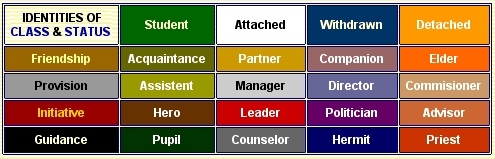
The
problem
with these identities of the so-called varnâs'rama
castes is the identification with them, the false pride that people can
take in them and shut each other out with. In filognosy we stress,
after the concept of vedic reform of Lord Caitanya, the importance that
these identities are positions in a fixed 'Game
of Order' of developing
quality, but that one is free to move up and down the ladder to heaven.
Naturally you evolve through these castes. So, although by birth you
may be predisposed for a certain class, by nature you may follow
another route. Therefore do I for you call it status-orientation groups
or societal identities. The status is something natural of age that
changes over time, the class likewise is something that may change
because of personal choices and an education. Even though one doesn't
seem to choose one's birth do things, as was explained in the previous
dialogue, work only right with respect for a certain process of
transcendence in which we develop the needed quality. By this quality
we develop the consciousness that offers one the choice, that thus
gives someone his freedom. Only this way can the caste-system, or
society of rank and order, he matters of class, be checked and
protected against false claims on the basis of identification and
pride. One isn't better by one's societal position, birth, age or
education, one is better by one's consciousness, one's talent to
transcend, discriminate and choose, by one's abstract ability to
oversee matters and keep order and thus stay absorbed in the goodness
and knowledge so necessary for the love for our fellow man.
You say you
can't chose your life. Isn't that determined by your previous lives?
Your
present life is undoubtedly the consequence of what you did before;
whether those previous lives happened in this life of lie more in the
sphere of other incarnations of yourself or of others of your
identification that preceded your life. So I might have been
René Descartes and you might have been Sigmund Freud and now we
have to figure it out what it means to be analytically of reason with
the soul. Even though you at any moment have the option to change lanes
in your life, is it so that once you head in a certain direction, you
have to accept the consequences. In that sense you do not have the
choice then. But up to the point of death one can repent and thus pave
the way for a better life thereafter. It is not the soul that dies, but
the body that dies, that is the basic assumption of yoga and thus also
of our filognosy.
So what does
it mean 'Playing the Game of Order'
It means that we accept the caste-system, but
then with respect for the process of selfrealization in transcendence
we also call emancipation. The identity of a caste or
status-orientation group should be functional. One and the same
identity can operate at different levels in different modes of
experience. That together is the game of order in which each person
finds his life's mission according his level of transcendence, his
status, his class, his experience and his style of progress going up
and down the ladder to heaven.
This is all
very much for me to understand...
Yes of course, it takes you your whole life to
figure out who you are and what your walk through life would be. To
oversee this in full no one can but the Supreme Lord. He grants you the
vision through the disciplic succession of the teachers of the
tradition that keeps the vedic literature in function. I can only tell
you as a pupil of them studying and singing to the scriptures myself
and so be happy to combine for you the different truths of the original
science of yoga and the options of spiritual knowledge in the six
departments of filognosy.
So there is
a specific type of culture behind it?
Yes, in my
case the paramparâ, the disciplic succession of
instructors or âcâryas of the Caitanya-vaishnavas,
as they are called. They are in the streets of the west , but also in
the east that way, represented by the monks of Lord Vishnu who are
known as the Hare Krishnas. Many fear them because they can be fanatic
about this disciplic succession and the worship of the gurus belonging
to it. But you do not have to go to the monastery where they live.
Albeit you very quickly might also pick this all up there with them, is
it also for Muslims and Christians quite normal not all to be monks and
nuns in service of the monasterial order. That order constitutes the
school of learning. Normally people attend schools to graduate and take
their responsibility in society. Also with Buddhists it is quite normal
for youngsters to be a monk and then later on be good fathers and
husbands in the normal society. But anyhow some type of systematic
respect is needed not to forget these dialogues and be firm in your
belief, and so it applies to the order of time as we have discussed
too; you must put the systematic respect for this originally religious
matter on your calendar. This personal section says: if you want to
be respected as a person, you will also have to respect other persons,
and
why not the original teachers, the Lords and Prophets of the
religions? Religion means reading, connecting again, and so do we as
devotees of the complete join on lunar signal days to read and sing the
Bhâgavatam, the original book where all
the wisdom concerning the vedic order filognostically is combined in
one story; the Story of the Fortunate one, the One of fortune that you
also want to be and - partly - can become by the grace of God.
I have to go
to India? Or must I go to Jerusalem or Mecca being a Christian, a Jew
or a Muslim?
Well you may
go on a pilgrimage to get initiated into the routines, philosophy and
social structure of the religion and forget your erroneous past there,
but you will have to return and pick up your life here where you were
destined to live. The Muslims say, you have to do it once in your life.
But who says what a holy place would be? A place is holy by the people
assembling there. So can you, next to India, also go to Lourdes or
Santiago the Compostella, or visit the pope. Sometimes it is enough to
meet a strong representative of the teaching on the road. He represents
all the wisdom and purity and the remembrance of him may suffice to set
you on the right course and keep you there. Thus some people are
perfectly satisfied with their own pundit, imam, parson or reverend
being holy enough. Let's say that it is not bad to look beyond your own
horizon and realize what's more in the world about this.
So filognosy
is not especially Indian then?
In my case it is a mixture of the christian
background I have, the experience with professional psychotherapy and
scientific methodology I had as a graduated psychologist, and the
change to yoga with it that followed my being faced with the
indifference of our materialist society. But a Muslim may stay a Muslim
visiting the Sufis and return from Mecca just to participate as a
perfect and sanctified equal in the same game of order that we talked
about and are involved in the two of us. The filognosy binds the
different religions and personal stories of selfrealization in the
gnosis, in the knowledge of the spirit, in the person of God and in the
factual reality of time in relation to the forcefield of the ether and
of life we deal with.
And how
about all those guru's and teachers?
They come indeed in
all shapes and sizes. The basic duality for their division is found in
the difference between the discipline and the source 0f knowledge. As
for the source of knowledge there are three kinds of teachers: the
co-believers who, more on a basis of equality, assist by counsel and
deed and initiate you by example and inspiration in the field; the
teachers of the in succession transmitted spiritual and intellectual
disciplines and religious traditions that are of instruction; and there
are the gurus from within that are known by the scriptures. These three
types of teachers are also known by three different disciplines so that
one in fact has nine different types of guru-disciplines or individual
mentors for the spiritual. The three disciplines are what the indian
calls brahman, paramâtma and bhagavân: the
impersonal, the local and the personal with God. Thus one arrives at
the table as shown below. The teachers of initiation are first of all,
if not your parents, the therapist who teaches you to respect yourself,
the other person and the rules in general; next we have the new ager
introducing you into the principles of the true self and teaching you
how to meditate; and following are there the filognostics and other
representatives of the spiritual traditions teaching the love for the
structure of knowledge in general and the order of time, so that you
may have a life with the regulative principles. Gradually, falling down
and rising back to your feet reorienting yourself gaining in
experience, evolves with this category of relief workers a way of your
own and a stable form of association and culture of instruction.

That factual instruction originates from those
who, more formally as leaders, represent the intellect, enlightenment
and the tradition: to begin with, the professors and other teachers and
thinkers of science and scientific enlightenment who first of all
promote a sober sense for the right course of arguing and the factual
reality with the seeker; then there are the spiritual philosophers and
mystics of the spiritual type of enlightenment teaching you to be your
own man and assume your responsibility with the knowledge; and at last
we have the theologians, priests and teachers of example in disciplic
succession (the so-called paramparâ âcâryas)
who introduce you into the holy scriptures and the culture of
maintenance, or the religion of reconnecting time and again in ritual,
contemplation and prayer.
The teachers from within are christian-wise the
Father, the Son and the Holy Ghost, but filognostically seen do we see
them more as the different aspects of God of creation, destruction and
maintenance, in which the Holy Spirit or the Absolute Truth stands for
the principle of the Creator in service of a way of thinking that can
be shared - the homology; the Son stands for the principle of de
Destroyer removing all obstacles in the way of one's belief, the karma,
and
the Maintainer stands for the Father who, unseen from the beyond,
brings you your stability of consciousness, your culture, welfare,
happiness, association, community sense and durability. The latter
three are exclusively known through the scriptures and demand, for the
purpose of living with God from within, a certain course of learning
with the before mentioned groups of teachers. In India are those
scriptures the three times six bibles or Purânas of
Vyâsadeva that next to the s'ruti of the Vedas directed
at the rituals and the Upanishads directed at the philosophy,
constitute the smriti nucleus of the hindu-culture remembered
in the stories. An exception to this rule of scriptural direction is
formed by the incarnation of the Supreme Personality, the so-called avatâra,
who
independent of the place and time, takes up another form time and
again to resettle this entire array of teachers and their business.
Only in Him there is full remembrance, continuity and control over the
fields, the knowledge and the material (see also the definition of teacher/guru/filognostic).
Can you give
examples of these types of teachers?
O.K. Freud was one of the first real
psychotherapists. From him we learned to be alert about time schedules,
opposing the 'Father' and sexual matters. Osho Rajneesh, the guru from
Poona, was the godfather of the New Age movement who presented himself
as an equal friend. Temporarily engaged in a New Age center set up in
resp0nse to his teachings, found the concept of filognosy its existence
in 1993, originally as an idea of regularly talking and meditating
together. Avatar Sathya Sai Baba is with His multicultural sarva-dharma
approach a textbook example of a filognostic in the religious sense, of
someone who, with a lot of love for the integration of knowledge on a
vedic basis, prepares one for the tradition and the sciptures. Of Him
e.g. we have the four times six division of the day as also a
collection of vahini-books in
which He introduces the vedic culture his own way. The greek
philosopher Socrates is one of the great spiritual teachers who laid
the foundation for modern western science. From him we have the
principle of this dialogue. The indian Krishnamurti is a typical
philosopher of spiritual enlightenment who gave a lot of directions and
thus contributed in the being motivated for the regulative principles,
and Swami A. C. Bhaktivedanta Prabhupâda is the textbook example
of the teacher of liberation in devotional service, the monk, the âcârya
or teacher of example, teaching people the love for
as well the reform-minded as the traditional of the culture of
vaishnavism, de culture of Vishnu. From him we have the books of
Vyâsa as they are, Sanskrit and all.
The Father, the Son and Holy Ghost we know in
the abstract sense from Christianity, but as real persons we know them
from the Hindus who have given them in their eighteen bibles - the Purânas
- of Vyâsadeva, six for each demigod, the names of resp. Vishnu,
S'iva and Brahmâ. The latter from-within-culture of
selfrealization is typically the indian way to bring to life the
diversity of the different disciplines in endless rows of different
temples, traditions, holy people and schools of learning.
How must I
think about that notion of the ether you regularly refer to?
Regard
the
ether as the force field of the universe in the form of a galaxy,
which binds together the stars, and thus also our sun, moon and earth
in their collective orbiting the black hole in the middle of the
milky-way which, in the scriptures, is also presented as a golden
mountain, the mountain Meru. It is a mountain of stars in the middle
that, if we peek through a telescope, can also be seen by us in other
galaxies, which sometimes also, astronomically and vedically being
older, look like a golden egg. The force field of the ether is the
unity of the coordination, the covering, of all forces influencing us
in the material world. Thus there are factually three types of ether:
the one of the linear time of the expanding universes in space-time
which is represented by Mahâvishnu or
Kâranodakas'ayî-vishnu; the one of the galaxy of this
universe stabding for the cyclic of time, for the cakra of the Vishnu
who is called Garbhodakas'âyî-vishnu, and the one of the
local order, the normal radio-ether of the planets and the sun called
Ks'irodakas'âyi -vishnu. It's all about the harmonious
experiencing of that unity of Vishnu, and for that reason is it advised
to respect, next to the order of the sun and the moon as discussed
earlier, the celestial sky by celebrating your birthday every year
twenty minutes later or, being less after the ego, at least respect the
galactic new year which from the year 2000 on midnight (from the
6th-7th of July the closest to the center) each year falls about a
twenty minutes later. Relating to that cakra-order, the order of the
big wheel, which by Lord Vishnu with the Hindus is wielded as a weapon,
you must try to be of respect for His spiritual order, the order that
Vyâsa teaches us to follow in his books. The Lord, as our
spiritual teacher within, is the sound in the ether and one must see
Him so as the impersonation and personal integrity thereof. Also must
that ether itself again be regarded as His presence. In the Bhâgavatam
is stated that He, the Unseen One, is visible in the form of the
celestial sky. The movement of the celestial sky spinning, de so-called
redshift, and the gravity-lens effect around stars, do to His linear,
cyclic and local Time, therefore constitute the proof of the existence
of the ether as being the effect of the unity of its force field, to be
precise. Dhruva e.g., a vedic ruler from the Bhâgavatam (see 4.8 & 9), came to his realization in
the relatively short period of a couple of months, by meditating, on
his one leg, on the in the ether unified spirit, with in his mind's eye
the celestial sky, the cakra-order, the order of the time of Vishnu. In
doing yoga it is all about this control of the forces of ones spirit
and body in the ether. Respect therefore the cakra-order of the true
time of the sun, the moon and the stars and guard against the rut of
the linear, clouding and commercial abuse; it is the natural order with
the ether that gives you the control of Vishnu, the control superseding
all other forms of control. Also the vedic three-footer, the gâyatrî
that we spoke of, reminds you of the association and harmony with the
ether in your respect for the natural proportions, the measures of time
that represent the effect of that great force in nature. Therefore you
practice that mantra three times a day being good with the
yoga-exercises and with other devotional practices in the sphere of
your association, in the sphere of that field of action. The ether is
also considered to be the first effect, of the Lord in the form of the
Time, in creation (S.B. 11.22: 19, and in the Brahma-sûtra, pada 3.1, 1-7); it
is a basic element of creation that is part of the Absolute Truth.
Factually you can only respect it; to lord it over, to desire a certain
outcome or result, in a material sense, is quite useless. Make your
birthday e.g. a holiday. The ulterior motive in controlling the force
is the dark side, so shun that, for it prepares you a fall-down, it'll
bewilder you. That is the true meaning of absolute truths; you have to
see and respect matters exactly as they are of nature. To stay sober is
the command of transcendence.
How about
the emancipation from karma to dharma?
There is enlightenment and liberation, civil
virtues and the way of the devotees. Let me explain. Enlightenment is
not just the reasoning from your own as we sometimes think in the West,
but the end result of giving up desire in which the entire weight of
your material concerns falls away so that you're literally lighter. Of
course you carry a load of habits with you in which you foster desires.
That we call karma. The karma is the being entangled in fruitive
activities, the work done for a result, the craving for an effect, for
success, money, esteem, sex and all the other material rewards you can
think of. But in the enlightened state the rewards seem more like a
burden. One has changed one's mode or model of thought valuing things
differently. Such a paradigm shift, which the japanese Zen-buddhists
call satori, can be a sudden experience. Suddenly you see the clouds
from the other side then. The reality stays the same, the vision
changes. Today one believes with relativism that the element of the
ether does not exist, but tomorrow one might have respected and
confirmed the ether by scientific empiral evidence and thus further
elaborate on the notion with the vedically ruled paradigm of filognosy
that does depart from the connecting element and so have a better life
of respect for the universe.
But the teachers
teach us that enlightenment is just the beginning, you are really only
liberated when you manage to serve that cause of non-desire and
felicity. Beatitude, the ultimate state of consciousness, bliss and
eternity aspired in emancipation, in the process of becoming a person,
is reached only through serving that cause. And so become the
enlightened step by step devotees following the slow path.
There is also the
fast lane of joining the monks and skipping all the materialistic
concerns at once. All desires are redirected in the service of the Lord
then, but the end-result is the same. Also the liberated monks and nuns
must struggle to find enlightenment with the being bound to the order
of their service and so, in a way, that could be the slow lane too. One
has to find one's own way, one's svarûpa, one's original
position of service in being liberated in devotion and being
enlightened in non-desire. Not just monks are devoted, every serious
adult has some type of devotion with a certain science of respect. This
can be deeply ingrained in the soul as an essential mark of identity
present there right from one's birth. The realization of this svarûpa
or original identity of service to the dharma is the
goal of the emancipation process. In this process one learns to listen
to the scriptures, sing the songs that celebrate the person of God,
remember the Maintainer, the Lord, to serve the institute, the master,
the devotees as well as the form of God chosen, do the prayers and
mantras, become a trusted friend and at last accept the guru from
within in full surrender to the teachings. One says first you see Him
before you, then you see Him within you and then you become that part
of Him you always were, namely your svarûpa.
What are the
hindrances?
Simply stated
your attachments. As a young adult, but also later, you fight the being
attached with regulation in regard of the order of time; the desire,
the lust, the sexual attachment is gradually overcome by
regulation. In the voluntary acceptance of frustration of the lust, a
mind of penance is needed as said. The desire for money is settled by economy.
The
society taxes the moneymaker and forces him to act responsibly with
the means of exchange. Money and responsibility, means and end , must
be linked. Money is a burden, a responsibility which, as also Jesus
confirmed, can be a serious hindrance on your way to heaven. So this is
regulated. On the dole you may not possess more than so much, with a
private business you may not evade taxes and with a salary you must be
careful not to have a mortgage to high. So material needs and desires
are neatly taken care of thus. Also the religion is there to
link you up and remind you of the scriptural truth that you tend to
forget about in your material life. Stay focussed is the message in the
early stages of emancipation. Also dedicating one's labor to the cause
of transcendence is an important directive. The profit-minded ego can
oppose the spiritual mind, and therefore there is the uniting in
working for a good cause as a volunteer. At least part of one's time
should be reserved for it, just to keep the gate to heaven open and
stay motivated for the joy of life shared with all creatures. But that liberation
also involves consciously countering the time-system of making money
and having conflicts in political opposition. The civil virtues
thus seen, of the regulation of the lust, the money, the religion and
the liberation, only work progressively if the authentic order is
remembered. Religion offers the culture of remembrance, liberation
offers the original order of nature and our humanity as an a option of
choice that must be served if one also, or even entirely, wants to pull
one's weight in society in a selfless sense. Not doing so you will be a
victim of the modern neurosis with all its psychological symptoms of a
low self-esteem, uncontrolled emotions, anxieties and what not. In
general it is good to remember that the hindrances of culture (sex, money,
forgetting
and ego), of nature (the modes, the climate, calamities) and
of your own lack of discipline (your disbelief, your psychology) must
be overcome.
So to sum
this dialogue up: emancipating from civil virtues I have to play the
game of order watching the ether, the teachers and the hindrances?
Yes, so it is with the organized respect for
the person in as well the sense of mature self realization as in a
religious sense. It is difficult to demarcate the two. In a political
sense though things are not all said yet. That is the final dialogue.
Dialogue six III-b Rhetoric
Now we must discuss the necessity and the way
to defend what was realized in the previous sections. We must find
closure with the filognosy and arrive at comprehension. The cause must
be promoted and defended. The practice is called rhetoric: the way we
speak of it, not just from impressing and persuading, but as a standard
prayer to keep in mind.
Necessity?
Do I have to preach?
Yes and no. Yes it is necessary to tell others
as far as they are open to it, because helping others you will help
yourself, but preaching you must not; you may do so, but you better
speak being welcome with your science. Never impose the love that has
to keep it's arms open. You may defend and help to defend, that is the
Kingdom of God, but be apprehensive asserting yourself, it may result
in the opposite with you meeting your own assertion. True love is the
love of God this way. Love is love in freedom and confidence. Blessed
are the ones who see it coming their way, the classics say. The
filognosy of it must step by step become part of your identity. So also
it must in the end become part of our, your and mine, educational
system. But pushing it, must the one desiring and attacking with it
always return to where he came from and find his peace there. Not the
conquest of the earth is the purpose, but the conquest of heaven. That
is where your salvation lies. This so is your honor, this is your
defense. So take pride in it, but be careful with formalization.
Formalizing it all by institutes of control may not go at the cost of
the dynamic nature and freedom of choice and selfrealization of you as
an individual as well as others being happy with themselves to their
own standards. See it more as a system of prayer, the prayer to have a
normal life as a normal human being that can be a model, a beacon for
others. So, expect nothing and be glad with what you have. Don't try to
win, be the winner.
So I have to
pray now?
Let's say prayer means to be directing the
mind for the cause of filognosy.
So what is
the prayer of filognosy? We discussed so many issues that a whole Bible
doesn't seem to be enough, not even a pile of all the holy books there
are in the world. How to find closure then?
Let's stick to the fundamentals. The prayer
set to the basic values goes as follows:
'let peace with the natural order,
rule the world in respect of the truth,
sharing all with each in moderation,
loyal to the cause of unity'.
Filognosy refers to finding stability with the soul in
respect for the order of time and the forcefield of the ether. In this
connection we have to remember a few more basic things. First of all
time implies a dynamic living universe. It means that no fixation will
do in fact, like it is with a mechanical prayer that performed without
understanding is as good as useless. The order of time after all is the
order of the sun, the moon and stars right before us irrespective our
minding about it. The cloud of thoughts we call the relative truth, the
actual reality of the by God given dynamic universe that we, with the
unity of the ether, call the absolute. As long as we with ourselves as
the silent witness see everything in motion is that the absolute truth,
but if we derive from fixations, from material forms that are only
relative truths, do we have illusions. So does every image of God
constitute an illusion if we do not uncover the silent witness with his
knowledge, eternity and bliss behind it; road signs like the cakra
order are permitted, nay mandatory, of course, but the person must be
known.
So first we
discriminate between the absolute and the relative truth?
Right, the
Lord is the time of the universe and not so much the time we make of
it; that self-righteous time is more like what one has with the
political 'demigods', by whom an adaptation to the original order is
mediated. God is the original order, the love of the goodness as it is
by nature in its entirety. If we fail to respect that dynamical
complete because of our fixations and preconceptions, are we in a state
of illusion. The basic problem thus is the denial of the error we tend
to have sticking to our human concepts of relative truth. The mechanism
is called 'the psychology of denying the error'. Because of that
mechanism is there the misery of living in a world of conflict in the
politicized false ego of identifying oneself more with the fixations
than with the object of the fixations and the unity of and with the
ether in the beyond.
So we fix on
the change and do not change on that fix?
Right,
politics is all about order. In political debate one relativizes one's
concept of order opposing another one. Successful politics are the
politics that know of the absolute truth behind all this practically
necessary discussion. Successful filognosy - the word you pronounce as
philognosy - means we count with the different options of science,
spirituality and religion. That means that relating to God in the form
of time and the ether we basically accept the four positions of fixing
us on the truth concerning the order that we already with the first
section of methodology realized by proper argument. This is no new
insight; it was defended 5000 years ago already by sage Vyâsa in
the Bhâgavata Purâna (in 11.21: 10).
1) One may
accord by setting a clock to the sun. That is the first
scientific option of externally validating the clock to make
it
a tempometer. This option
is most efficient; one doesn't waste one's energy on deviance and its
rationalization, but it makes for a completely different mind and
culture. And that could mean maladaptation not counting with the
existing culture of a settled and agreed upon deviance and
compensation. That is the risk of this option of shifting one's
paradigm all together.
2) The second
option is that of comparison. Natural time is the thesis of our
original nature and standard time is the practical and cultural
antithesis of relativity. The counter-argument is that the relative of
standard time on itself gives an endless debate without an authority.
Therefore the conclusion must be that standard time can only be
accepted with the authority of a tempometer telling the position of the sun. In summary
then we say that the time is best managed with two clocks and not with
one: a master tempometer and a slave of societal entanglement in
pragmatical arguments. As long as the dog is on the leash the animal
can be accepted. The system as a necessary prison of compensations we
cannot do without just like that.
3) The third
option is that of discourse. In political. scientific and
spiritual discourse one can maintain a mind, a cloud of thoughts that
compensate for the difference that the culture with its false absolutes
makes with the absolute and irrefutable of nature's dynamic reality.
Therefore do we after the Hindus speak of the political age of quarrel.
By debate, by a conscious effort for reason and logic we compensate for
our failure of following the dynamical of nature. We are bound to the
cross of a fixation of culture. We need an accord, a fixed order of
time. That attachment constitutes a threat to our sanity and
intelligence, since the attachment leads to passion in denial of
alternatives and the passion itself to the aggression of being stuck in
the illusion of dead matter; the aggression so manifesting in
opposition overrules the discrimination and thus leads to bewilderment.
So the constant effort to stay reasonable with that possible failure of
your and my memory and intelligence has to express itself in discourse:
who aggresses is the loser; one has to discuss it constantly to assure
oneself of the reason and logic that does justice to the person that we
originally were, still are and have to be. Reason is the way.
4) The fourth
option is that of ritualized respect. By ceremonies of a
sportive, religious or some other formal kind like bowing to each other
before a judo-fight or lifting the chalice in a holy mass, or handing
out a medal of honor to a war-hero, we can assure us of the respect we
need to have for each other and for the Lord or the hero of our
reverence as manifestations of the will and nature of God. The more
regular this respect is shown the better it is. It is namely the lack
of respect for the person that we suffer if we miss to serve the
impersonal of God in the form of the absolute of His natural cyclic
time of the sun, the moon and the stars revolving and His oneness in
the ether. Thus do we by a ritualized concept of celebration restore
that respect consciously in forgiveness with those original sun, moon
and stars we were born to with our fallible material nature of a
certain culture. In this context we speak of grace, forgiveness and
salvation. This is the fourth option.
And this is
what we say to people? Isn't that too complex?
Yes it is complex, but that is the reality we
have to accept being faithful to the method concluding conscientiously.
This is the comprehension we need. The respect for the person that we
amount to with our systematic approach of filognosy implies that we
have to deal with the complexity of a paradox. The person is
essentially unique, not just spiritually but also materially by his
very genes, and any denial of it leads sooner or later to an offense of
misattribution, of wrong categorization. So in a systematic form of
respect we have the problem that being predictable by formal agreements
the unique of the person seems to be in danger of being disrespected.
But the problem can be solved. The predictable unique we look for is
exactly the state of affairs in the universe. The solar system is like
a clock with nine or eight hands: each moment it is perfectly defining
the unique of the moment while it is still perfectly predictable by the
laws of Newton. So it is not necessary that the unique is forced by the
denial of Newton with quantum mechanical considerations of energetic
indeterminacy. That is scientific overkill. Newton is perfect for
people behaving normally on a normal planet. We need to be down to
earth in touch with the planet and not scientifically be obsessed with
exceptions to the rule that only really are of importance on a
macrocosmic scale. The respect of the dynamic time of the sun and the
moon to the backdrop of the stars and the ether makes our lives
interestingly diverse, but still predictable enough to be able to count
on each other. There is, in filognosy with the principles equipoised to
the fields of action with the civil virtues, thus no need for the
difficult boring rut of linear time and the associated uncertainty
equations to avoid that rut; let the rebel rest in peace with the
predictable unique dynamics of the universe. It were the fixations
against it which he fought, not the original nature.
With the
being predictable in a dynamic sense, what do we say about the virtues
in relating to the fields of action and their order of time?
The civil virtues to the
common man are explained as the ones relating to religiosity,
liberation, lust and economy. (artha, dharma, kâma, moksha).
These
matters require regulation with the B, P,C and S- fields of
action (see dialogue 1).
1) B (of business - artha). The economy is
settled in the business field covering a quarter of your life: six
hours of work for six days a week practically making for a thirty-six
hour workweek of which we have 48 a year (see also dialogue three and
four). The b-days extra indicated on the lunar calendar are there to
contrast the S- day of your club-life. At these B-days you get together
for discussing practical matters in the business sphere or, being on
your own, doing other practical studies of some kind (see Full Calendar of Order).
2) P
(of
private - dharma). The religiosity is next as an
individual daily duty there to warrant the quality of your personal
life covered in the private field in which one:
a - cares for oneself for six hours actively during the day,
b - cares for one's own nature and body sleeping for six hours each day
and one
c - cares for doing one's personal meditations set apart from the
association of the club, the church, the mosque or temple.
The religiosity consists of the talent to retrieve your original nature
and sense of duty. Nature and natural time is the form of God you
worship in the private sphere. Most people meditate on the t.v. to have
a heart for the stories of the world and be committed to what's going
on. Not much ego is involved, one meditates on the universal form of
the Lord so to speak in the form of His diversity in the world, with in
the back of one's mind the silent hope that the sweet person of God
will manifest His two-armed normal form before you again in being a
friend in the battle of life. One is liberated, finds one's devotion,
in the next discussed S-field of one's favorite club, but one finds
enlightenment in the private sphere where one takes responsibility for
oneself and distances oneself from the world. This can only be done
stability under the control of a
clock running to the sun. Without it will the karma timesystem sucked in by the t.v.
and political railroad-clock will seize you by a soap-series e.g. or a
movie watched too late. The t.v. is a means of communication with many
advantages, but can also, as said before, be the cyclops, the monster,
that locks you up in the house - like Ulysses was in the cave - in
false oneness , of estrangement, loneliness and illusion. So you may
live this private interest for six days a week tops, but the seventh
day you must respect the C-field of the social cakra-days.
Married people must take care of at least one
quality time evening to spend with the family and bachelors must at
least once a week spend an evening with a friend, relative or other
intimate at home or, being without, at least close the t.v. down for
one day to find time for him/herself in an inner association with the
help of a good book e.g. These are the P-days on the cakra calendar
that never coincide with the C-days of going downtown. The
cakra-calendar is de calendar that shows the order of the moon as
projected on the solar calendar. Also at the fifteenth cakra-day you
must hearten this field but then without the materially endeavoring of
doing your job. This is an extra day of study and fasting in the
private sphere on which you with your schedules leap back to the
dynamics of the universe. Not doing so will your life's tempo with 52
in stead of 48 weeks in a year be too high relative to the lunar order.
3) C
(of
Cakra - kâma). Following are the holidays not
saved up to a 'thirteenth month' of four weeks to lie on a foreign
beach at the end of the year you worked. This department of the lust
for a natural, unregulated existence free from the cultural dictates is
settled at the seventh and fourteenth day of the cakra calendar. They
are more or less set to the order we had with the abolished ancient
roman, julian calendar with its signal days of a solar Ides, Kalends
and Nones. The cakra days or holidays spread through the year are there
for the regulation of your lusts. You walk the dog so to speak down
town an let it sniff its way around naturally. This builds and
maintains your community sense and thus you make friends at the social
cakra days..
4 S
(of
spiritual - moksha). The liberation is finally settled
by the lunar calendar on the signal days of the astronomical lunar
phases that contrast and never coincide with the specific B-days
thereof. At these spiritual and/or sportive S-days in the club-field
one studies the fixations. In the form of books and songs, but also in
the form of concepts of association like your favorite game of sport,
you respects the rituals of the fixed routines you perform to exercise
the respect with; the respect needed to return to the concept of the
ether as was fixed by the rules of the game, the holy book or another
fixation like e.g. a fixed route for strolling. Thus you are liberated
from all materialistic concerns, since you at these days do not try to
add to, change or seek it elsewhere. But correcting errors you may
always. These are your factual sundays of not working for the money or
another result. You only care for getting together then to remember how
it all should be in dharma, the original duty to the nature of
the soul, in the in moksha being liberated from the karma,
the
load, the cross you carry in the business field.
In
short we say: business and club life balances the virtue of the
financial and liberation interests to the moon; and the private and
social life balances the being virtuous with the religious and lusty
interests to the sun. The cakra fifteenth-days and the two-monthly leap
days are there to fast and study and your normal days of work must be
balanced in being up for others and yourself for twelve hours with
equally resting and meditating for the other half of the day. Not being
this systematic, and failing to be of respect for the regulative
principles, you will be devoured by the cyclops, the one-eyed monster
thus of the commercial t.v.-time of the karmic system that disqualifies
you as a selfrealizer. Do understand that this schedule is but a
general directive; if you want to avoid other participants in this must
you plan everything a day later e.g., but if you want to meet everyone
of it and with it, as also everyone on another frequency, then is this
the way.
How are
these regulative principles defended again?
They
are respected in the filognostic prayer that says: be truthful, be
pure, be of penance and be compassionate. Satya, tapas, s'auca,
dâyâ. That's it. They are the ones opposite to the
animal values of the sleeping, eating, mating and fighting that human
beings have in comon with the animals. Sometimes we translate it with: truthfully
and
faithfully, we promise to share and care. That sentence can be
expressed with someone else as a kind of vow to confirm one's relation
in filognosy. From then on one may greet each other with saying cakra!
to be reminded of the order of time and the harmony therewith in the
ether. As a hand gesture one can spin an inward upward held index
finger. Or spiritually one also says sometimes: being dutiful with the
truth, find love with nonviolence. Sometimes one also says to the
command: no booze or drugs, no promiscuity, no gambling or running
after the money, and no unnecessary violence in being a joyous
vegetarian. In fact have our cultures a history of improvising on these
basic rules, principles, commandments and values that Christians know
as the commandments of not stealing, not coveting but respecting, and
not lying nor killing. They are the rules of the societal game of
identities in progress that we people play to be good humans.
Should we
also dress up a certain way?
Not
necessarily, but in a formal setting you can follow the next more or
less scientific filognostic color code based on observation: black for intellectuals
(originally christian clergy), gray for business people (their common
suit), red for politicians (the king's color), and beige/brown for
laborers (as of an overall). The status can be expressed with green for
celibates ('greenhorns'), white for married people (like a bride), blue
for withdrawn people ('divorced and blue') and orange for detached
people (like a sâdhu in India). You can improvise with
your own style of fashion in these colors, but you may also group-wise
agree upon a certain formal suit with the status colors for the shirt
and the vocational colors for the trousers and jacket and an eventual
collar in the same color as the suit. Even honorary signs as badges,
medals and stripes are possible if the social situation demands such a
confirmation of identity. In formalization is necessity always
the master and not an individual desire of ego. One must guard against
the possible falsehood of these matters.
To set thing right: there is. concerning appearances, the formal and informal,
the liberated and the not liberated appearance. Casual wear is informal
and not liberated, viz. not of service to the cause directly, nor
dressed to a certain command. One has the perfect right to manifest an
attachment of ego in one's own time. People in uniforms are formal, but
not liberated either. They do service, but not to the cause of the also
- in filognosy - formally confirmed differentiation of identities. The uniformed may not be of class-justice; may not cherish
any preference or partiality. They serve the general order in defiance
of a corrupt personal identity. They derive thus from a state (of
emergency) that is contrary to the ideal - and are thus possibly,
fighting the crime or terrorism, endangering it in false oneness - and
are so being bound to the neglect of individual differences then not of
the liberated state. The liberated state is always in service of the
oneness without defying the diversity. That is what we call liberation
and thus is a formal suit of a filognostic as described, or a more
classically religious or spiritual appearance of authority in defense
of the human identities, a representation we call formally liberated.
There is finally also the group of the informally liberated. They are
not so much dressed up to a certain formal command but do qualify as
liberated because they manifest their respect as a popular
representative in service to the cause of a conscious individuality and
accountability of social order, viz they conform - be it somewhat proud
and vain sometimes - to dress-codes in wearing tuxedo's, neckties,
gowns and other fair and neat 'sunday and party' wear or 'evening'
dress (see also picture). Healthy people easily
change dress with a good wardrobe. That's the norm in the end. E.g. a
police man can do his job in uniform, be casual at home, dress up
nicely to a party and also be of a positive spiritual identification
participating in a religious or spiritual ceremony. Such a man is
closest to the filognostic integrity of appearance.
So what is
for the order of time and th ethet the rhetoric in conclusion then?
For the
natural order of time with the ether
in general we say
that: 'balanced to the fields of action we accord, compare, discuss
or pray', the choice to the outdated clock that is missing
the wheel to follow the sun is yours; just make sure you correct
yourself on the human error of being attached to fallible fixations
(practically you correct your normal clock once each cakra-week to step
up to the sun). Leap it or weep it. Compensations collapse and create
terror, so to accord is the best one can do and that requires the
leaping of the day, the week, the month and the year, but that again
may at times also be too much at variance with the actions of others.
So don't be a square and stiff, go with the flow but remember what you
know, and... beware of false causality, the idea that there would be
one causal explanation of things; for time is not just linear, but also
cyclic and so there are different types of causality. The chicken and
the egg you know, God and man, the darwinian evolution theory and the
biblical creationist explanation, etc. Both arguments of causality to
these dualities are true, not just one. There is a standard simile to
this diversity of visions: people describing God and His order compare
to five blind men describing one and the same elephant. One man says it
is tight and firm, the other says it is supple and thin, the other says
it is thick and solid, while the next one says it is cool and hard with
the fifth one saying that it is small and hairy. They all touch the
same elephant but each describes a different part: the trunk, the ears,
the leg, the tusk and the tail. Likewise there is one Absolute Reality
of God, but as many visions of it as there are humanoids in the
universe.
And what to
this alternative consciousness then, this idea of a better world that
we need to ward off depressions and such?
That is covered by the classical truths of
belief, hope and love. However one is entangled in the compensations
with the differing, discussing and praying, there is always the
scientific accord as an ideal to strive for, to believe in, hope for
and love with. Do not condemn people for being entangled, nor
compliment them for it; fight with them against illusions not against
them with illusions. The better world is the world wherein everyone is
eager in this, the world wherein we do not have to fear our own
negligence and ignorance. E.g. do not fight godlessness by considering
the unemployed godless; to call people unemployed in the first place is
an economically inspired illusion of godlessness. For God no one is
unemployed. Illusion is the problem and ignorance is the affliction.
Materialism is the disease and the tyranny of the -ism constitutes the
corruption. Filognosy is the solution. And the practice of it with this
rhetoric is the cure. Never give up being a servant of the syncretic
view of the six-fold philosophy of filognosy that essentially says:
methodical with the facts analyze matters with respect for the
principles of spirituality so that with a systematic and pious respect
for the person you arrive at proper comments and practical politics.
So, never turn against the method that gives the proper argument and
uncovers the truth. Never deny the facts even though it is
paradigmatically challenging; never tire to express your intelligence -
artistically or not - with analytic insight; never forget the
principles of conduct of truthfulness, purity, penance and compassion;
never give it up to play the game of order making your identity work
however much you may fall down; and finally never give up the politics
of delivering the right comment fitted and effective to the place and
time. You do not have to become a politician as such, but your honor
commands sincerity and thus the allegiance to this complete practice of
filognosy. Be clear, clarity is love. Love for the other is love for
yourself is love for God.
How to fight
the devil then?
By keeping order, purifying yourself fighting
your errors and by being the example as described: sing o philosopher,
respect the person with heart! But do not impose your utopia, that we
now simply call the world without sloth, but do not forsake it either
as a model for others freely to choose for it they want to. Keep the
door open as said, but drag no one against his will into your heaven.
After all it is something confidential and personal, the conversion and
the faith. Always remember to be grateful, feel obliged for what saved
you and stay of progress in critical self-control with your fixations.
Never be too sure of that disc-weapon of order, it can kill the user
too. Be faithful but not compulsory, be progressive but not offensive
or chaotic. Remember where you came from and where you are heading for.
The moment is nothing but the realization of the past going into the
future. Do not separate the three. The God of Time is known that way.
What vision must by people be assumed in order to
find the fortune they are seeking in life? And what is the consequence
of adopting a faulty approach in this?
The six opulences of the
fortune (bhaga) linked to the six filognostical visions (darshanas),
viz.
the one of intelligence and knowledge linked to the nyâya
or the argumentation of philosophy; the power linked to the science of vais'eshika;
the
beauty linked to the sânkhya or analysis; the
renunciation linked to the yoga or the connectedness; the fame
linked to the mîmâmsâ or the religion, and
finally the riches linked to the vedânta or the comments
of politics, form, put in a table, an indication of what the
consequence is of not finding the right definition of the fortunate, of
missing the correct balance between the fulness and the vision:
one is then a materialist with a conviction out of balance or of a
corrupt determination.
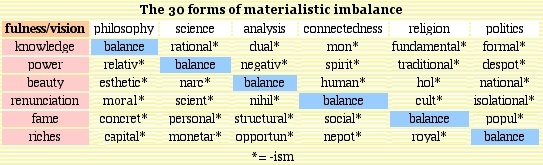
The table
above shows the thirty forms of materialistic imbalance one thus may
notice. Materialism thus seen can be described as a lack of balance
between the opulence of welfare at the one hand and the order of life
and thought belonging to it at the other hand. One's thinking, out of
balance in the fields of action and the civil virtues, erodes to an
-ism, a one-sided conviction, which, at the cost of others, is bent
upon a certain idea of happiness which rather demonstrates the lack the
lack one suffers with the conviction at hand. These -isms may, rising
to political power degrade into despotic regimes. For that reason we
seek the filognosy of the balance in these matters. Philosophy e.g. is
in balance thriving on the love for knowledge, but building on the
concept of power it degrades to the relativism of postmodernism,
defined by the propensity to denounce, from the desire to control all,
all absolutes blocking in the way. Thus there are in theory six correct
forms of according in fullness and vision, which in the filognosy
together define the fortunate person as a person of God: knowledge is
fulfilled, is balanced, with philosophy, power with science, beauty
with analysis, renunciation with connectedness, fame with religion and
riches are balanced in politics. Only in filognosy, in the spiritual
knowledge of âtma-tattva, the reality and principle of the
soul, is there a chance for the full realization of all opulences as
being the means, and the visions as the goals to be attained. All other
attempts to have one-sided, with another opulence, the same vision in
mind leads to the imbalance of a certain -ism which can be recognized
as a form of materialism. The imbalance then expresses itself as a
foolish or faulty way of linking a fullness of fortune - or a means of
knowing - to the purpose of a certain vision. The corruption consists
of one's taking the means for an end. The imbalance is what we normally
have to tolerate of materialism, but the corruption is the obscuration
of the vision that must be fought. That twofold option also applies tot
the six forms of balance. They constitute on themselves -isms again
which are the philosophies of defending a singular,
non-filognostical-syncretical equilibrium: knowledge with philosophy
leads at its best to Hinduism, power with science leads fulfilled to
Buddhism, beauty with analysis leads in perfection to Taoism of which
Confucianism - despite of the competition between the schools - is the
rhetoric, renunciation with connectedness leads enlightened to
gnosticism or spirituality in general, fame with religion leads
enlightened to Universal Sufism and riches with politics perfectly
combined leads to Vaishnavism. To that knows Hinduism for safeguarding
her integrity three more sub -isms because of caste falsehood: Parsism,
Sikhism and Jainism. Filognosy thus does not belong to gnosticism or
Vaishnavism, but gnosticism or Vaishnavism is a part of filognosy. The
filognosy of the soul is inclusive, covers everything, but the -ism of
of the ego is exclusive, it limits itself to a single contribution. So
must filognosy therefore not be counted among one of the other more
materialistic, foolish -isms, even though they constitute an element
thereof when one describes the weaknesses of the individual, false ego
or a collective Superego. So does filognosy itself easily degrade into
structuralism when the reference to classical divisions is abandoned
and one is making for an all too idiosyncratic concept of dividing
matters. This e.g. is often found in the science of psychology, where
different divisions of personal traits in the personality theories
tumble in such a way over one another that it is all too easy to doubt
the authority and the integrity of that science.
So how to see the past and from that
the future?
Culturally we have the value systems of the
different religions and political cultures struggling for balance and
comprehension. Everything added complicates the matter for repressive
progress is progress in denial which is no real progress at all.
Progress means to find, to cover, the complete in all its complexity
and thus be stable in one's consciousness. Repression sooner or later
leads to a fall-down. The god of destruction is there to overcome
hindrances, the god of creation is there to find structure and the god
of maintenance is there to be of goodness, happiness and endurance.
But I mean
in detail, how to think of our cultural inheritance and what is the
future of it?
In short we on this earth first had the vedic
order teaching us the yoga in all its diversity of philosophy, service
and devotion; then we had the Chinese to tell us of the balance of Tao,
the way with the yin and yang of the duality in general
and the sun and moon in relation to the clearing of ether in particular
- the same heavenly bodies that meanwhile also were defended by the
ancient Egyptians and south american Indians with their astronomical
respect for the gods; then we had the Buddhists who taught us to find
the reality without the mind; then we had the Greek who taught us the
dialogue as the essence of the reason by which we now conclude
filognostically; then we found parallel to that the Jews (and their
persian neighbors) from whom we learned to live by the spirit of the
absolute, more than by miracles and outer forms of God; next we had
Christ who taught us to carry our burden in compassion with our fellow
man; then we learned to know the prophet Mohammed stressing the
importance of respecting God by the pure of the sun and the moon again;
then we had reform and enlightenment to remind us of our personal
responsibility to live more to the spirit than to the letter; and
finally we learned to know the democracy as the challenge to cover the
complete of the complexity of our multicultural world order. This is
how you should see the past of us humans on this planet. It has been
the struggle to arrive at the comprehension of order as I have
mentioned in the beginning of this last dialogue. The future is to find
stability all together as mankind with first of all balancing the
different options of the fields of action in our personal lives and
secondly in our representing those interests in the form of according
political parties as well find the balance. The legislative power, the
political world, so will have to count with financial, national, social
and private interests in an equal manner in specially, as we saw in the
second dialogue, to this filognosy arranged, election groups
superseding the nepotistic, political tendencies so that the democracy
finds stability in a representative parliament properly tuned to the
executive power of state-departments following the same division of
interest of the statusorientations.
The future is that we
will accept and know our identities in their inevitably being linked to
the profession, the civil status connected to one's age, the level of
abstraction in transcendence and the individual mode of experience from
self that by the ego arrives at wisdom; and so learn to play the game
of order with it and forget about all the traumas of the class struggle
of the early nepotistic democracies and their dictatorial perversions
of notably the twentieth century. Religions will always remain as
classical schools of learning, but none will ever dominate the world.
Consider them like the chapters of a book, and then try to appreciate
the whole book. So too will political parties never individually rule
the earth but rather find their place and function according the basic
duality and analytic conclusion of the inscrutable Oneness in diversity
that is our soul and heart, our God, love and our life in the force
field of the ether.
I thank you
Aadhar for the comprehensive view of this complete of the order of
time. It has boggled my mind enormously, that complexity, but now,
given all these tools of knowledge, it is all clear to me. Now I
realize what the time of my life is in the sense of being reborn: it is
the realization of this filognosy.
The
site
linear as a perfection of the causal illusion:


|