Table
1: Equation of Time
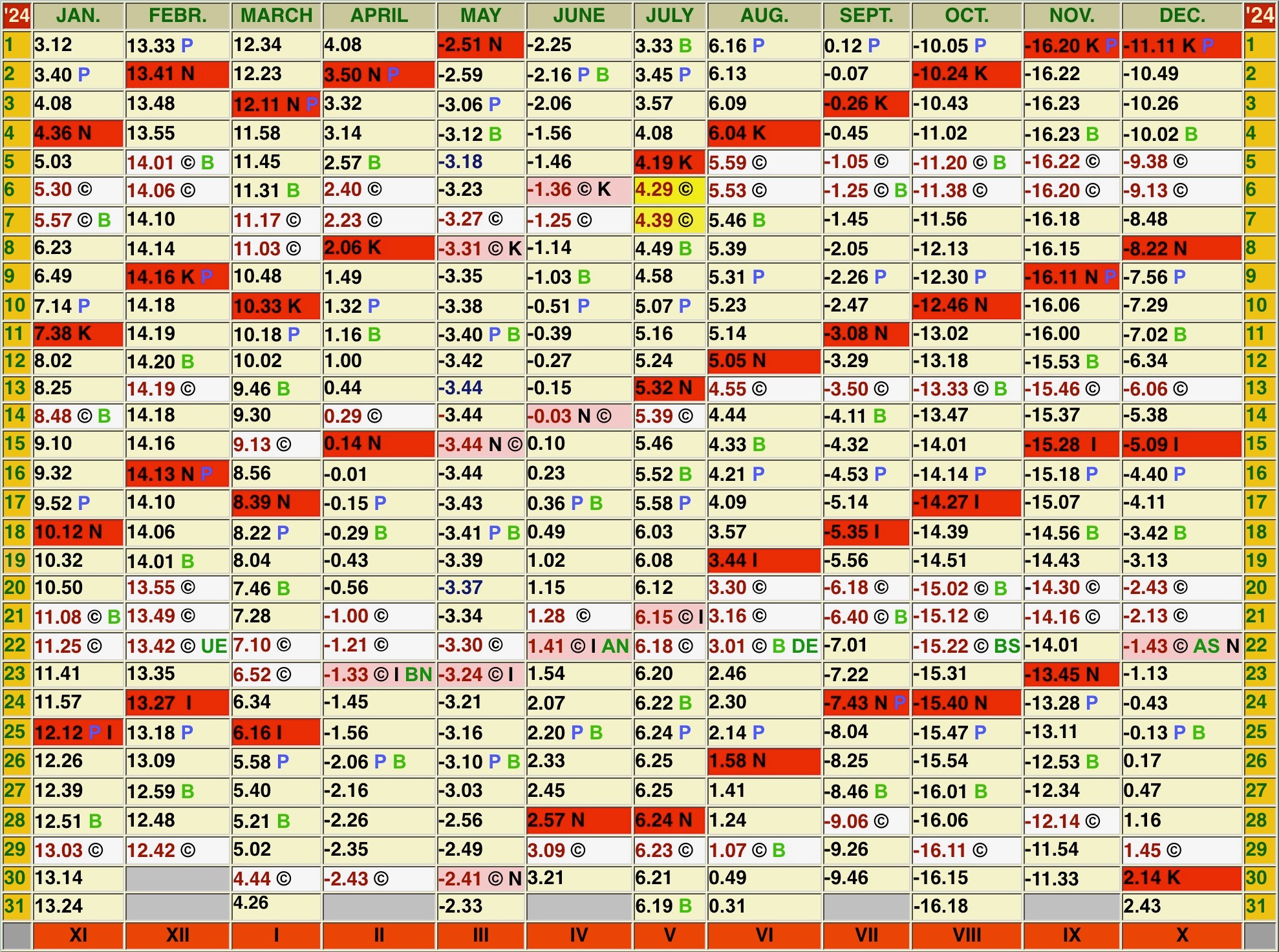
Correction-table with the cakra calendar and
lunar order

"Time designated by
nature....
by authority...
and by custom and caprice''
(Roger
Bacon, Opus Maius 1267)__
Nature: the lunar phases
and the equation of time.
Astronomical/religious
authority:
the
Cakra-calendar.
Custom
and caprice: the politically set
divisions of the solar year's dates.
A.D.
2024/ 2777
A.U.C.*

Previous years
/ Nederlandse
versie
Short description:
In this
calendar,
solar-wise
also called
the cakra
calendar,
are combined
the order of
the sun, the
moon and the
stars that are
needed to be,
relative to the
ether,
in harmony
with the
lawfulness of
the cyclic
nature of
time. The
numbers
indicate the
degree to
which a clock
deviates from
a sundial (see
also equation).
Positive
values
indicate the
number of
minutes and
seconds a
standard clock
runs ahead of
the sundial,
negative ones
the time it
runs behind.
For automatic
recalculation
to the time of
the local sun
see the
tempometer.
The days with
a ©-sign in it
(white and
pink) are the
14th and 15th
cakra days of
the cakra
calendar, with
as the third
one in a row a
two-monthly
extra
leap-day, or a
season holiday
(with
UE,
BN
etc.).
Cakra old
year's day is
at December
21th. Dark
red and
pink
are the days
of the lunar
phases that
respectively
do not overlap
and do overlap
with the cakra
calendar. K(alends)
means a new
moon, N(ones)
half a moon
and I(des)
a full moon. A
lunar cycle is
called a
lunation,
there is no
lunar year.
March was
month one on
the ancient
roman fasti
calendar.
Three days
after a lunar
phase day, balancing
to the field
table,
a B(usiness)-day
follows and
three days
after a
fifteenth or
sixteenth
cakra-dag a P(rivate)-day
follows.
A solar C(akra)-day
(©), a holiday
or day of
going out, is
each half
month the
seventh and
the fourteenth
cakra sunday.
The fifteenth
cakra day is a
half monthly
leap day,
suitable for
self study and
fasting. The
sixteenth
season day of
June coincides
(midsummer)
with the
fifteenth day
(fasting
during the
day,
celebration in
the evening).
The days of
the lunar
phases
(red/pink) of
the
cakra-order
are meant for
spiritual
exercises as
singing
together,
reading the
scripture in
association
and meditation
(S-days).
Yellow/orange
are the days
of July the
6th en 7th
when we are
closest to the
center of the
Milky Way (see
further
the
more extensive
cakra
calendar-discussion;
under terms: fields
and
cakra-order;
the
dialogue nr 6
in
the synopsis;
and apart from
the text below
also the
entire site
for
more in depth
studies).
.
|
See
also the
BPCS-table 4
explaining the
B
and P
indications.
Use
also the
tempometer for
setting a
clock to the
sun!
|
Click here for the
use of the equation
The
yellow at 6/7 of july
indicates the
Galactic New Year.
The Red fields indicate
the Lunar Calendar
The white and pink (overlap
with the red fields) indicate the Cakra calendar
Source for the numbers of the
equation: Daily
Sun Data (update:
1999)
Note:
The days set for the KNIN
lunar phases (in the red
fields)
can differ up to a day as they are set to
Greenwich (UTC/GMT-0) (see
below)
Also the actual astronomical time of the Cakra New
year (solstice) differs from year to year.
Surf to the solstice
page for the exact timing .
For
a shedule of prayertimes or timereformed taking
your coffee and tea-breaks in local Standard Time:
consult Prayer
Minder
The
Cakra year begins with a season-day called AS
(after the solstice)
that is preceded by the day of the wintersolstice

The Full Calendar of
Order
offers three discrete calendars in
one:
And Jesus said to Thomas:
''Woe
to you who dwell in error,
heedless that the light of the sun which
judges and looks down upon the all
will circle around all things so as
to enslave the enemies.
You do not even notice the moon,
how by night and day it looks down,
looking at the bodies of your
slaughters!''
Nag hammadi, The
book of Thomas the Contender
1) Solar Calendar
This is the christian
reformed roman solar year in twelve
months called the gregorian calendar
fixed in 1582. It is shown in ocre/yellow for the numbers
of the days of the gregorian reformed
roman calendar and the abbreviations
of the names of the months according
julian, and later reform. The individual days in
the cells show the numbers of the Equation of Time: A positive value
means: the clock is ahead of the
sundial so many minutes and seconds.
For calculating solar time for your
own place go to the
time-equation-page or check the tempometer. Note that the
christian civil political week
order is not considered here
since there is no scriptural or
astronomical support for it as to how
a year should be divided by it (in
fact it doesn't divide the year but
constitutes a cultural contrast; see
the Order of the Sun-page). And concluding:
Pantha Rhei!: this table has a
shift in phase of one day per 25 years
for the data of the equation of time
(updated 1999 at this page)
See further the start
page on the Solar Order.
2) Cakra-calendar
(vedic/roman weekorder and 6 seasons
to the solar year)
White: Cakra-weekends
Pink: days of cakra-weekends
that overlap with the KNIN
moonphase-calendar
Light Green: : beginning of the six
seasons
UE: upward along the
equinox (spring in the northern
hemisphere)
BN: before the northern
solstice (early summer in the northern
hemisphere)
AN after the northern
solstice (late summer in the northern
hemisphere)
DE: downward the equinox
(autumn in the northern hemisphere)
BS: before the southern
solstice (early winter in the northern
hemisphere)
AS : after the southern
solstice (late winter in the northern
hemisphere)
* : gregorian leapday in
February : leaps 21 Dec. for the
Cakra-calendar
The Cakra-solar year begins
at the 22nd of December and
counts following the gregorian count
of dates 365.242 days
It is called
vedic/roman because the Bhâgavata Purâna, the vedic scripture
this cakra-division is derived from,
does not mention 7-day roman weeks,
only 15 day fortnights. The seven days
division of christian custom is taken
from the Holy Bible.
This calendar is called
astronomical because it begins at the
astronomically set
date of the shortest day and is truly tropical
of nature.
See further the
previous page on the cakra
calendar.Calendar
3) Fasti-calendar/
Lunar calendar
This is a revised
version of the ancient lunar roman
'week' order (before the Julian
reform) of holidays called fasti
which means days of no commercial or
legal business. It is indicated by the
red fields (or pink by overlap) in the
full calendar of Order. Black Roman Numbers refer to the original
count of lunar months in an old
unreformed lunar year that was to
begin in March, and white letters in a
red field, or black letters in a pink
field in case of overlap, refer to the signal days K, N and I (roman holidays). Thus this calendar
offers ±12.3 lunar month's in a solar
year.
K: Kalends, the day of
the new moon
N: Nones the day of the
first and last quarter
I: Ides the day of full
moon.
A.U.C.: Ab Urbe Condita means 'from
the foundation of the city' 753
B.C., the date our presently gregorian
called calendar, before all its
reform, factually for the first time
in history was implemented, was born
so to say.
N.B.: One lunar month
or lunation, a period of four
consecutive lunar phases, is ± 29.5
days long.
See further the
Order of the Moon - pages.
*: The revision of
the ancient roman lunar calendar at
this site means that it is
rationalized: it has a solar year of
12 solar months which are named with
their numbers , starting in March with
I . For the signal days (holidays) a
modern astronomical table is used (see
above) setting them to the phases of
the Moon. The Length of the lunar year
is one complete cycle of four phases
about the earth relative to the sun
(29.5 days), thus making for a solar
year that has 12.3 lunar cycles in it.
Originally as said this calendar had
no last quarter nones after Ides nor
such an equal distribution in 'lunar
weeks', and was it fixed lunisolar by
a regular leap month every three
years. Also it originally had names of
goddesses and emperors and a year of
only ten months -two months of
uncertainty about when the solar year
would end. In fact it has been trimmed
of all its then relevant social
meaning of celebration down to the
sober concept of only having signal
days to the lunar phases indicated
with the names of Ides, Nones and
Kalends that were used at the time.
|
To the use of this
discrete calendar-system
the following advise:
It
is wise to consider the divisions
according their original purposes:
1)
The division of the
months (the dating) and length of
the year is
derived from the gregorian reform of the julian
calendar. Therefore the civil New
Year is the normal traditional
celebration of the first of January
(provided corrective leaping). With
the solar month one organizes one's
holidays, birthday celebrations and
festivities, but also rounds of
fasting can be settled thus like
going on a milkfast in the month of
May e.g. or having a fast of solid
food every fiteenth day of the
cakra-week for health purposes and
spiritual well-being.
2)
The division in weeks to the Cakra calendar is set to the vedic
mission of Hindu culture in the
West: to restore the social control
and the respect for scriptural
truth. Hence these days, marked with
a ©-sign and black letters in a white/pink field, are meant for
socializing publicly at the seventh
and 14th day (media-arrest in the
private sphere) with the fifteenth
day (FD) of them for fasting and
study (private) and the bimonthly
season days (SD marked light green)
for celebration (in free
association). The P and B days are there to
balance ones actions according the
fields of action (see BPCS-table). With these
cakra-days of the solar order it is
vital to reset once a week, every
cakra© -sunday e.g., a reference
clock to the true (apparent) sun by
means of the values of the equation
of time given in the table (see also
tempometer to have the math for
it done for you by a program). The idea is that in
order to 1) live with the natural
force field of the ether and 2) be
in control with a system set to
ulterior motives like it is the
system of standard time, one needs
an other system, the cakra-division
that is tuned to nature. Commanded
by standard time only one will lack
the motivation to relativize it, a
relativizing which is something
morally necesary.
3)
The revised lunar roman
civil calendar ('fasti') is to be used for
the purpose of setting holidays - or days
of study and spiritual practices -
and the legal days for work. It can, according
classical roman law, be considered 'fas'
to work on days that are not marked
with black or white numbers in a red
or pink field (even though one
should remember to go out e.g. every
cakra sunday, as well as fast and
study for ones filognosy every fifteenth
cakra day). The original roman order
was much more complicated with
another system of determining what
civil actions would be legal on what
days.
4) The year count is in gregorian
years A.D. for civil purposes (as
long as the majority wants it) and
in classical roman A.U.C.-years for
the purposes of The Order of Time
(apollonian loyalty to the
historical authentic, that is roman,
truth of the civil calendar).
5) The
political setting of the muslim
friday, the jewish sabbath and
christian saturday
and sunday is, by this
calendar, considered invalid to the
actual purpose of civil order as
there is no sufficient scientific
support to the astronomical reality
of them. The week one observes in
nature is the lunar phase and thus
are regular solar weeks derived from
them to be leaped with the cakra
kalendar in order to have them
follow the liunar division. The
religious approaches on the fridays,
sundays and saturdays of our
standard time weeks are considered
reactive or compensatory to the
bewilderment of civil time as
settled by the julian reform of 45
B.C. and constantine reform of 43
A.D., and should as such be treated
as subcultural and private
(temporary
religious/political/economic/pragmatical
management-) options of order (just
as is iot is with the indications of
civil standard time on a regular
clock). According the full Calendar
of Order one may work on many
gregorian saturdays and sundays or
do whatever the cakra calendar
combined with the lunar order would
allow according to ones personal
use, since one, to the "God" of
time, has one's holy days on a
regular cakra-basis settled already.
The religious advantage is that with
this full calendar any day can be a
holy (- that is: pure to the actual
sun and moon -) sunday of
contemplation and study, and thus
relativizing takes this order away
the compulsory nature of ones linear
standardtime fridays, sundays and
sabbaths.
N.B. This concept of order
may be used for political, religious
or counseling purposes of
proselytizing. But since each
citizen may adopt and use this
scheme to settle his own life to his
own liking, must, eventually
promoting it publicly, be guarded
against doing any harm to the
integrity of the order of filognosy;
which implies e.g. not to impose it
nor to be dogmatical with it.
Freedom of choice and human rights
must prevail in this. Also after
achieving an acceptable democratic
(international) majority that is
willing to account for an - always
risky - switch of the formal
time-system, must this be observed.
|


© The Order of Time
|