Table 3: The phases of
the moon

The dates
given in this so-called KNIN -table below make for
the signal days of the above mentioned revision to
the ancient lunar roman calendar.
K:
Kalends, the day of the new moon
N:
Nones the day of the first (and last ) quarter
I:
Ides the day of full moon.
This
calendar-naming of the lunar reality originally
did not have such a neat division in lunar 'weeks'
marked by signal days of Kalends, Ides and Nones , as
given in this astronomical table. The second
quarter nones were added by this revision to match
with the weekorder we know from the gregorian
calendar and to be in accord with the actual
astronomical data of the lunar phases. The
original naming of this calendar as 'fasti' was
concerned with making days where it was not 'fas' or 'nefasti
' to conduct as said legal and
commercial business. They were the early roman
precursor of our present sundays when usually we
do not have office hours or commercial businesses
opened (it is still under legal control).
Therefore setting these moonphases on ones
calendar can be done for the sake of
having an alternative for the christian sundays that is
more loyal to the original (uncorrupted scientific
and natural) roman concept of social - and
religious - order.

Japanese
print called the Moonsick Monk or the Stupid
Starings at the Moon.
Kitagawa Oetamaro woodcarving 1798
As said: originally
the roman order was far more complex than that.
The days that were legal were not the same as the
days suggested by the severely rationalized
revision below. Because of its arbitrariness in
the political/religious manipulation of
unscientific intercalation the
roman empire fell of its original lunar
order with the julian reform 45 B.C. which fixed
the lunar order to the solar year: Ides and Nones
meant no longer any loyalty to the lunar month.
They had no other scientific ground in
astronomical observation any longer than some
likeness of rhythm and the factual solar year. In
the old as well as later days of Rome the
politicians were the priests of order and priests
became emperors. The separation
between religion and politics is in fact an
illusory one when one is bent to
setting a calendar or clock to 'the order of God'
that in fact then consists of discrete natural
rhythms that defy a uniform-reductionist system as
we had in the 20th century. Modern politics of
time make as such just another religion of
reductionist legal morality setting the time (a
television-religion). Not naming the timesystem a
reality of respecting God (and His natural time)
does not make people respect the time purely
political as if that would be the standard of
rationality. In fact it makes a psychology of it
that is in constant doubt about the reference
which with some derange seriously in private
selfmade religions recognized as forms of neurosis
and worse. (Psychoanalysis speaks of modern
compulsory neuroses as a " private religion"). It
is interesting to wonder about what
actually heresy would be in
setting the time. One could speculate that any
division of time deviating from natural
points of measurement (like
these moonphases) and natural numbers (like
having at least and at most 12 lunar months in a
solar year) can be called heresies of gauging and
division. At the other hand we are inspired to
respect each odd setting of the clock and calendar
as a way of respecting God, thus leading to a more
enlightened new duality of timerespect (see a new
duality at The Order of time: Politics )
Therefore
The Order of Time here proposes the earlier
mentioned full
Calendar of Order that
offers these natural numbers (in operations on the
number of twelve fixed on astronomical data) and
their division relative to a possibly heretic
'gregorian division' of (in fact) commercial weeks
on the gregorian calendar (which unless corrected
to its present 'centurion'-rule still deviates
1day in a 2.500 year period).
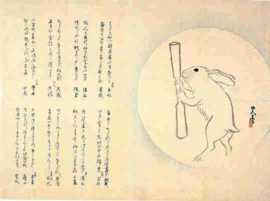
One of the regular appearances of
the harvest-celebrations
in Japan are the images of the hare with its
pounder in the moon.
The
old Idea of lunar irregular
weeks on lunar signal days ( a lunar
month is about 29.5 days long) was in fact
abolished by the same early roman rule which
protected the christians against further roman and
pagan persecution: the constantinian reform of the
calendar in the fourth century (325) A.D.
abolished definitely the old roman - to its lunar
order - perverted system and replaced it with the
commercial market rhythm of 7 days (formerly 8 and
also 10-days) in succession making time-management
and calendars more of a mystical experience on the
number of seven than a proper respect of any
natural order (in monasteries still the old
'reformed'fasti-order from before Constantine was
respected throughout the entire Middle Ages
though). The linear concept of time took it over
from the cyclic at that time and in fact we have
ever since a balance of religious and commercial
respect on unnatural weeks through weekdays of
working and weekends of praying and ritual
ceremony. To the spiritual interest of individual
and collective well-being though nor formalized
rituals of religion nor commercial activity on
itself is the purpose. What commerce or religion
can unify the world? That duality should not be
considered necessary any longer. Therefore we
offer here, contrasting the religious/commercial
timeconsciousness of unnatural weeks, the
authentic classical authority of the natural
division of the moon by its phases which so
clearly sets the timeconsciousness relative to the
basic Order
of the Sun known from the reformed
Romans from 45 B.C - A.D.321 and the old vedic
culture as we know it from the scriptures.
A.D. 2026 /
2779A.U.C.
All times are
universal time
UTC (Greenwich
Worldtime
corrected)

Source:
Phases of the Moon 2001-2100
Lunations of
previous years
Lunation: the period of a
synodic revolution of the moon,
or the time from one New Moon to the next,
varying in length at different times from about
29-1/4 to 29-5/6 days. The average length is 29
days, 12 hours, 44 minutes and 2.9 seconds.
Lunation number: the Brown Lunation Number,
which defines lunation 1 as beginning at
the first new moon of 1923 (this occurred at
approximately 02:41 UTC, January 17, 1923).
The old roman calendar of before the Julian
reform started at the new moon of March.
The new roman calendar of the Julian reform
started 45 BC at the first of January.